Specs Fine Books
1677 JEREMIAH BURROUGHS. Christian Contentment with Unpublished American Puritan MSs Poem.
1677 JEREMIAH BURROUGHS. Christian Contentment with Unpublished American Puritan MSs Poem.
Couldn't load pickup availability
A wonderful artifact of early American Puritanism, being both a superbly provenanced puritan standard work, and including a previously undocumented early American puritan devotional composition with significant eschatological content.
The book itself, Jeremiah Burroughs's treatise on "Christian Contentment," was one of the most influential texts in the transatlantic Puritan world. It served as a spiritual manual on maintaining inner peace and submission to divine will amidst intense worldly trial. It takes little imagination to envision its usefulness for early American Puritan settlers. For a first-generation or early second-generation [it is disputed] New England settler like Samuel Hayes of Norwalk, Connecticut [1641-1712], owning such a text helped structure daily spiritual and civic life in the wilderness of the Connecticut Colony, shaping the mindset of the people who built its early institutions.
The addition of Hayes’s handwritten, previously unpublished poem inside the volume makes this a significant primary artifact of early American Puritanism. Though not averse to verse as aesthetic, American Puritans saw poetry more directly functioning as an extension of or expression of prayer, as self-examination, as devotional response, and as a tool to help internalize doctrine. By physically transcribing his own verse onto the pages of Burroughs's work, Hayes engages in a deeply personal, active dialogue with the text, one worth scholarly exploration.
This artifact and original production offers a rare glimpse into the interior spiritual life of a prominent colonial citizen who, outside of his private devotion, served his community as a long-standing deputy to the General Assembly of Connecticut. The unpublished poem stands as a testament to the high literacy and theological sophistication of early American settlers, demonstrating how the demanding doctrines of the Puritan pulpit were seamlessly integrated into the private intellectual lives and creative expressions of ordinary colonial administrators.
The poem, in full, from the flyleaf.
Samuel Haies his Book 1689 [Norwalk, Connecticut]
Dear family rejoyce continuously
in this gospel Report
Ye fall of antichrist is nigh
his time is now But Short.
His agents Rage & polisy
he dayly doth imploy
he musters up his armis great
gods Servants to distroy
The nations Rush yt they will dash
There motions now bespoke
god's anger Smoks with dreadfull stroks
There powers he will Broke
Ye he will purg & fan his flood
his temple purify
Whose hous is found on a Rok
Or on ye Sands will try.
Each Church & ech professor he
will try ym every one
Who haid there vessals stood with oyle
& wedding garmants on
Therefore ye Saints awok & pray
to scape what is at hand
& in ye last great Judgment day
Before which ye [will] Stand
On the reverse of the title.
sarah Hayes her book to be safly restored to her whan ever she doth **** it
To the Reader signed in type by Thomas Goodwin, Sydrach Simpson, William Greenhil, Philip Nye, William Bridge, John Yates, and William Adderly.
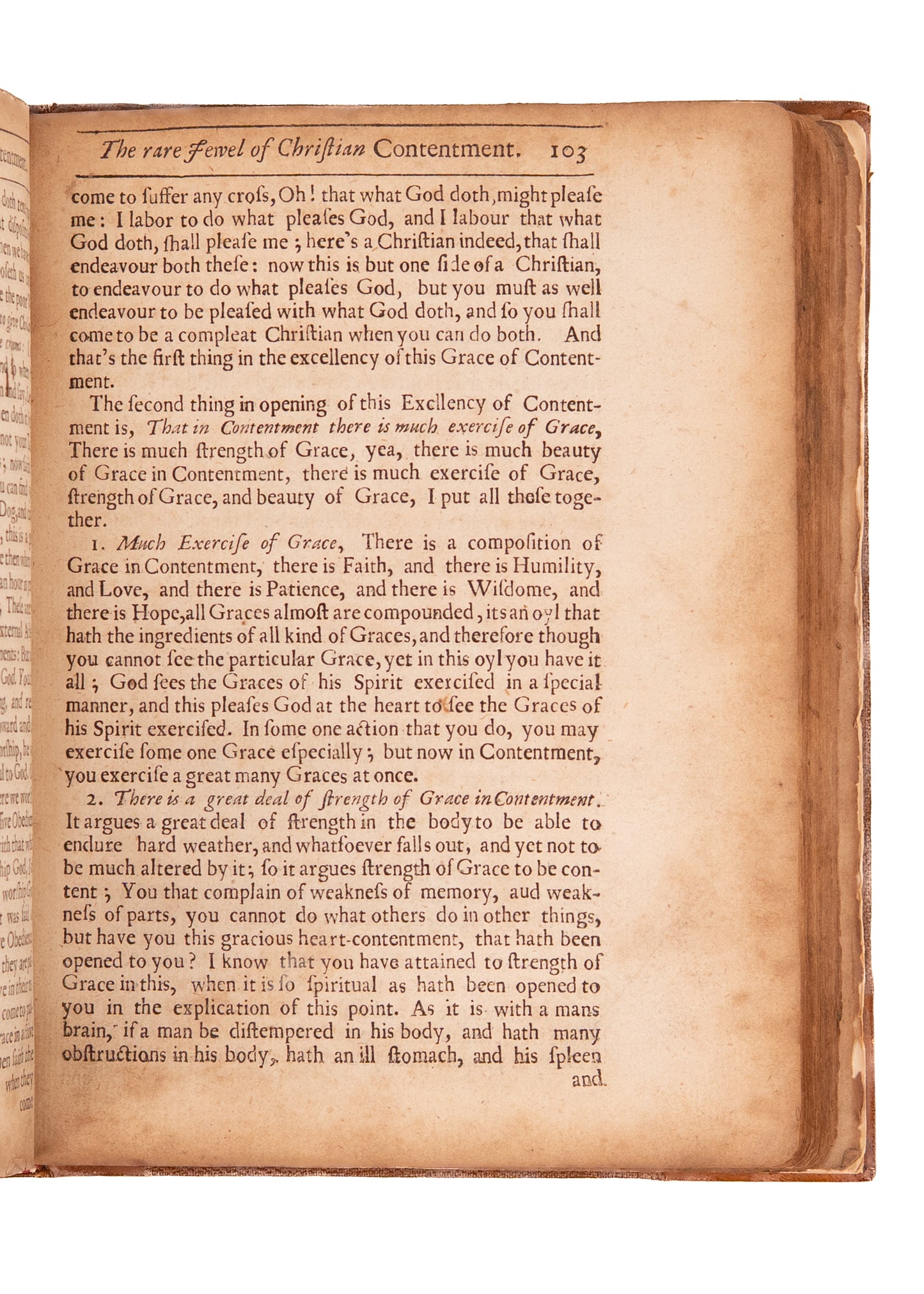
Burroughs, Jeremiah. The Rare Jewel of Christian Contentment. Wherein is Shewed: I. What Contentment Is.2. The Holy Art or Mystery of It. 3. Several Lessons that Christ Teacheth to work the Heart to Contentment. 4. The Excellencies of It. 5. The Evils of Murmuring. 6. The Aggravation of the Sin of Murmuring. London. Printed by S. Streater, for George Sawbridge, at the Bible on Ludgate-Hill, 1677.
Good + to very good in 20th century half leather with some minor rubbing, newer endpapers as well. Original flyleaf retained, gutter exposed between title and "to the reader," and between the final two pages of text, presumably both pulled at the insertion of the endpapers. Textually a bit handled and thumbed as shown, but on the whole quite nicely preserved.
Share