Specs Fine Books
1768 AMERICAN REVOLUTION. Religious Liberty, Spiritual Taxation and the American Revolution.
1768 AMERICAN REVOLUTION. Religious Liberty, Spiritual Taxation and the American Revolution.
Couldn't load pickup availability
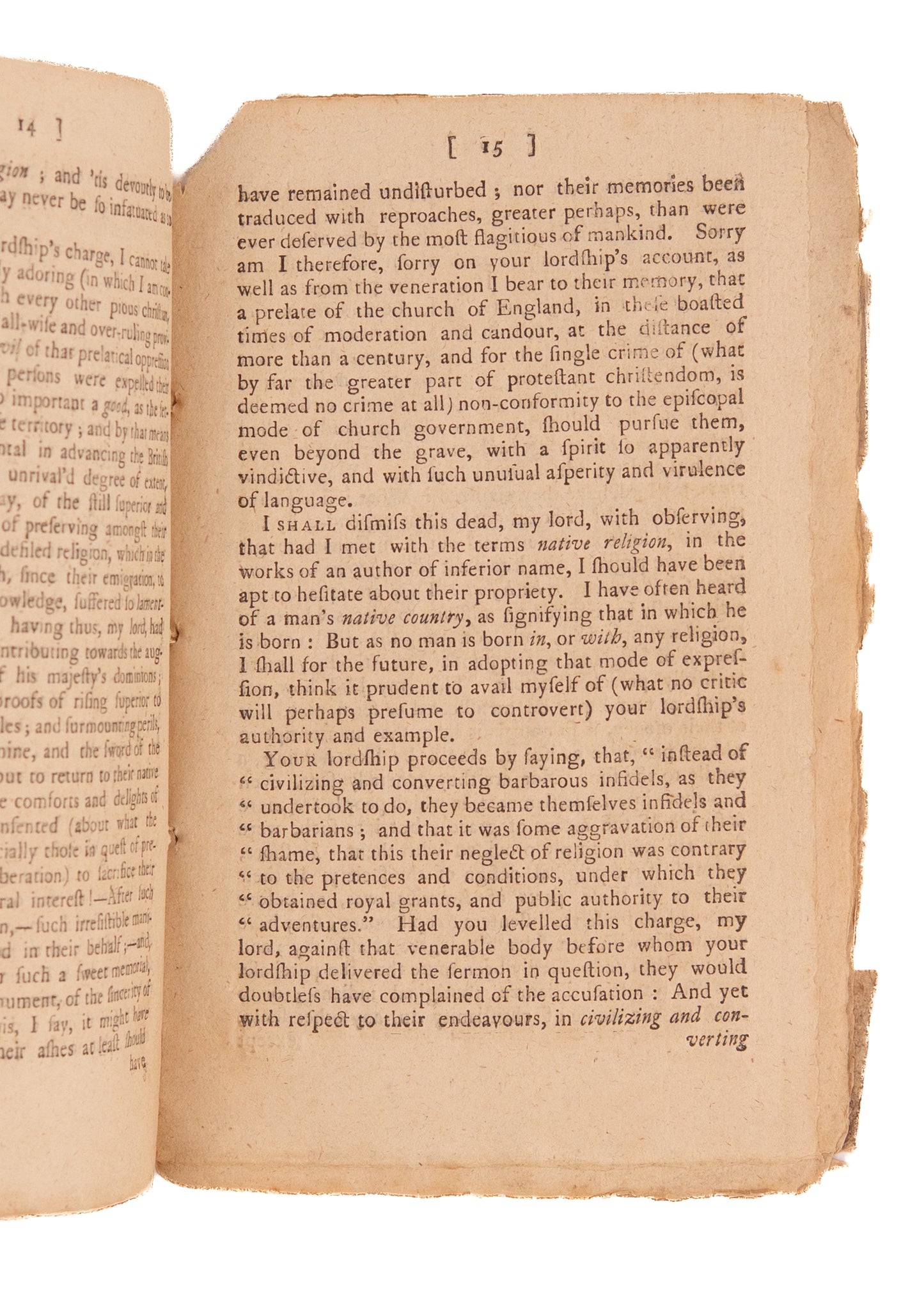
William Livingston’s A Letter to the Right Reverend Father in God, John, Lord Bishop of Landaff (1768) was a foundational document in the intellectual and political effort to mobilize the American colonies during the pre-Revolutionary crisis. The pamphlet was written in response to a 1767 sermon by John Ewer, the Anglican Bishop of Llandaff, which disparaged the colonists as moral degenerates and called for the establishment of an American episcopate to control and reform the dissenting Congregational and Presbyterian mongrels. Livingston’s reply transformed [or perhaps understood] what might have been seen as an internal theological dispute into a central constitutional debate. For colonial leaders, the threat of an American episcopate was not merely an ecclesiastical concern, but a terrifying extension of parliamentary overreach. Following the outcry over the Stamp Act of 1765, dissenters feared that the British Crown intended to export both civil tyranny and religious conformity. Livingston, a prominent Presbyterian attorney and future revolutionary Governor of New Jersey, forcefully defended colonial morality while arguing that an established church hierarchy would inevitably utilize state power to crush religious freedom and enforce spiritual taxation, i.e. the tithe to the Anglican episcopate, thus stripping Presbyterians and Congregationalists of their income and effectively linking religious liberty to the broader cause of political autonomy.
The pamphlet highlights how deeply religious liberty served as a primary driver of the American Revolution alongside tax and trade disputes. In the eighteenth-century colonial mind, political rights and spiritual liberty were inseparable. The proposal for Anglican bishops conjured historical memories of Stuart tyranny, ecclesiastical courts, and persecution, uniting Nonconformistsm including Presbyterians, Congregationalists, and Baptists, across colony lines against a common British threat. By framing religious self-determination as a natural right under attack by the British hierarchy, Livingston helped establish the core ideological principles that later informed the First Amendment. His argument demonstrated to the colonists that defending their civil charters required an equal defense against religious dominion, directly fueling the revolutionary momentum that made reconciliation with Great Britain increasingly impossible.
Originally printed in New York, where Livingston lived, the rapid reprinting of this 26-page tract in Boston underscores New England's role as the emotional and logistical epicenter of anti-prelatical sentiment and its eventual source of the conflagration that would become the War of the American Revolution.
The Boston edition not offered at auction since 1979 and no examples of any imprint in the trade at the time of cataloging. The Boston imprint issued specifically in aid of stoking the revolutionary flames already starting to flare up across the city.
Signed by John Howe, 1814 on the title. Whether it is the Loyalist printer of the era or the Connecticut patriot and revolutionary, we have been unable to determine.
[Religious Liberty, American Revolution] Livingston, William. A Letter to the Right Reverend Father in God, John, Lord Bishop of Landaff; Occasioned by Some Passages in his Lordship's Sermon, on the 20th of February, 1767, in which the American Colonies are loaded with great and undeserved Reproach. Boston. Re-Printed and Sold by Kneeland and Adams, next to the Treasurer's Office, in Milk-street. 1768. 26pp.
Good with some handling and soil as shown, corner loss at top of spine and title page at top outer edge as shown. Nothing impacted textually.
Share