Specs Fine Books
1771 POOR RELIEF. How Early Americans Responded to Poverty Caused British Taxation and War.
1771 POOR RELIEF. How Early Americans Responded to Poverty Caused British Taxation and War.
Couldn't load pickup availability
An inexplicably rare imprint of Pennsylvania's important 1771 complete revision of its poor laws. The Act represented a radical departure from previous treatment of the poor, authorizing the local overseer system, construction and operation of Houses of Employment, and boarding out the poor. It also provided for the apprenticing of poor children, the law of settlement, and the reciprocal three-generation duty of support, and further authorized the seizure of assets of fathers who abandoned their wives and children. Far from a mere update of previous policy, this was a comprehensive restructuring of how the colony managed poverty, one that placed the welfare of wives and children at its center and built institutional structures capable of breaking cycles of poverty within family systems. The new approach soon exerted considerable influence well beyond Pennsylvania's borders, being adopted almost verbatim into the laws of the Northwest Territory, shaping poor relief policy across a vast swath of what would become the American Midwest.
It was no accident that such a compassion-driven approach emerged in Philadelphia. Poor relief in the city had long been administered by churches and private organizations, above all the Quaker Society of Friends, whose communities bore the greatest share of the burden. By the 1760s, that burden had grown acute. Struggling under the weight of a postwar economic slump, the city had approved a plan by a group of wealthy Quaker merchants to replace the existing Almshouse with a new institution. The Act emerged from that genuine urban crisis: poverty was rising, driven by the aftermath of the French and Indian War and the economic disruptions of British taxation policy, the very grievances then fueling revolutionary sentiment. These financially burdened and marginalized became easy supporters of the Revolution just a few years later.
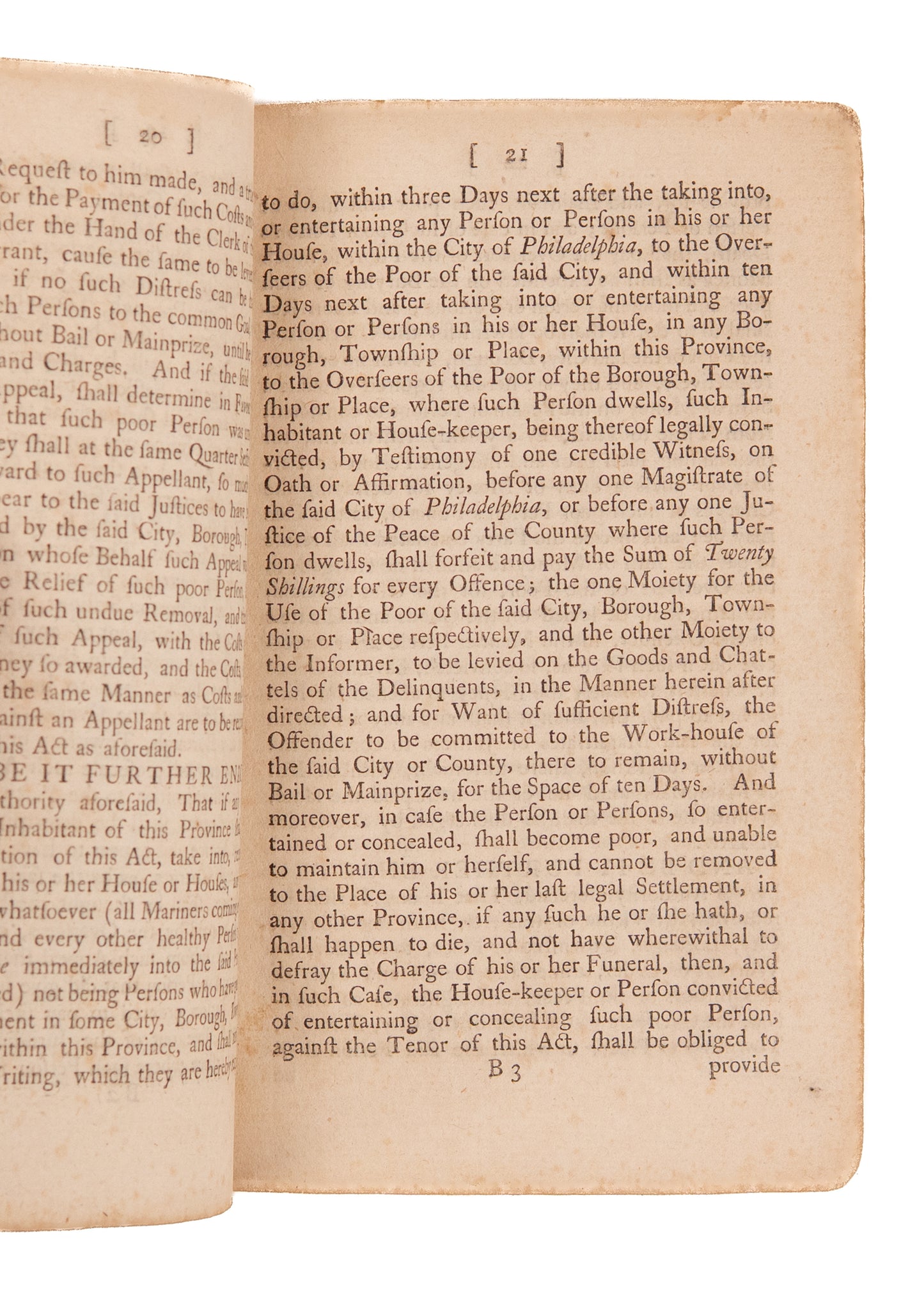
[Quaker, Poor Laws, American Poverty] Act for Relief of the Poor. Philadelphia. Printed and Sold by D. Hall, and W. Sellers, at the New-Printing-Office, near the Jersey Market. MDCCLXXI [1771]. 30pp.
Good + in original mineral blue wraps, stained, with early ownership signature of George Miller of Providence, Pennsylvania. Some chips and losses to wraps as shown, stain as shown on title extends to first 8 pages, more faint as it moves through the text. Sound and generally clean as shown.
Share