Specs Fine Books
1775 BATTLE OF CONCORD. American Quakers Consoled and Counseled as American Revolution Begins.
1775 BATTLE OF CONCORD. American Quakers Consoled and Counseled as American Revolution Begins.
Couldn't load pickup availability
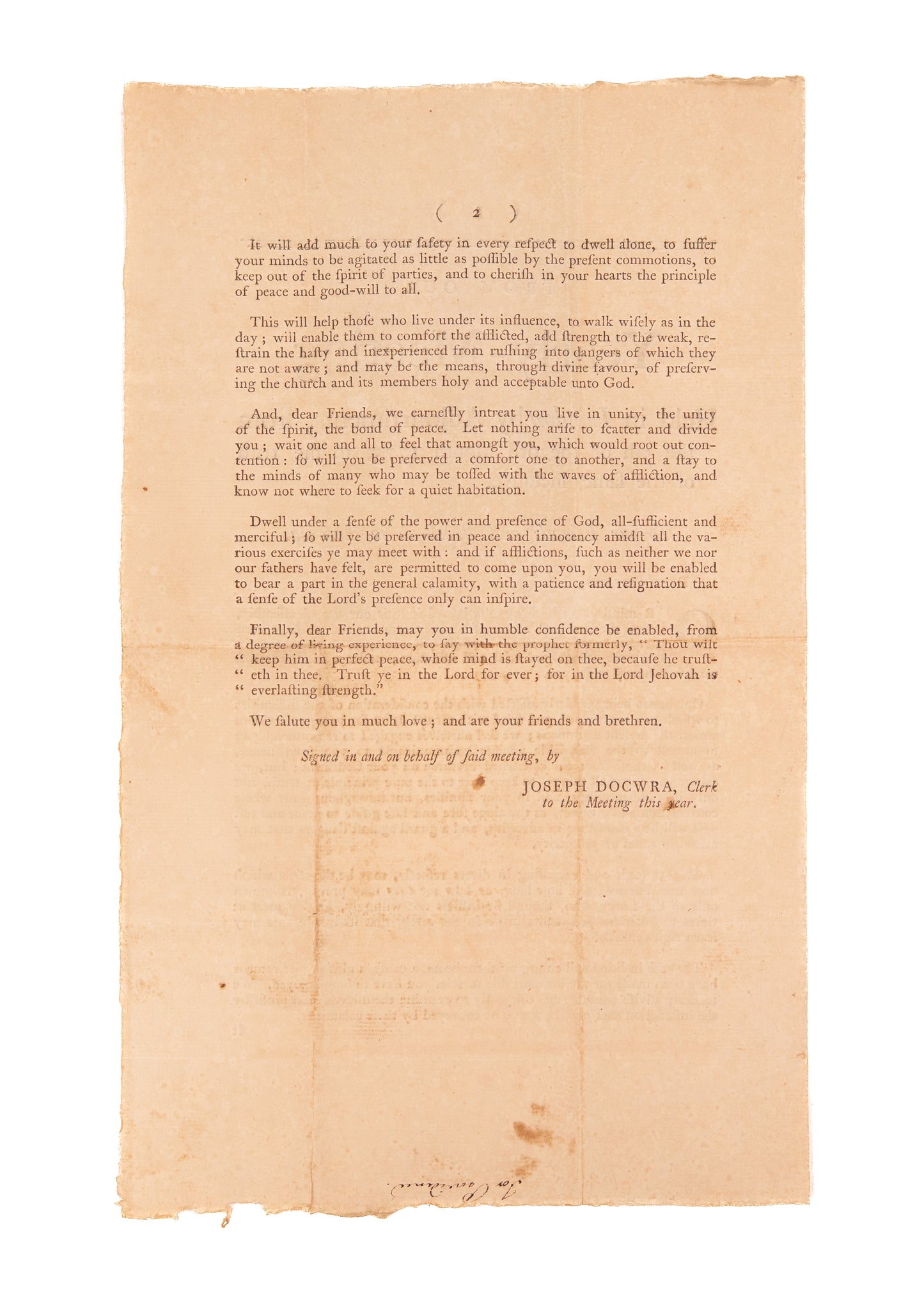
A superb 1775 epistle reactive document composed in the immediate aftermath of the Battles of Lexington and Concord, capturing the precise moment when the American Revolution transformed from political protest into open armed conflict.
Printed by the central London Yearly Meeting during its late spring sessions and immediately dispatched across the Atlantic, this document was released into an empire suddenly fractured by what was then a civil war. As news of the bloodshed in Massachusetts reverberated throughout the colonies, the primary significance of this artifact emerged from its role as an urgent, paternal lifeline designed to steady and console American Quakers who found themselves abruptly cast into the epicenter of a violent rebellion.
Quaker leadership felt the spiritual danger of the moment and issued an explicit warning that participation in the unfolding revolutionary movement constituted a fundamental betrayal of Christian faithfulness. While mainstream colonial society was rapidly mobilizing for war, forming militias, and demanding public declarations of patriotic loyalty, this epistle acted as an institutional anchor, instructing American Friends to reject the martial spirit of the rebellion entirely.
The London leadership used this text to reaffirm that the Quaker Peace Testimony was absolute and unyielding, making it clear that taking up arms against the King, joining revolutionary committees, or supporting military measures violated the fundamental tenets of the Gospel. By forcefully drawing this line, the document provided the spiritual and organizational backing that enabled colonial Quakers to resist intense local coercion, even as their neighbors branded their pacifism as political treason.
This 1775 circular established the foundational strategy for how the Society of Friends would navigate the years of warfare that followed. By counseling members to remain entirely neutral, avoid the political passions of both sides, and bear the inevitable fines, property distraints, and social ostracization with Christian meekness, the epistle set the template for Quaker survival during the Revolution. It stands as a vital primary record of how the religious community mobilized its members to "Christianly" endure the birth pangs of a new nation, choosing to preserve their historical testimonies of non-violence at the cost of being thoroughly marginalized by the emerging American republic.
Small ink inscription, "For Providence," i.e. the Providence Meeting House.
[American Revolution. Battle of Concord. Quakers] Docwra, Joseph. From Our Yearly-Meeting Held in London by Adjournments, form the 5th of the 6th Month 1775, to the 10th of the same, inclusive. To our Friends and Brethren in America.
Very good on a single folio size sheet with old folds, the fold which was long on the exterior darkened as shown. A few minor spots of foxing. A very nice example.
Share