Specs Fine Books
1775 QUAKER MSs. Fine 17pp Commonplace Addressing Outbreak of American Revolution.
1775 QUAKER MSs. Fine 17pp Commonplace Addressing Outbreak of American Revolution.
Couldn't load pickup availability
A 17pp previously undocumented American Quaker resistance commonplace book with texts selected both indicating against Governmental tyranny and in sympathy with Revolution, but also toward encouraging the faithful in American to patient suffering by the example of the Quaker sufferers of the 17th century.
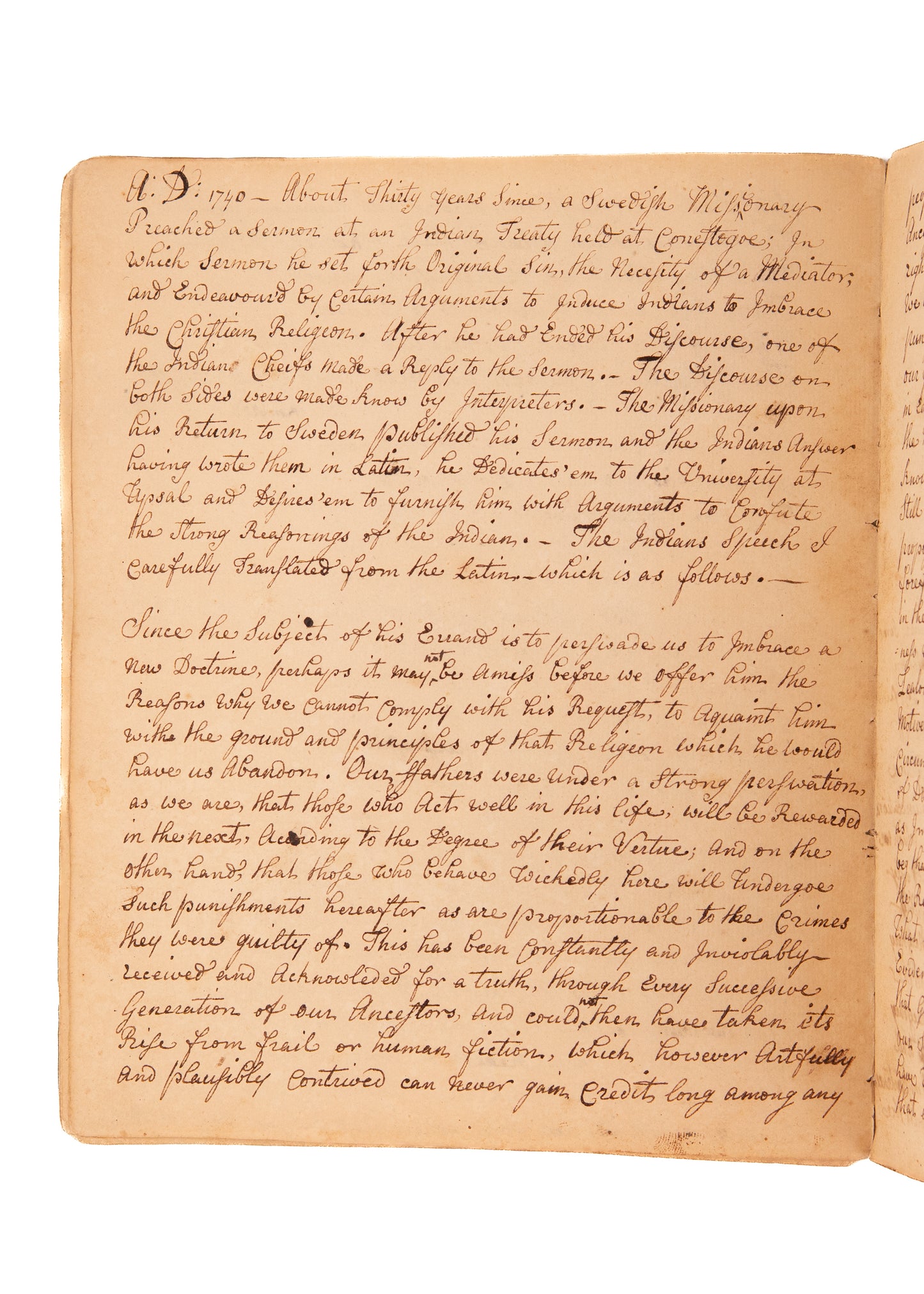
Neatly handwritten, almost certainly by George Miller, Clerk of the Providence, Pennsylvania Quaker Meeting House. It has been neatly penned on 9 leaves of Pro Patria paper corresponding with the watermark issued during the 1760's and up until c.1775, with the Maid of Dort seated inside fence with a spear, and counter-marked with a non-integrated crown, indicating it as for the British and American markets. This design was phased out 1775/1776 in favor of a watermark integrating the maid, fence, and spear, inside a larger cartouche.
The document itself has come to us with a mass of other material related to the Quaker interaction with the emerging revolution in the aftermath of Concord. Other documents include petitions of support for suffering Quakers, broadsides urging fellow Quakers to stay true to their non-political and non-military Christian commitments, calls for support and relief of Quakers who have been imprisoned for non-payment of "blood taxes" to support the revolution, etc., All of which originated with George Miller's papers and effects, though the present is not signed by him.
The extracts match the moment precisely, perhaps with the aside of the Native American extract. Though the same pro-Revolutionary Presbyterians resisted militarily by the Quakers were also substantially more intolerant of the Native American population in Pennsylvania. See the Paxton Boys Massacre of 1764, etc.
The four timely, lengthy extracts as follows:
1. A King Arthur: An Heroick Poem in Twelve Books by Sir Richard Blackmore [1697]. 260 lines, containing largely the speech of Reverend Olban, beginning appropriately with the lines,
Extract:
He ceas’d. And Reverend Olbar rose and Spoke.-
The Gospel genius and a Christian mind
All fierce Destructive Methods still declined.
Our founder did not raise his Royal Throne
By his opposers sufferings, but his own.
He gave his Church no arms for her defence,
But wisdom joyn’d with dove-like innocence;
He always taught his followers to profess
Meekness divine, and god-like gentleness
When urged by eager Zealots to employ
Fire from Heaven, opposer to destroy
He used not other flames but those of love
The gentle fire he brought from above, &c.
2. Creation. A Philosophical Poem in Seven Books by Sir Richard Baker [1712]. 30 lines.
The lines here recorded are easily applied to the courting of the pro-revolutionary Americans of the Quakers to join the cause and their subsequent persecution via imprisonment, financial seizure, and social isolation.
With amorous language and bewitching smiles
Attractive airs and all the lover’s wiles
The fair Egyptian Jacob’s son caress’t
Hung on his neck and lanquish’d on his breast
With freedom courted now the beauteous slave
Then flatt’ring sued, and threat’ning now did rave.
Not all the various eleoquence of love
Nor power enraged could his fixt virtue move
See aw’d by Heaven! The blooming Hebrew flies
Her artful tongue and more persuasive eyes
And springing from her disappointed arms
Prefers a dungeon to forbidden Charms.
Stedfast in Vertue’s and his Country’s cause
The illustrious founder of the Jewish laws
Who taught by Heaven at genuine greatness aim’d
With worthy pride emperial blood disclaim’d
The illuring hopes of Pharoah’s Throne resigned
And the vain pleasures of a court declined,
Pleased with obscure recess to ease the pains
Of Jacob’s race and break their servile chains
Such generous minds are form’s where blest religion reigns.
3. An Indian Answer to Calvinistic Christianity, 1710. 4.5pp. It contains the speech of an Indian Chief delivered in response to the Swiss missionary Jonas Auren, after his sermon delivered at the signing of a treaty with the Indians at Conestoga in 1710. The sermon and the Chief’s reply were apparently both printed c.1740. The MSs contains only the Chief’s reply, likely indicating some measure of approval of its contents by George Miller, since the other three works all quotations favorable to the local Quaker perspectives.
4. Testimony of Quaker Martyr, Robert Smith, burnt to Death for the ancient testimony of the Quakers. 5pp. For the Quakers, Robert Smith was used as an example of godly non-resistant suffering during the Glorious Revolution, and is invoked here, at the onset of the American Revolution as well.
Share