Specs Fine Books
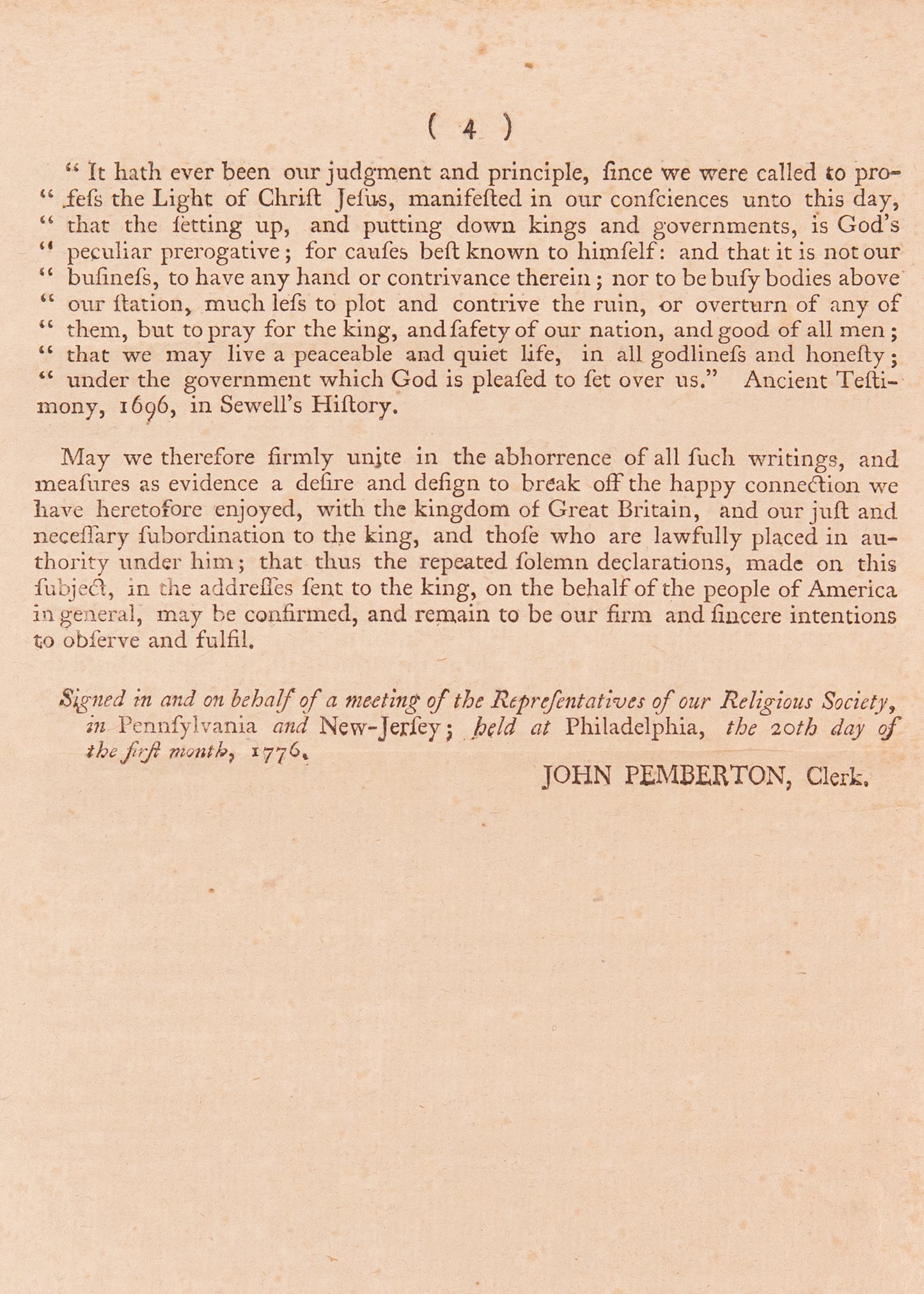
1776 QUAKER NON-RESISTANCE MANIFESTO. A Significant Contemporary to the Declaration of Independence.
1776 QUAKER NON-RESISTANCE MANIFESTO. A Significant Contemporary to the Declaration of Independence.
Couldn't load pickup availability
A remarkably preserved example of a significant document in American Revolutionary history, standing alongside the Declaration of Independence and Thomas Paine’s Common Sense.
By early 1776, Thomas Paine had just published Common Sense, the Continental Congress was moving toward rupture with Britain, and Philadelphia — the largest city in the colonies, the seat of Congress, and the historic heart of Quaker America — was the epicenter of revolutionary agitation. The Quakers were being pressed from all sides to declare themselves on the side of the Revolutionaries or the Crown. In a bold, official statement, the Ancient Testimony chose neither. They chose to be a spiritual community whose sole focus was embodying the life and teachings of the Christ.
Their answer was deeply unpopular with the Patriot cause, and the Ancient Testimony is even to this day often interpreted incorrectly as an explicityly loyalist document. Instead, the testimony was attempting to reground the Friends of Philadelphia in their ancient opposition to armed resistance, grounding their position not in mere political preference but in religious principle. It was additionally, favorable to submission to the Crown. Quakers, however, historically believed in submission to established civil authority as a matter of faith rather than politics, and their pacifism was absolute. Many historians have read the document as having been issued as a direct counter to Paine's Common Sense, which had appeared from the presses just weeks earlier — where Paine argued that monarchy was corrupt and independence divinely favored, the Quaker testimony argued precisely the opposite, though not on political grounds.
The consequences were severe. Quakers who refused to bear arms, pay war taxes, or support the Patriot cause were fined, had property confiscated, and faced social ostracism. In September 1777, seventeen prominent Philadelphia Quakers were exiled to Virginia without trial by the Continental Congress, a direct result of the political suspicion such testimonies generated. The document also deepened fractures within the Quaker community itself, as a minority — sometimes called Fighting Quakers, including figures like Betsy Ross and Nathanael Greene — supported the Revolution and were disowned by their meetings for doing so.
Beyond its immediate consequences, the testimony is significant for what it represents philosophically and historically. It gives formal, articulate voice to the substantial portion of the colonial population that was loyalist or neutral — a reminder that 1776 was far from a moment of universal revolutionary consensus. It also demonstrates genuine courage: publishing the testimony in Philadelphia in January 1776 invited the persecution that followed. And it raises enduring questions about political obligation, the justification of revolution, and whether religious communities can maintain principled neutrality in times of civil conflict.
Alongside Common Sense and the Declaration of Independence, this Quaker testimony belongs to the remarkable burst of political literature that 1776 produced — and it stands as one of the most striking dissenting voices of the entire Revolutionary era.
Last offered by Sotheby's, 2010, as part of the James S. Copley, Magnificent American Historical Documents auction. Previously, not since 1968.
[American Revolution; Pacifism] The Ancient Testimony and Principles of the People called Quakers, Renewed, with Respect to the King and Government; and Touching the Commotions now prevailing in these and other Parts of America. Addressed to the People in General. Philadelphia. 1776.
Bifolium, measuring 9 x 11.5 inches. Quarter folded and slightly soft at creases. Very crisp as shown. An exceptional example retaining the original family collection since 1776.
Share