Specs Fine Books
1792 EVIDENCES FOR ABOLITION. Scarce Early American Abolitionist + Boycott of Sugar & Rum.
1792 EVIDENCES FOR ABOLITION. Scarce Early American Abolitionist + Boycott of Sugar & Rum.
Couldn't load pickup availability
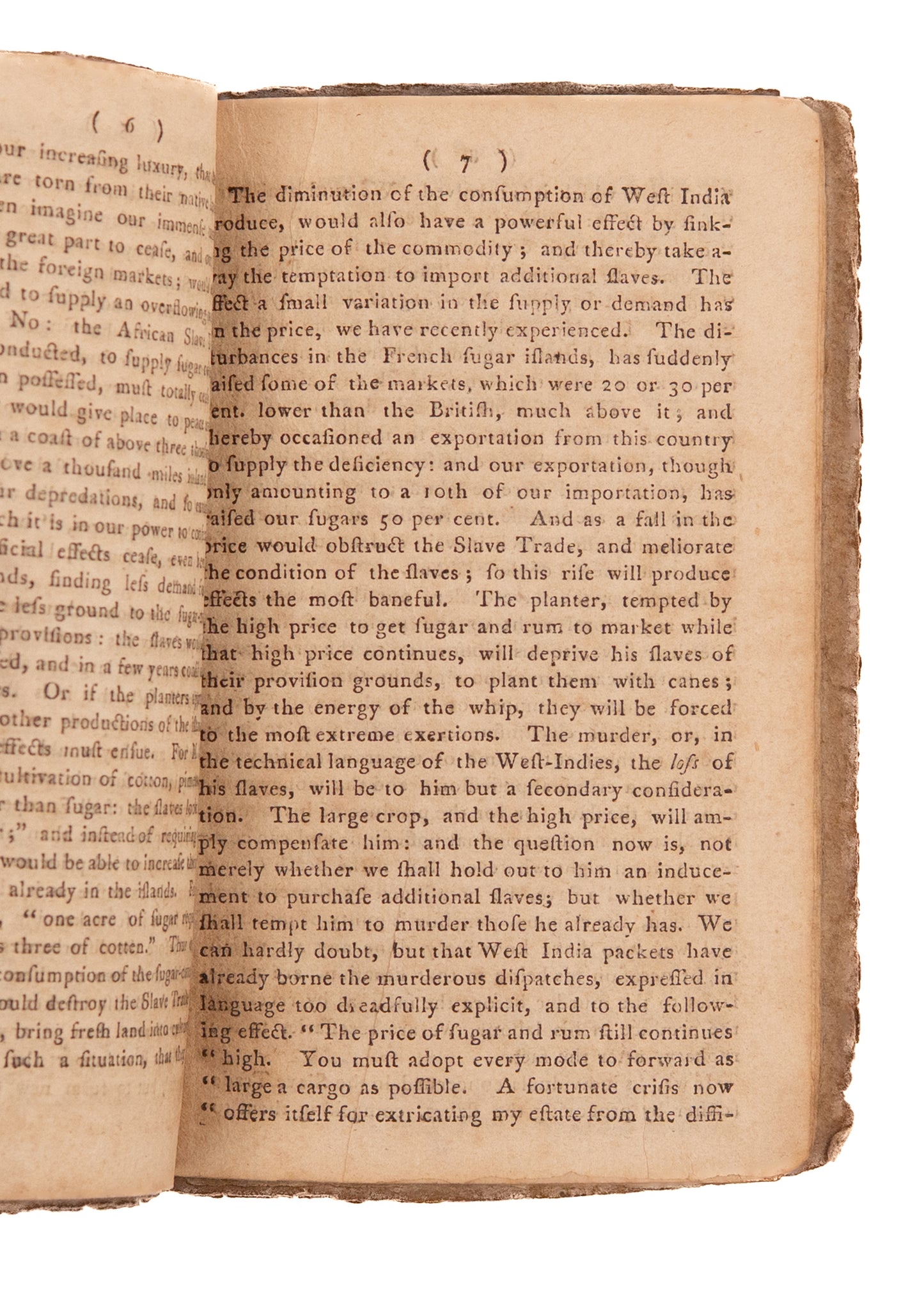
A superb first American edition of William Bell Crafton's testimony given before a Select Committee of the House of Commons during the landmark parliamentary inquiry into the slave trade — one of the most intensive legislative investigations of the 18th century, driven by the Society for Effecting the Abolition of the Slave Trade (founded 1787) and figures like William Wilberforce and Thomas Clarkson. The original London edition appeared in 1792, one of the most consequential years in the abolition debate. The pamphlet was designed to make the dense parliamentary evidence accessible to general readers, and its subtitle — A Recommendation of the Subject to the Serious Attention of People in General — signals its explicitly popular and evangelizing purpose for the abolitionist.
The choice of Philadelphia for the American edition as the site of reprinting was not accidental. Few regions in the United States can claim an abolitionist heritage as rich as Philadelphia. The creation of the Pennsylvania Abolition Society (PAS) in 1775, and its reorganization and expansion in the 1780s, marked the beginning of abolitionism in the United States. The PAS gained a significant reputation throughout the Atlantic world. By reprinting Crafton's work there in 1792, Daniel Lawrence was placing it at the very heart of the American antislavery network.
The year 1792 was particularly fraught in America regarding slavery. The new federal Constitution (1787) had left slavery intact, and the slave trade question was deeply contested. All U.S. states abolished the transatlantic slave trade by 1798, though South Carolina reversed its decision in 1803. Making British parliamentary testimony available to American readers in 1792 contributed evidence and moral force to these ongoing domestic debates, lending the weight of a formal legislative inquiry to the abolitionist cause.
Between the works, a charming full page 18th century inscription relative to the slave trade.
[Crafton, William Bell]. A Short Sketch of the Evidences for the Abolition of the Slave Trade, Delivered before a Committee of the House of Commons, to which is Added, a Recommendation of the Subject to the Serious Attention of People in General. London, Printed, Philadelphia: Re-Printed by Daniel Lawrence. 1792. First American Edition.
[with]
[Fox, William] An Address to the People of Great Britain, on the Propriety of Abstaining from West India Sugar and Rum. Philadelphia. Daniel Lawrence. 1792.
Containing an additional postscript to the American edition.
Good + in original bespoke wraps, some handling and light foxing. A really nicely preserved example.
Share