Specs Fine Books
1795 ABOLITION OF SLAVERY. An Encouragement in Abolitionist Cause in Light of Current Setbacks.
1795 ABOLITION OF SLAVERY. An Encouragement in Abolitionist Cause in Light of Current Setbacks.
Couldn't load pickup availability
. . . the cause of the oppressed Africans, and the abolition of the slave trade, has also engaged our serious attention . . . and although the direct prospects of success are for the present clouded, we do not slacken our endeavors, nor lose our hope.
An excellent primary document related to the earliest days of transatlantic Quaker abolitionism and abolitionism more broadly, documenting the vital communication network that united British and early American anti-slavery efforts in the late eighteenth century. The Religious Society of Friends, or Quakers, were pioneers in the global fight against human bondage, establishing the world's first organized anti-slavery movement and the first in the United States as well.
The year 1795 is of special interest to the early abolitionist movement. The year's events placed the cause at a pivotal and tumultuous crossroads. In the years immediately preceding this letter, British Parliament had seen intense debates led by William Wilberforce, and American states were gradually enacting localized emancipation laws.
However, by 1795, the momentum had drastically stalled. The geopolitical chaos of the French Revolutionary Wars and the unfolding Haitian Revolution had stoked widespread fears among the ruling classes that pushing for the immediate abolition of the slave trade would destabilize empires and economies, causing mainstream political interest in the cause to plummet.
By explicitly addressing the cause of abolition during this period of severe political backlash and distraction, the 1795 epistle serves as powerful evidence of the Quakers' refusal to abandon their campaign. It stands as an important primary record of how early abolitionists sustained their moral momentum through hostile political climates, keeping the anti-slavery framework alive until the legislative breakthroughs of the early and mid- nineteenth century.
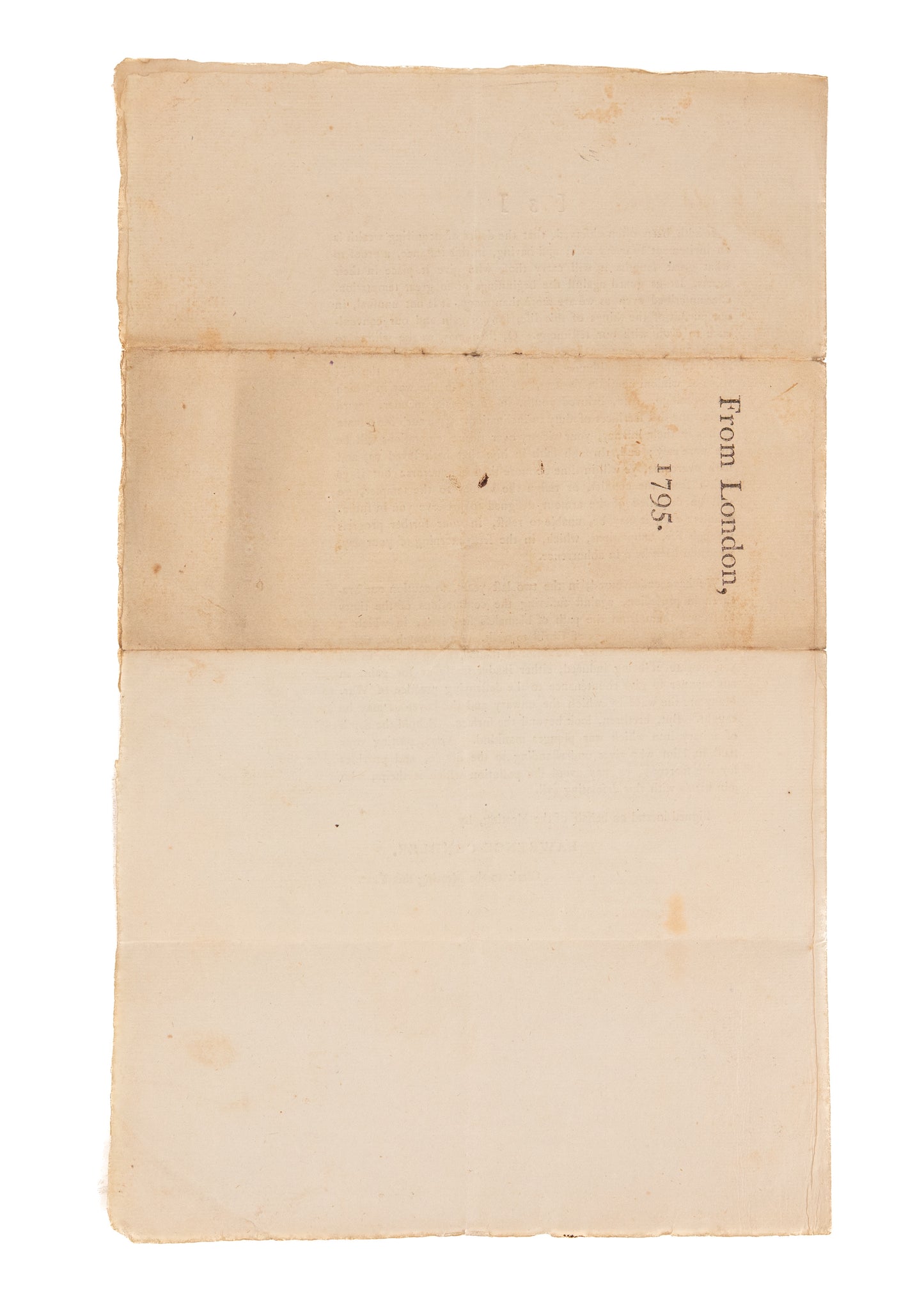
[Slavery. Abolition] Candler, Lawrence. From the Yearly Meeting Held in London, by Adjournments, from the 18th to the 27th of the Fifth Month, 1795, inclusive, to the Quarterly and Monthly Meetings of Friends, in Great Britain, Ireland, and Elsewhere. 3pp.
An attractive large bifolium with original folds, Generally very clen and bright.
Share