Specs Fine Books
1796 FIRST ABOLITIONIST SOCIETY IN AMERICA. Minutes of the Third Convention of Abolition Societies in Philadelphia.
1796 FIRST ABOLITIONIST SOCIETY IN AMERICA. Minutes of the Third Convention of Abolition Societies in Philadelphia.
Couldn't load pickup availability
By 1796, the delegates (primarily Quakers and elite reformers like Benjamin Rush and Jonathan Edwards Jr.) had refined their strategy and become more organized and sophisticated in their approach. The significance of this specific year is found in its shift from broad moralizing to highly specific legal intervention.
Much of the 1796 convention was preoccupied with the fallout of the Fugitive Slave Act of 1793. The Minutes record the delegates' increasing sophistication in providing legal counsel to Black Americans kidnapped under the pretext of being fugitives. This established the "Legal Defense" framework that would characterize Northern abolitionism for decades.
A notable outcome of the 1796 meeting was a formal, strategic address sent to the Southern states. The delegates sought to "conciliate" Southern legislators, using economic arguments about the inefficiency of slave labor rather than purely moral ones—a hallmark of the "Old Abolitionist" pragmatic approach.
They also began to focus intensely on education of Black children, requiring each local society (from Connecticut to Virginia) to submit detailed reports on the schools established for their instruction. This reflected the conviction that "mental improvement" was the most effective weapon against the prejudices of white citizens.
It also records successes, providing documentation for the number of manumissions achieved through legal suits. It serves as a ledger of the movement's progress.
The most enduring significance of the 1796 proceedings is the formal adoption of a unified "Plan" for the treatment of free Black people. This plan recommended:
Industrial Apprenticeships: Placing Black youth in trades to ensure economic independence.
Moral Supervision: Establishing "Committees of Guardians" to oversee the social welfare of the newly freed.
Registry of Free People: Creating local registries to provide individuals with "Certificates of Freedom" to protect them from kidnappers.
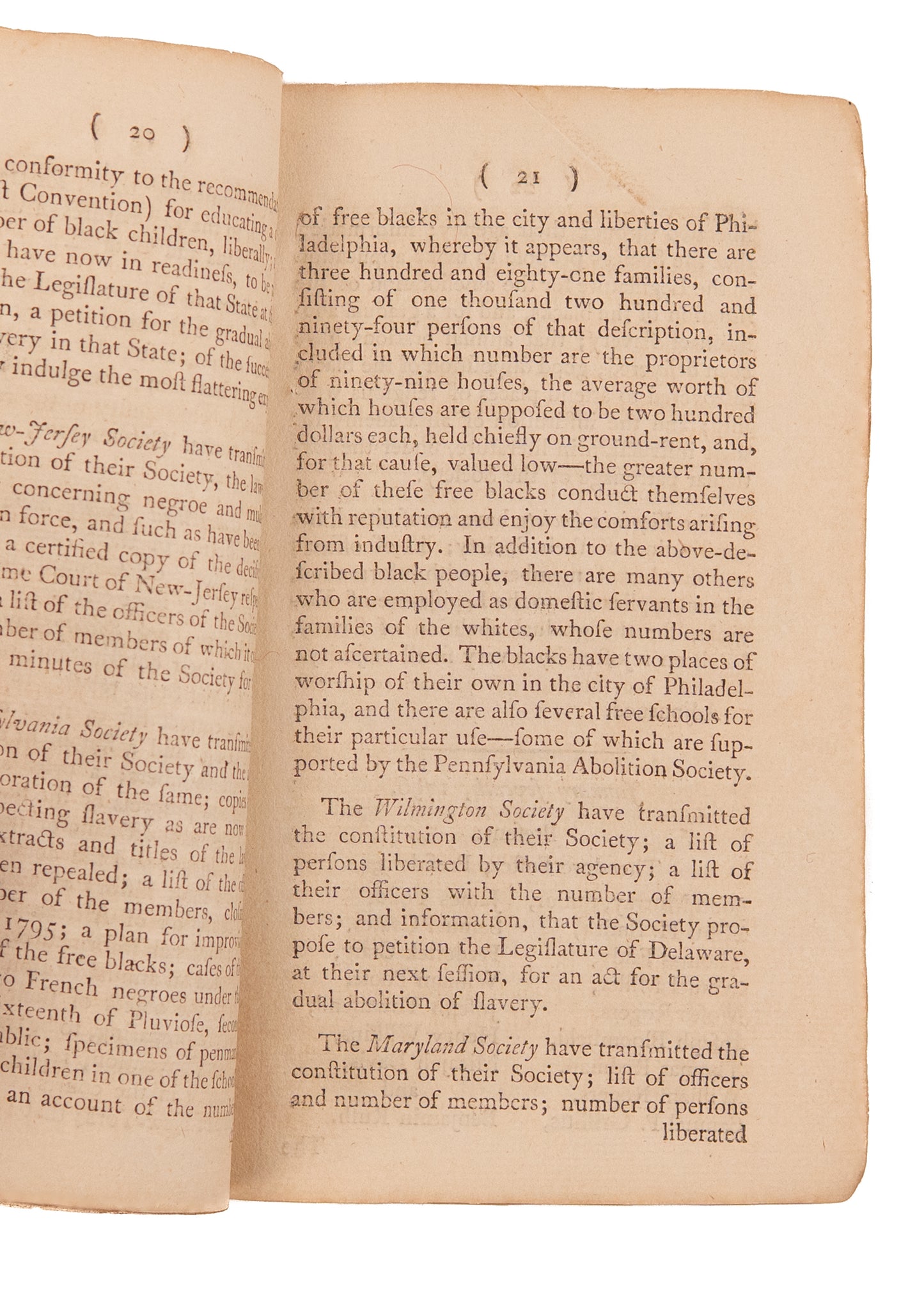
Minutes of the Proceedings of the Third Convention of Delegates from the Abolition Societies, Established in Different Parts of the United States on the First Day of January, One Thousand Seven Hundred and Ninety-Six, and Continued by Adjournments, Until the Seventh Day of the Same Month Inclusive. Philadelphia. Zachariah Poulson. 1796. 32p.
Good + in original mineral blue wraps, some light deterioration of wraps as shown; interior rather good and clean with light handling.
Share