Specs Fine Books
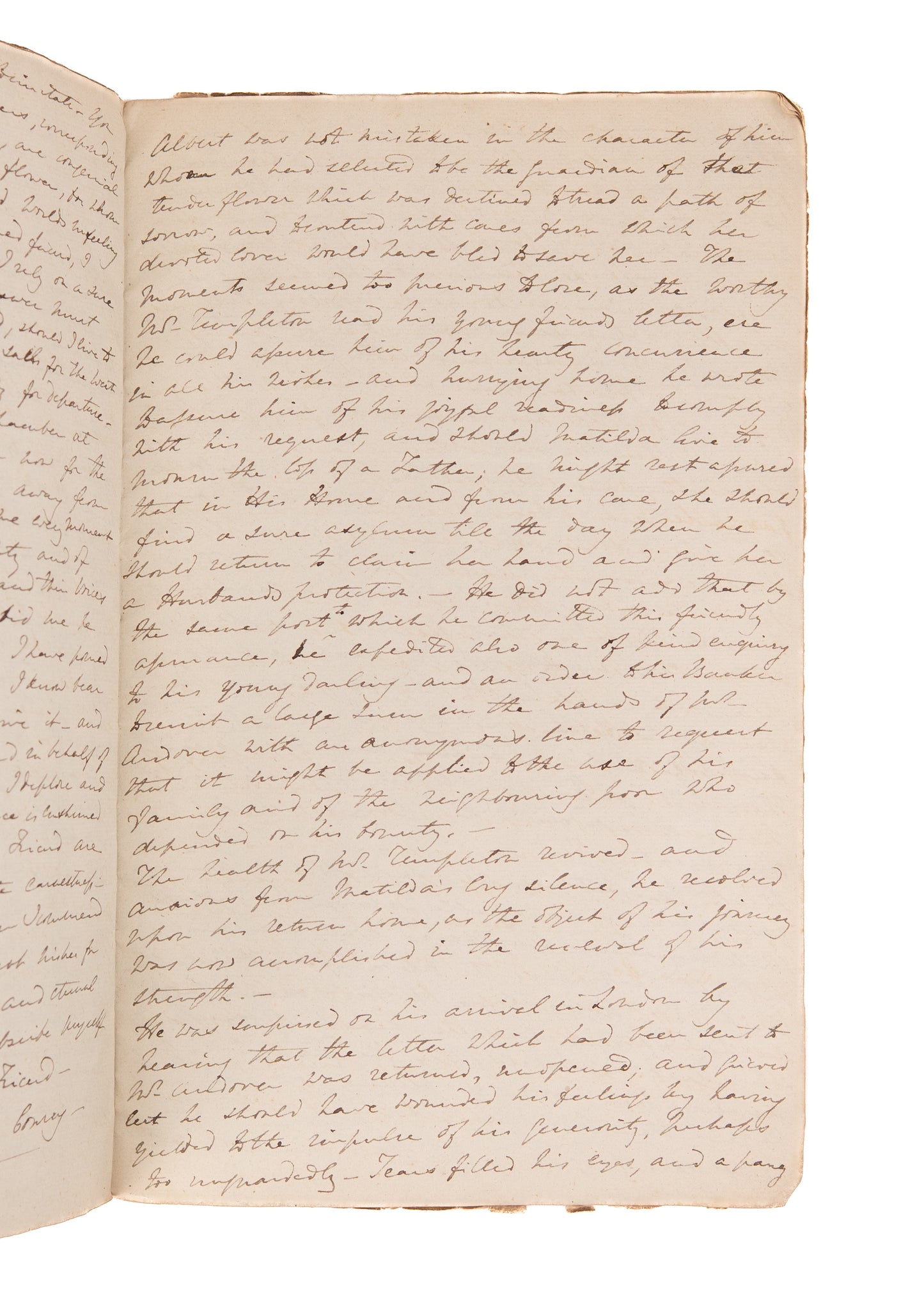
1824 UNPUBLISHED 35pp MSs. A Tale Inducing Christians to Care for Orphans of Industrial Revolution.
1824 UNPUBLISHED 35pp MSs. A Tale Inducing Christians to Care for Orphans of Industrial Revolution.
Couldn't load pickup availability
A fascinating 35pp unpublished Georgian devotional tale designed to encourage the wealthy, especially the wealthy who professed to be Christians, to be mindful of the state of the increasing orphan population, assuring them, via a prophetic dream, of God’s interest in care for these little ones.
The 19th-century saw an intense surge in orphaned and destitute children in England, primarily driven by rapid urbanization and overcrowding resulting from the Industrial Revolution. The emergence of new industrial work conditions, long hours, and little workplace oversight, combined with the rapid mobilization of an underpaid workforce, resulted in widespread poverty, deadly outbreaks of disease, such as cholera and tuberculosis, and high adult mortality rates. These were the forces that led to the emergence of George Muller’s orphan homes, the work of Dr. Thomas Barnardo, and gave the ring of truth to tales like Charles Dickens’ Oliver Twist. The emergency elicited the compassion and support of other early Evangelicals, including William Wilberforce, Hannah More, etc.,
This story sits early in the situation and purports to be An Unvarnished Tale to promote the cause. And indeed it is, sparing no detail of the sufferings and losses of the young during the period.
It begins with a wealthy Mr. Templeton, who is enjoying a peaceful stay at a country parsonage with the venerable minister, Reverend Mr. Andover, his daughter Matilda, and an orphaned companion of some family means, young Mr. Albert. Mr. Templeton is immediately framed as a spiritually minded Christian. And it is his Christian compassion and perception that causes him to recognize an impending cloud of sorrow in the home. Thus, before leaving, he offers Rev. Templeton his lifelong friendship and his ongoing financial support before returning to London.
Rev. Andover, because of his grave illness, travels with Matilda to Florence in hopes of recovering. Meanwhile, young Mr. Albert finds that his family’s estate, left under management of others, is facing financial ruin in the East Indies. Though young, he is forced to leave for the colonies to attempt to salvage his family’s business. Before sailing from Plymouth, he sends a desperate letter to his ailing friend, Rev. Templeton, begging him to make provisions for Matilda should he pass away from his present illness.
Alas, while young Mr. Albert is in the West Indies and Mr. Templeton in London, the dreaded event materializes. Reverend Andover dies, leaving the village parsonage abandoned. Matilda is left entirely unprotected and is forced to flee to London, and later to Brighton, where she takes up a difficult position as a veiled music governess for a demanding and cruel family. This is better than her having to “take to the streets,” bust just barely. She is treated cruelly and lives in her mourning dress and veil, even while instructing the children.
Upon hearing of the state of affairs, a desperate Mr. Templeton begins searching across England for Matilda. At last, guided by a prophetic dream while on the Brighton coast, he overhears a familiar harp melody coming from a fashionable home. Upon waking, he locates the home and discovers Matilda, still in her mourning clothes, and rescues her from her life of servitude.
Mr. Templeton provides Matilda with a safe home under the supervision of a widowed cousin, though they endure a year of agonizing silence regarding Albert's fate in the East Indies. Finally, on a melancholy autumn night, Albert makes a sudden, triumphant midnight return, family fortunes restored. The lovers are blissfully wed and enjoy a lifelong relationship with Mr. Templeton and his family.
Presumably the tale provides a best-case scenario. There is a wealthy benefactor. The deaths are not immediately caused by oppressive industrialization, and fortunes are restored. The children are in their teen years when the tragedies begin. The reader is then led to ask, what happens to the 8 year olds, to those without a Mr. Templeton, or a fortune to restore? These questions are answered by what Matilda observes, in "unvarnished reality" while in London. Child labor, hints at prostitution and beggary, etc.
Complete on 9 bifolium sheets, some corners dog-eared, minor corrections throughout. Likely intended for publication by the Society for the Promotion of Religion Knowledge or the Religious Tract Society. From our tracing, it was never published. An English production, similar forces were at play in major metropolitan areas in America as well.
Share