Specs Fine Books
1829 THOMAS ERSKINE. Effective Christian Universalism & Scottish Heresy Trial. John McLeod Campbell & Edward Irving.
1829 THOMAS ERSKINE. Effective Christian Universalism & Scottish Heresy Trial. John McLeod Campbell & Edward Irving.
Couldn't load pickup availability
A very fine example of Thomas Erskine of Linlathen’s The Unconditional Freeness of the Gospel, a pivotal 19th-century Scottish theological work that challenged strict Calvinist double predestination by asserting that God’s forgiveness and love are universal, unconditional, and already granted to all humanity through Christ’s atonement.
Erskine argued that Christ’s death did not merely create a conditional offer of salvation for an elect few, or even for all - vis a vis traditional Arminianism, but that it actually effected a universal pardon for all mankind, shifting the burden of faith from securing God's forgiveness to simply realizing and inhabiting an already accomplished pardon; this framework provided one of the most intellectually influential springboards for 19th-century ultimate reconciliation and wider universalist thought in Britain and in the United States.
Erskine’s treatise served as the primary theological catalyst and theoretical foundation for John McLeod Campbell’s famous Row heresy trials and his landmark 1856 work The Nature of the Atonement; Campbell adopted Erskine’s core insight that God is inherently fatherly love rather than judicial wrath, developing Erskine's concept of universal pardon into a formal doctrine of vicarious repentance that transformed Scottish soteriology.
Erskine's thought also played a role in the development of Edward Irving's theology. Erskine's emphasis on the immediate, unmerited presence of the Holy Spirit and universal grace deeply influenced Irving's circle during the late 1820s, particularly through Erskine’s close personal friendship with Irving and his early defense of the miraculous charismatic revivals at Rosneath and Port Glasgow; though Erskine eventually distanced himself from the movement's apocalyptic excesses and formal hierarchy, his theological assertion of an active, universally available divine spirit laid the spiritual groundwork for the charismatic manifestations that defined early Irvingism.
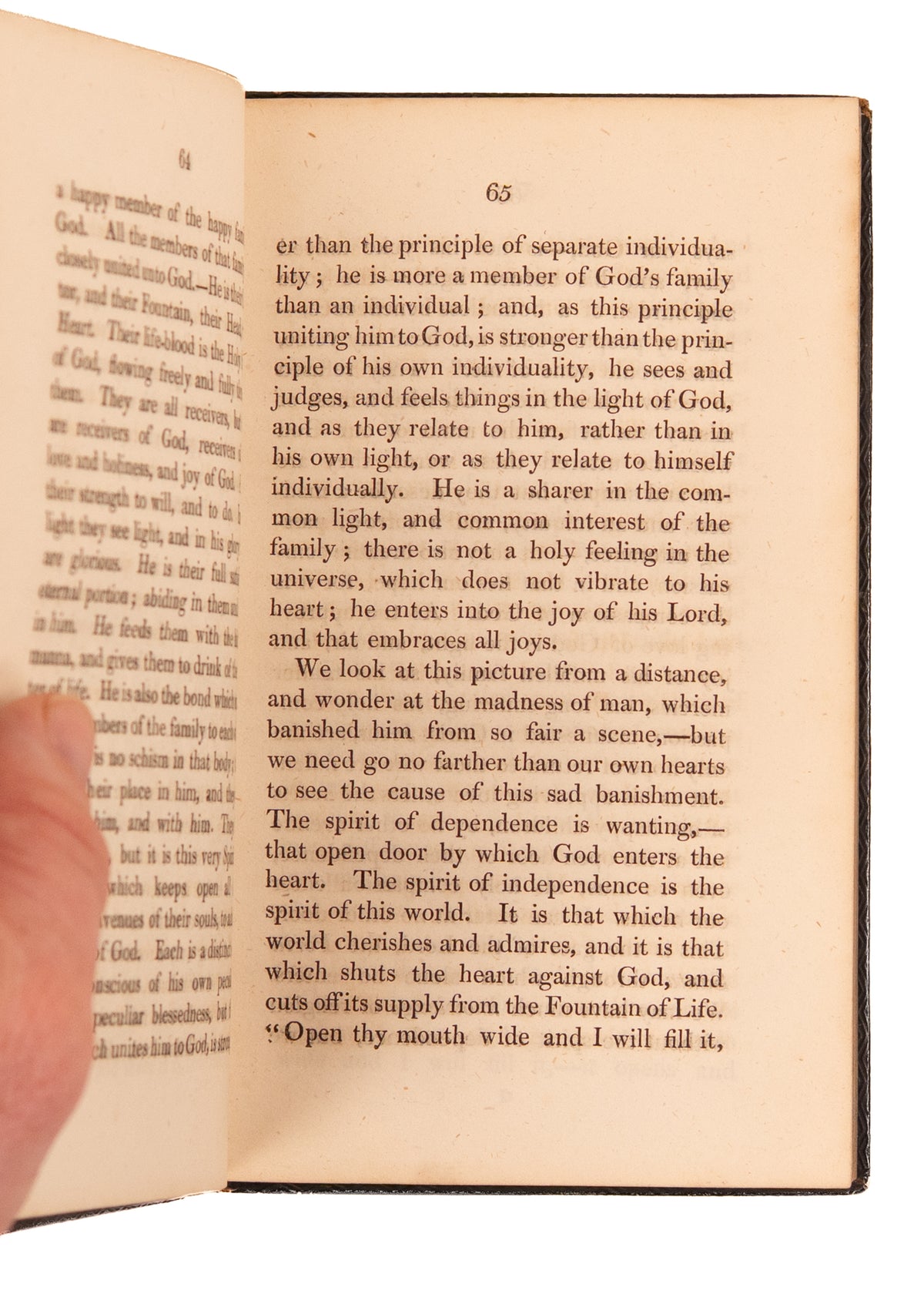
Erskine, Thomas. The Unconditional Freeness of the Gospel: In Three Essays. Edinburgh. Printed for Waugh and Innes. 1829. 245pp.
Very good in original deep blue full leather binding with raised bands and compartments tooled appropriately with Scottish thistle design. Some generalized rubbing, but very attractive and sound. Title with two ownership inscriptions as shown. Some pencil markings.
Share