Specs Fine Books
1830-1835 FLORIDA AN INVALIDS PARADISE. Correspondence of a Florida Invalid, Seminole War, Cholera, &c.
1830-1835 FLORIDA AN INVALIDS PARADISE. Correspondence of a Florida Invalid, Seminole War, Cholera, &c.
Couldn't load pickup availability
A superb archive of a New York pair traveling to Florida as invalids, with excellent content both from their period at home and at Saint Augustine, the "Invalid's Paradise."
Rare correspondence from the brief window between Florida's transfer to the United States in 1821 and the outbreak of the Second Seminole War in late 1835. During this time, East Florida, particularly St. Augustine, emerged as the young nation's premier winter sanitarium for wealthy northerners suffering from consumption (tuberculosis) and other chronic respiratory ailments.
Accounts from this exact era are historically vital because they document the very birth of Florida's identity as a health resort and tourist destination long before the post-Civil War boom. They offer rare, peaceful observations of the region's subtropical climate, local orange groves, and Spanish-influenced architecture just before the territory was plunged into a devastating, decade-long frontier war that effectively halted all domestic tourism and altered the demographics of the peninsula.
Also included in this lot is the daily journal of our traveler and his life as a craftsman in Coxackie, New York, during the entirety of the 1820's and into the 1830's, before his needed convalescence.
Items included:
1. June 25, 1833. Cairo, New York from Benjamin Lisk Bessac [1807-1871]. Cousin, and Attorney in Orleans County. 3.5pp. Addressed to James C. Lisk of Coxackie, New York.
I am well with the exception of a middling good sized cold which I caught one evenign last week at a dancing party. I will give you a short description of my feelings. My joints are as stiff as I should suppose Capt Samson's was theday after he slew one thousand Philistines with the jaw bone of a cow's ass. My nose feels as though I had been hung up by it on a nail ever since America was discovered. My brain appears to me as though I was transmorphed int a porcupine and every quill had been somehow inverted and stuck three inches through my skull bone into the brain. When I put on a chapeau it hurts as shtough heaven and earth was coming toghether - my ears each and every one of them feel as though they had been poured full of melted glue and the outside of it had got cold while that within was "flamin" hot as old Lim Garet says. If someone had screwed my head in a vice and took me by the heels and twisted me around as many time as Jesus Christ commanded his followers to fogive their erring brethren, my neck would not ache worse than it does this minute. And my whol ebody seems to feel as though from the sole of my head to the crown of my feet [sic] it was full of wounds and bruises and putrifying sores - ah - - - - I am in good spirits. . .
He then goes on in the same colorful manner to comment on the town of Cairo, his legal studies, his reading Blackstone, Chitty, his charge of entertaining the 18 year old young ladies, etc.,and concludes his thoughts on his present arrangement with I am middling busily employed for a lazy fellow.
He then inquires about the camp meeting, concerns about their friend, John Lawton, who is in New Orleans where the cholera is fearfully extending its ravages and revisiting many sections with increased fatality. New Orleans is in a special manner severely scourged this summer again, the number of deaths amounting to about one hundred in twenty some houses.
2. January 5, 1834. Coxsaciei, New York from Dr. J. C. Dorman. 2pp. Addressed to James C. Lisk, now in St Augustine, East Florida.
. . . I regret that your health is not good. My Dear Sir, do not be discouraged, for many have been very sick & now well. If you should have pain in your side & fever, do not be disheartened at that. Although it is very unpleasant to have pain, you must not be discouraged for I still think you will get quite well. I think well of your balsam copaiva & I would have the seaton in my side without fail. Do not give up the ship. etc.
3. February 12, 1834. New Baltimore from Charles Lisk to James C. Lisk and Charles Lisk Jun. [in Florida]. 1.5pp.
We have seen a letter from James to Mark Ladoux which informed us of your health, and situation &c. and we were pleased to understand that you were comfortably well and enjoying pretty good health, which is the greatest of blessings as respects the comforts of this life - according to xxx James wrote to Doctor Dormon some time ago that he was attacked with severe pain in his side and considerable fever. We expected to hear that he was declining in health but are very agreably disappointed to understand that his health is rather improving and has a prospect of taking a trip to Cuba or to Key West and perhaps may be gone before the arrival of this Epistle. . . . Charles asked my opinion of his staying in Florida. I should not consider it prudent to undertake to stay in so warm a climate during the hot season of the year. Money would be no temptation to me because it ought not be put in competition with health, but he ought to be his own judge in this matter. etc.
4. March 11, 1834. Charleston, South Carolina. From Charles Lisk Jun. to James C. Lisk, who remains in Saint Augustine, Florida. 1p.
I arrived here Sunday the 9th about eleven in the forenoon. I find this place far more pleasant than I expected. The afternoon we left the wharf we came down near the lighthouse the wind was against us we could not go out, went back and cast anchor near the fort, went out next morning in company with the Gazette an after we got over the bar the S. S. Mills came on and past us and went out of sight by sunset. etc.
The schooner, S. S. Mills would sink during a hurricane off Jekyll Island, Georgia in 1837.
5. November 3, 1835. S. V. and Elizabeth Gifford of Saint Augustine, Florida write to James C. Lisk, now returned to Coxsackie, New York. 3pp.
I do intreat you to fly to this paradise for invalids - you cannot imagine a climate more beautiful than this has been since I arrived, which has been three months now. . . the moment you get this letter just say to your friends that you are just going down to St. Augustine, and do not stop to think of it, but pack up a few things, take the steamboat to Charleston, and in four days you will be there, and then take the Mills and you will be in this delightful city. Now Lisk, you know how many come here ten times worse than you have ever been and recovered. If you will but come out I will promise and become obligated to put you into a tight coffin if you die in one year and transport you back to your Fathers at my own expense. You shall have the best room in my house with a good fire place and as much fire as you wish, and no pains will be spared on my part to make you comfortable and happy. . . Strange Mr. Ulena and his mother have built two new houses on that lot front of the City Hotel yard and there are several more going to be built this winter. etc.
You know General Smith, when he came here you could scarcely hear a word he said, now he sings in church - reads sermons &c. He told me he thought the summer better for invalids than the winter, that he improved more. Oh did you but know what a delightful summer summer it had been you would want to live here forever - the coolest summer I ever passed anywhere and as to venomous reptiles, I have seen no more of them than I did in the winter. etc.
6. February 14, 1834. Charles Lisk Junior writes from Julington Creek, St. Johns County, East Florida to James C. Lisk of Saint Augustine, East Florida.
The day I left you I arrived here about 7 in the evening I had the Horrors for two or three days, but since then I have been in good spirits. I now stay with Mr. Henry Hull. I have worked some for him. He is clearing a piece of land for a grove. etc.
7. January 16, 1834. From Charles Lisk Jun then in Charleston, South Carolina to Mrs. Weeks of St. Augustine. 2pp.
Madam. I expect you will say this is not doing as I agreed to do. I well remember I promised you that I would write you as soon as I arrived in Augustine, but I have written sometime since to Hannah and expect you have known the contents of the letter if she has received it, but these Southern mails are as badly managed that I fear she has not received it, it is much safer to send by Ship - I will not trouble you with our passage to Augustine, suffice it to say we had a pretty tough one. . . We had on the night of the 6th a little ice, and the following night a white frost for the first instant in Augustine - that night ice frose more than an inch thick and 3 drunken negroes actually frose to death. Charles has been with a planter on the St. Johns River near ever since our arrival in Augustine. The hurricanes comes on us now and I try to avoid it like the devil, but it is no use. On the 9th I gave a sailing party at Augustine. The vessel left the warf at 11am with about 180 gentlemen and ladies on board, sailed three miles to the light house, came to anchor, and partook of a splendid dinner, drank 6 doses of champain, 2 doses of Madana and at sunset returned to the war and drank a little champain . . . I could walk straight and narrow, but some of the gentlemen could not say shibboleth for souls of them and one lady drank without intermission 6 glasses of champain. What do you think about that? etc.
8. February 2, 1830. 3pp imaginative letter from B. L. Bessac t James C. Lisk. The same whose severe man cold description is chatted up in letter 1.
Addressed to the Most Worshipful Cousin Esquire he jests that his cousin has learned to practice transmogrification, turn invisible and, indeed, into a lion. This explains why he has been absent for many days, etc., then May therefore, as evidence s the main point in law, what evidence is there that this aforesaid Jim has not been basely murdered after the manner of Sally Hamilton or abducted as has been done to the famous William Mugan of Anti Mason's Memory, or translated like Enoch of old or transmogrified like Saint Paul, a like old Captain Lazarus in the Tastament, ben camed by angels to rest in Abams, or in other words, Old Brams bosom, etc.
9. December 17, 1835. Seth Nickerson of Saint Augustin, Florida to James C. Lisk in Coxsackie, New York. 2pp.
. . . there is not so many invalids here now as there was last winter and I don't expect there will be many more this winter on account of the Indian War. The Indians have burnt several plantations and the most of the planters have removed their families to this place and Camp King for safety. The troops have all left this place and gone to the Indian Nation and last week the militia was called out a part of them have gone to Indian river and a part to the t Johns. It is feared they will do a great deal of damage before they can be got off.
10. February 7, 1831. Benjamin Lisk Bessac writes from Mobile, Alabama. 3pp. To James C. Lisk.
I thought I should puke my insides all up for the first 72 hours during which time I neither got out of my birth nor eat or drink anything, nor did anything else but cast up my account. By this time I began to conclude that I was about square with the world, and got up. When I came on deck, I found every body else as sick as I was, only they could puke so handsome as I could. Some were laying on the water casks, heaving up Jonah, some lay flat on the deck asleep, who had like me cast up all their accounts. Some stood leaning against the masts, looking like patience on a monument, etc.
The vessel appears to have been caught in a hurricane; it took over 30 days to reach Mobile; they saw vessels wrecked, were driven into the Bahamas. His wife had already traveled in advance and had set up a school for girls in Mobile.
I have a fine house, which I can not spend time to describe now, an 5 young ladies in the family and two servants, besides a little black girl who we have taken to **** up. . . . My wife has a school of 25 young ladie and it is daily increasing. etc.
11. December 25th, 1833. Charles Lisk Jun. writes from Saint Augustine.
took passage on board a vessel bound up the St. Johns River in East Florida, went inland passage to the entrance of the Altamaha, then put out to sea, which was on the 16th. The light house at the entrance of the St. Johns was washed quite away and the buoys entirely gone. Our pilate was lost and could not discover the entrance, wandered up and down the coast until the night of the 17th (a night that I shall long remember) the wind sprang up from the N East, blew a tremendous gale. Our vessel sprang a leak and we were in eminent danger. And our Captain, sensible of the danger, became immediately intoxicated with spirits and lay in the cabin. We were drove amongst the breakers on the coast when I expected that every foaming billow would send us to a watery tomb . . . in the morning we found ourselves out of sight of land, in the gulf stream, etc.
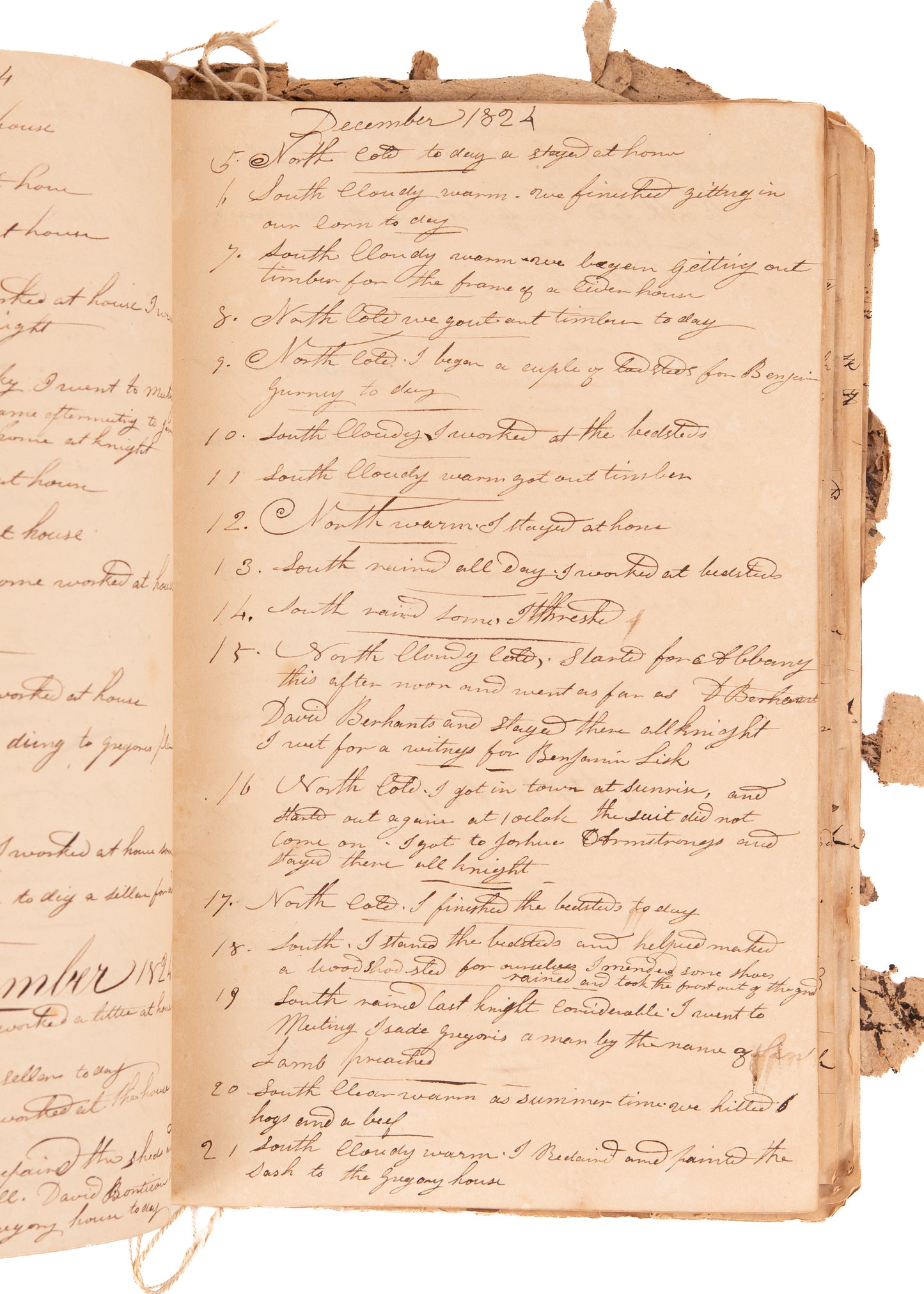
Additionally, there is included an almost daily journal for James C. Lisk, occupying 179 pages, dating from 1821 through 1833. The entries are brief, but often with interesting bits.
He mentions sledding, doing carpentry work, building a coffin for a three year old [he is apparently the local coffin maker; this crops up over and again], purchasing plans for making clocks, trunks, etc, harvesting and selling timber, apparently from a Quaker family as he mentions the Quarterly meetings and preaching being done by females, including Ruth Spencer who was a friend and co-laborer of Jemima Wilkinson's; a plague of grasshoppers destroys the hay crop and sheep are dying; attended Orthodox Quarterly Meeting; working at a cider mill; etc. etc. etc.
Share