Specs Fine Books
1835 EARLY ATHEISM IN AMERICA. Published in the Heat of the Boston Blaspheny Trials of Abner Kneeland
1835 EARLY ATHEISM IN AMERICA. Published in the Heat of the Boston Blaspheny Trials of Abner Kneeland
Couldn't load pickup availability
A rather scarce American edition of an influential anti-atheist work by Benjamin Godwin (1785–1871), prominent Baptist clergyman, abolitionist, and activist. A remarkable figure, he ran away to sea at the age of 15, was press-ganged into the Royal Navy during the Napoleonic Wars, and subsequently trained for the Baptist ministry. He became closely associated with the antislavery movement through his friendship with the abolitionist James Stephen, and was an important nonconformist figure both locally and nationally in the antislavery agitation of the 1820s and 1830s.
By 1834, when he delivered the lectures that form the present book, Godwin had become a nationally prominent Nonconformist voice, tutor at Horton College in Bradford and minister at Sion Chapel, a significant Baptist congregation in a rapidly industrializing city.
The timing of his work was not incidental. The 1830s saw a genuine crisis of confidence among British and American evangelicals about the spread of what was then-styled, "infidelity." This bucket term encompassed deism, skepticism, pantheism, and traditional atheism. In England, working-class radicalism and freethought were closely intertwined. Godwin's lecture series was a deliberate pastoral and apologetic intervention to his own communited, aimed at providing his congregation and the educated public with intellectual tools to resist these currents.
And similar trends were afoot in America. In 1835, Boston was the epicenter of the American atheism controversy. Abner Kneeland, who had founded the Boston Investigator as an organ of freethought, was at the very moment of this book's publication being prosecuted for blasphemy. The first trial was in January 1834 and Kneeland was convicted; the second case ended in a mistrial; the third trial was in November 1835. The case is notable for being the last time a court in the United States jailed a defendant for blasphemy. Kneeland's prosecution caused a city-wide controversy.
The Godwin lectures arrived on the Boston market at the precise moment when the question of atheism and infidelity was being litigated, quite literally, in the city's courts. The nature of religious skepticism had developed significantly: "the rare religious skeptic" of the eighteenth century "tended to be a bewigged gentleman, often socially conservative, who was content to let the rabble have their superstition." The public infidel of the early nineteenth century, in contrast, used social and technological developments to question what had once been settled.
The "Additions by W. S. Andrews" are a standard feature of this kind of transatlantic reprinting. An American editor would supplement a British work with material addressing specifically American controversies, including Kneeland and the Boston freethought scene, making the book more locally applicable.
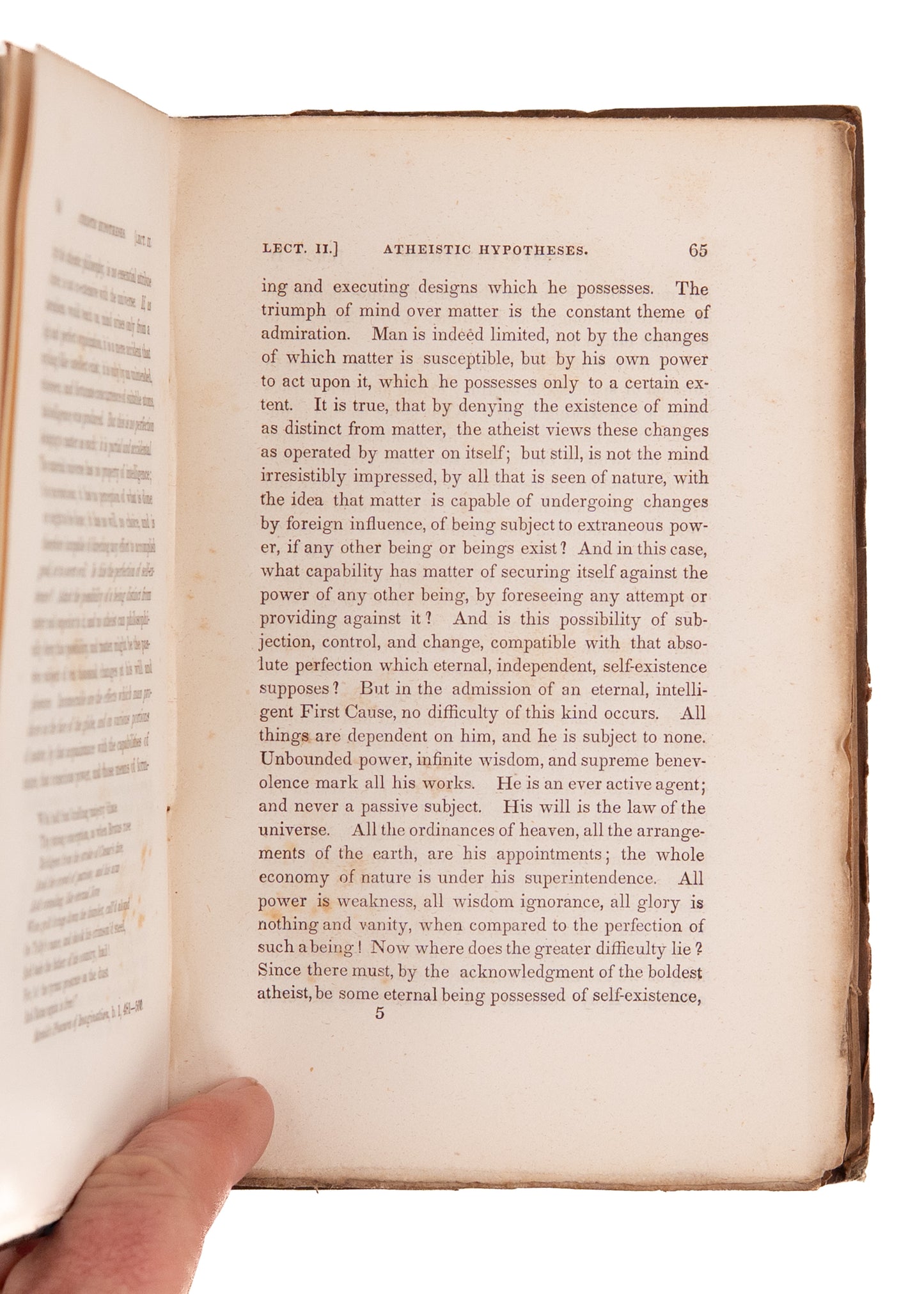
[Atheism, Apologetics] Lectures on the Atheistic Controversy; Delivered in the Months of February and March, 1834 , at Sion Chapel, Bradford, Yorkshire. Forming the First Part of a Course of Lectures on Infidelity. By the Rev. B. Godwin with Additions by W. S. Andrews. Boston. Hilliard, Gray & Co. 1835. 350pp.
An attractive example in its original publisher's cloth; some general wear and handling as shown; some signatures completely uncut. Early ownership signature of John Lloyd.
Share