Specs Fine Books
1838 SLAVERY & CHURCH. Rare Charleston South Carolina Presbyterian Church Manual - Slavery.
1838 SLAVERY & CHURCH. Rare Charleston South Carolina Presbyterian Church Manual - Slavery.
Couldn't load pickup availability
The Manual for the Use of the Members of the Second Presbyterian Church (1838) is a significant historical work that sits at the intersection of Charleston's elite slaveholding society, the Presbyterian Church's bitter internal disputes over slavery, and the broader intellectual project of giving theological and institutional legitimacy to the antebellum slave system.
Smyth himself was deeply embedded in Charleston's slaveholding elite. He married Margaret Milligan Adger, the daughter of James Adger, an elder of the congregation and one of Charleston's wealthiest citizens. The Adger family wealth came directly from Charleston's harbor commerce, which was built on enslaved labor and by facilitating the slave trade. More than 25 percent of black Americans today can trace that port as the beginning of their American story.
The Manual was produced at an extraordinarily charged moment theologically as well. In 1837, just one year before its publication, the Presbyterian Church split into "Old School" and "New School" factions, with slavery as a central fault line. Smyth's papers document dissensions in the Presbyterian Church concerning slavery, a schism in the Charleston Union Presbytery, and differences between the "New School" and "Old School" Presbyterians. The Manual thus established the rules, identity, and governance of a congregation that was actively involved in that sectional discord.
Smyth’s views on slavery seem develop over time. When his brother-in-law, James Adger, returned to Charleston from foreign mission work in 1847, he wanted to dedicate the remainder of his life to "the religious instruction of the negroes in Charleston," lamenting an inadequacy in "church accommodations" for them, as well as "a want of suitable instruction." His friendship seems to have urged Smyth in this direction. In 1850 the Second Presbyterian Church established a mission church for Black people, and then in 1858, with enthusiastic support from Smyth and members of the Adger family, the mission church was transformed into a self-sustaining church, though still with white eldership. The 1838 Manual was thus a foundational document for a congregation that would go on to develop one of Charleston's most deliberate programs of religious oversight of enslaved and free Black people.
Never an abolitionist or posing a direct challenge to slavery as a system, Smyth did urge reforms within the system of slavery for more humane treatment of slaves. His position was characteristic of "moderate" proslavery theology: acknowledge the humanity of enslaved people, call for kinder treatment, but still providing intellectual and spiritual cover for the institution.
His most important book was The Unity of the Human Races, in which he defended the full humanity of Africans and the sophistication of their past civilizations, attacking the claims of those arguing that whites and Blacks were so different they must have had separate origins. This sounds progressive, but its actual purpose was to defend the biblical framework for slavery against those who used racial "science" to argue Africans were a separate, lesser species; Smyth wanted slavery justified through scripture, not pseudo-science.
Smyth believed that "opposition to slavery has never been the offspring of the Bible. It has sprung from visionary theories of human nature and society; it has sprung from the mis-guided reason of man."
Smyth, Thomas. Manual, for the Use of the Members of the Second Presbyterian Church, Charleston, S. C. Prepared under the Direction of the Church. Charleston. Printed by Jenkins & Hussey. 1838.
[Containing]
Flinn, Andrew. God's Perpetual Presence in and Constant Watchfulness Over His Church. A Sermon, Preached at the Dedication of the Second Presbyterian Church. Charleston, South Carolina, April 3d, 1811. By the Rev. Andrew Flinn, D.D. First Pastor of the Church. pp.1-40.
[with]
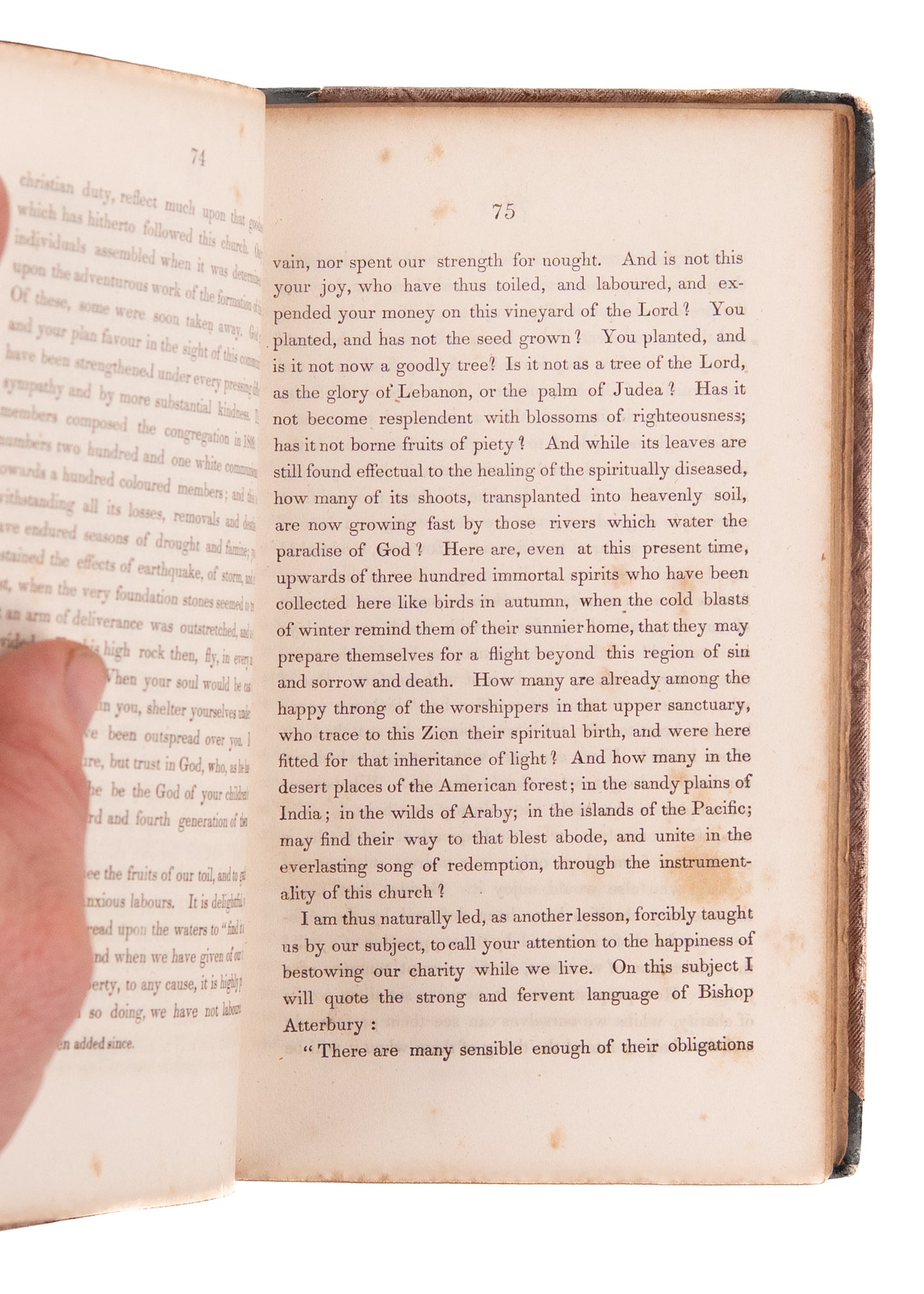
Smyth, Thomas. The History of the Second Presbyterian Church, Charleston, S. C. Two Discourses, Delivered in the Second Presbyterian Church, on the Occasion of its Twenty-Sixth Anniversary, April 3d, 1837. pp.41-98
[with]
Rules of the Association of the Second Presbyterian Church, Charleston, South Carolina. For the Temporal Government of the Church, As Revised by the Association in 1837. pp.101-128
[with]
A List of All the Former and Present Pastors, Elders, and Officers of the Second Presbyterian Church, Charleston, South Carolina. With a List of all its Members in 1832, and Also, a List of all who have become Members since 1832. pp.131-166
[with]
An Appendix. Containing Standing Notices, Practical Directions and Hints for the Use of the Members of the Second Presbyterian Church, Charleston, South Carolina. pp.167-236
Good - to fair condition. Original half leather with floral impress boards. Front board all but detached and the rear similar, though slightly more firmly held. Text is solid and generally clean with some generalized foxing as shown. Else quite crisp internally.
Share