Specs Fine Books
1840 WORLD ANTI-SLAVERY CONVENTION. Minutes of the First World-Anti-Slavery Convention. Excellent.
1840 WORLD ANTI-SLAVERY CONVENTION. Minutes of the First World-Anti-Slavery Convention. Excellent.
Couldn't load pickup availability
This is among the most historically significant documents in the entire canon of anti-slavery and human rights history. The Minutes of the Proceedings is the official contemporaneous record of resolutions, votes, and formal actions taken by the Convention and was the authoritative record — the institution's own ledger of what was decided and by whom.
The calling of a "General Anti-Slavery Convention" to meet in London in June 1840 represented an attempt to strengthen and enlarge the crusade against slavery by drawing together into one combined effort the abolitionist forces of the mid-nineteenth century.
The World Anti-Slavery Convention met for the first time at Exeter Hall in London, on 12–23 June 1840. It was organized by the British and Foreign Anti-Slavery Society, largely on the initiative of the English Quaker, Joseph Sturge. The official list of delegates has 493 names. Over 200 of the official delegates were British. The next largest group was the Americans, with around 50 delegates. Only small numbers of delegates from other nations attended, including delegates from France, Haiti, and the Caribbean — making it a genuinely, if imperfectly, international assembly.
The convention considered and discussed a number of issues. Conspicuously at the fore was the treatment of slaves in America and the internal slave trade in the southern states. They also discussed the condition of emancipated in British colonies; different forms of slavery throughout the world; the conduct of various religious bodies in the United States; and the condition of “colored” people who had fled to Canada.
The gathering assembled the greatest concentration of abolitionist leadership in history. Among the more distinguished people attending were Daniel O'Connell, Joseph Sturge, Wendell Phillips, Sir Thomas Buxton, Stephen Lushington, Amelia Opie, Lady Byron, Thomas Binney, Sir John Jeremie, Samuel Gurney, and Sir John Bowring. Thomas Clarkson — who had been fighting the slave trade since 1787 — presided over the opening sessions, embodying fifty years of continuous abolitionist effort. Haydon wrote of the Convention: "Of all the meetings for benevolent purposes which were ever held in London, none ever exceeded in interest or object that which met at the Great Room, Freemasons' Tavern, in June 1840, headed by the venerable Clarkson, and composed of delegates from various parts of the world."
The meeting also inadvertently launched the Women’s Rights movement in America. The Minutes formally records one of the most consequential procedural decisions in the history of reform movements. The Garrisonian faction supported the participation of women in the anti-slavery movement, and the American Anti-Slavery Society made a point to include a woman, Lucretia Mott, and an African American, Charles Lenox Remond, in their delegation. Wendell Phillips proposed that female delegates should be admitted, and much of the first day of the convention was devoted to discussing whether they should be allowed to participate. The women were allowed to watch and listen from the spectators' gallery but could not take part.
After leaving the convention on the first day, Lucretia Mott and Elizabeth Cady Stanton "walked home arm in arm, commenting on the incidents of the day, and we resolved to hold a convention as soon as we returned home, and form a society to advocate the rights of women." Eight years later, the result was the Seneca Falls women's rights convention of 1848, which touched off a major national debate and served as the foundation of the U.S. women's suffrage movement, which culminated in ratification of the Nineteenth Amendment in 1920.
The Convention also deployed a novel instrument of international moral pressure against religious institutions. The convention's organizing committee had asked the Reverend Benjamin Godwin to prepare a paper on the ethics of slavery. The convention unanimously accepted his paper, which condemned not just slavery but also the world's religious leaders and every community who had failed to condemn the practice. The convention resolved to write to every religious leader to share this view and called on all religious communities to eject any supporters of slavery from their midst. This was a systematic attempt to use international public opinion and moral authority to hold domestic institutions — particularly American churches — accountable.
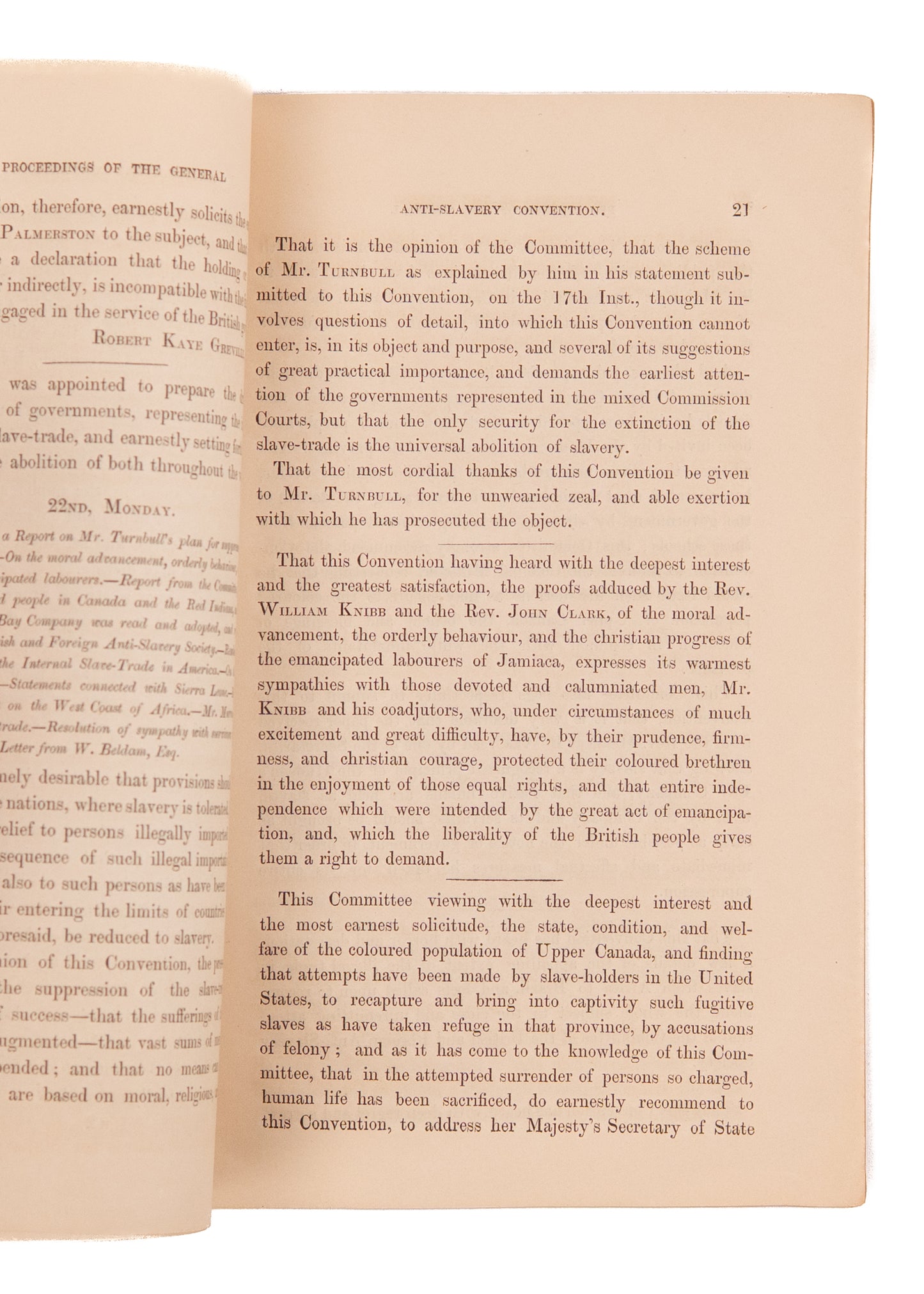
Minutes of the Proceedings of the General Anti-Slavery Convention, Called by the Committee of the British and Foreign Anti-Slavery Society, Held in London on the 12th of June, 1840, and Continued by Adjournments to the 23rd of the Same Month. London. Johnston & Barrett. 1840. 32pp.
A superb example with only minor handling and wear.
Share