Specs Fine Books
1841 SLAVE BREEDING IN AMERICA. A Report on the "Domestic Slave Trade" in America. Rare.
1841 SLAVE BREEDING IN AMERICA. A Report on the "Domestic Slave Trade" in America. Rare.
Couldn't load pickup availability
The 1841 publication of Slavery and the Domestic Slave Trade in the United States is a significant abolitionist document produced by the Philadelphia Yearly Meeting of Friends (Quakers) and it remains a primary source for understanding the internal mechanics of the American slave system following the 1808 ban on the transatlantic slave trade.
The document was the result of a formal committee inquiry established in 1839. Its primary significance lies in its transition from moral abstraction to empirical evidence. While earlier Quaker protests often focused on the spiritual "sin" of slavery, this report provided a cold, systemic analysis of the Domestic Slave Trade—including the forced migration of enslaved people from the Upper South (Maryland, Virginia) to the Deep South (Mississippi, Louisiana).The committee meticulously documented how the decline of tobacco farming in the North led to a "surplus" of enslaved laborers, who were then treated as a cash crop to satisfy the labor demands of the booming cotton and sugar industries in the South.
The report is particularly notable for its early and direct confrontation of American slave breeding, a topic that pro-slavery advocates often attempted to characterize as "natural increase." The Friends argued that the Upper South had effectively transformed into a "nursery" for the lower markets, providing evidence that enslavers in Virginia and Maryland deliberately managed the reproduction of enslaved women to ensure a steady supply of children for sale. The report highlights that the primary export of these states was no longer agricultural produce, but human beings. By focusing on breeding, the report emphasized the "heart-rending" separation of families. It documented how children were viewed as capital from birth, often sold away from their mothers as soon as they reached a marketable age.
The text also touched upon the more harrowing aspects of the trade, including the selection and "rearing" of young women for the "fancy trade" (concubinage), further illustrating the total dehumanization inherent in the domestic market.
This report is also known to have provided the factual scaffolding for later, more famous works. The data and anecdotes collected by the Philadelphia Friends influenced the rhetoric of Frederick Douglass and provided the "on-the-ground" details that would later inform Harriet Beecher Stowe’s Uncle Tom’s Cabin.
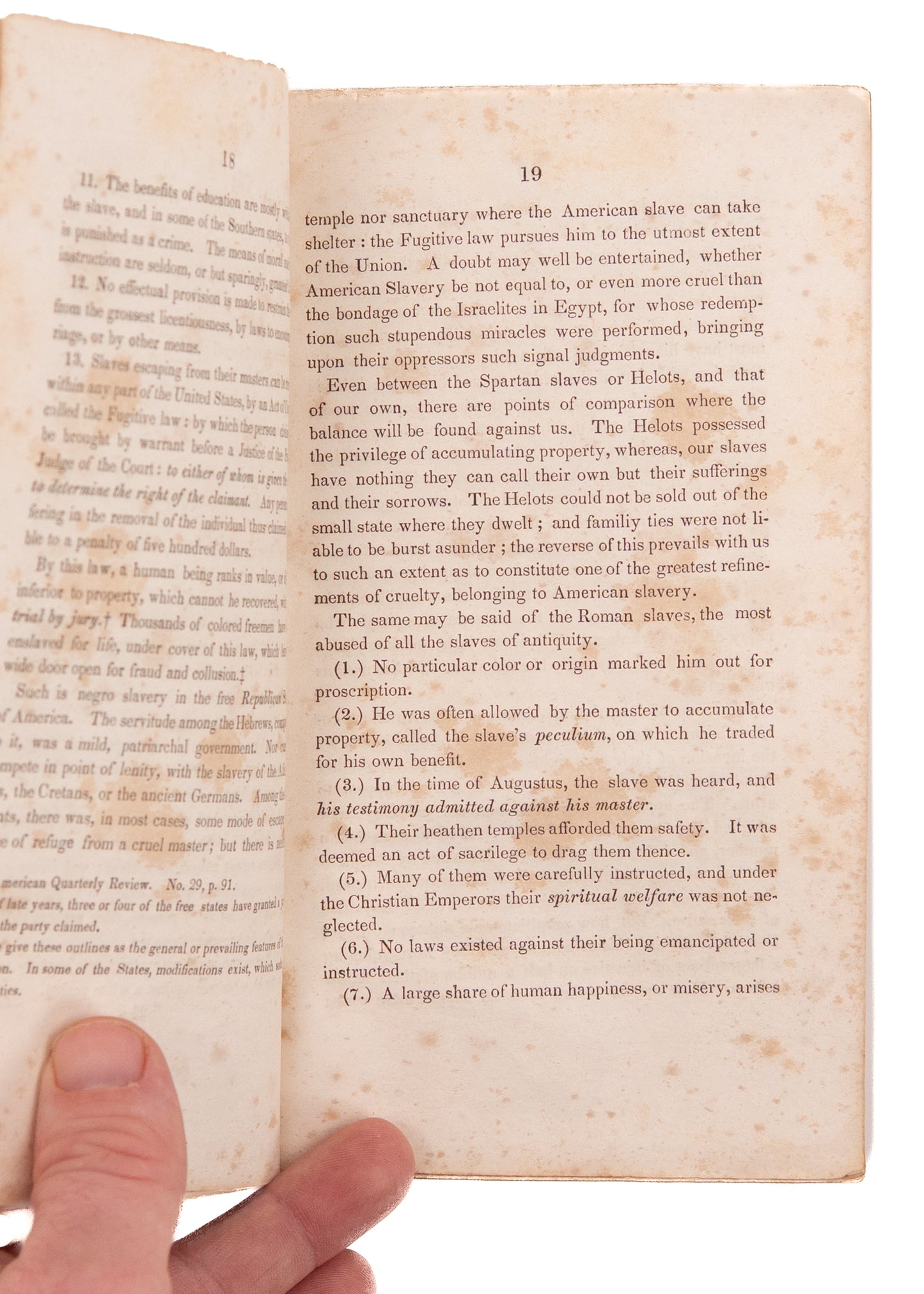
Slavery and the Domestic Slave Trade in the United States. By the Committee Appointed by the Late Yearly Meeting of Friends Held in Philadelphia, in 1839. Philadelphia. Merrihew and Thompson. 1841. 46pp + Errata.
A Good copy in original period brown wraps, first few pages and the wraps shaken and forward. A bit handled with light foxing.
Share