Specs Fine Books
1846-47 THE TRUE WESLEYAN. Radical Methodist Abolitionist Paper - Fugitive Slave First-Hand Testimony &c.
1846-47 THE TRUE WESLEYAN. Radical Methodist Abolitionist Paper - Fugitive Slave First-Hand Testimony &c.
Couldn't load pickup availability
An exceptional and scarce assemblage of issues of The True Wesleyan. Founded in January 1843, it was edited by the radical abolitionist preacher, Orange Scott and served as the primary voice and foundational organ for the Wesleyan Methodist Connection. The newspaper emerged directly out of the deep division within the Methodist Episcopal Church (MEC) over human bondage. Scott and fellow anti-slavery reformers had spent years attempting to reform the MEC from within, but growing episcopal suppression of abolitionist preaching convinced them that the church hierarchy was fundamentally compromised by its connection with Southern slaveholders.
The publication played a pivotal role in precipitating the formal breach in American Methodism. By providing an unsparing platform that denounced slavery as a moral sin incompatible with Christian fellowship, The True Wesleyan rallied like-minded believers to withdraw from the MEC and establish a new, explicitly anti-slavery denomination free from episcopal authority. Its relentless editorial campaign against the MEC's stance set off shockwaves that accelerated sectional tensions, directly preceding the massive 1844 schism that split the MEC into Northern and Southern branches. Beyond its ecclesiastical impact, the paper served as a vital vehicle for the broader antebellum abolitionist movement, linking Methodist theology with immediate emancipation, women's rights, and social reform.
Each with an early sepia inscription from "Yale College" or "Yale College Reading Room."
Later issues headed with the quotation, "American Slavery - The Vilest that Ever Saw the Sun. John Wesley"
Even a single issue scarce. A very significance and lengthy account of the fugitive slave, Isaac Brown. See June 19, 1847 issue notes below.
Scott, Orange [Ed.] The True Wesleyan. Vol. IV. No. 52. December 26, 1846. New York. 1846.
Contents include: Methodism in Canada; Call for Missions Work North of the Nenah or Fox River; Lay Representation; The Rights of the Laity; Horrid Massacre of Nestorians; Attempt to Prove that the Constitution is an Anti-Slavery Document; Doings of the 29th Congress; Moorish Ladies; etc.,
Account of a wealthy New Hampshire land-owner who has gifted his land and some sale proceeds to "colored people." To whom among the poor I shall make these deeds, is a question I did not solve hastily. I needed no time to conclude, that, inasmuch as my home and my land are both in this State, it would be very suitable to select my beneficiaries from among the people of this State. But for a long time I was at a loss to decide whether to take my beneficiaries from the meritorious poor generally, or from the meritorious colored poor only. I could not put a bounty on color. I shrunk from the least appearance of doing so; and if I know my own heart, it was equally compassionate toward such white and black men as are equal sufferers. In the end, however, I concluded to confine my gifts to colored people . . . the colored people [were] the poorest of the poor, and the most deeply wronged class of our citizens. That they are so, is evdient if only from the fact that the cruel, killing, Heaven-defying prejudice of which they are victims has closed against them the avenues to riches and respectability, to happiness and usefulness. That they are so is evident from the fact that, whilst white men in this State, however destitute of property, are allowed to vote for civil rules, nearly every colored man in it, who does not own landed estate to the value of $250, is excluded from the exercise of this natural and indispensably protective right, etc.
Iron gall or sepia stain at head of the paper which has deteriorated a section about 2 x 2 inches, just impacting a few lines on page two of the paper.
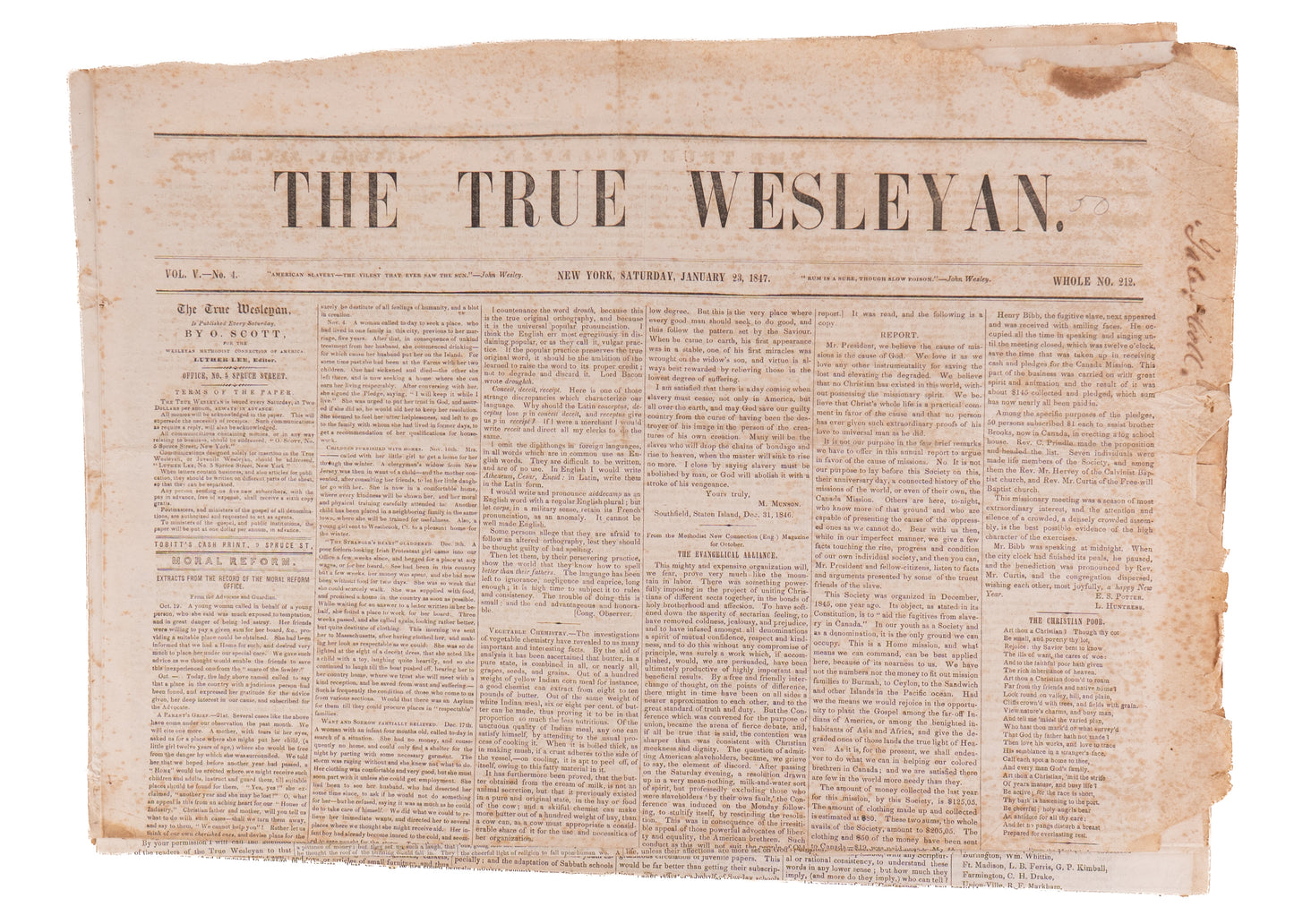
Scott, Orange [Ed.] The True Wesleyan. Vol. V. No. 4. January 23, 1847. New York. 1847.
Contents include: Extracts from the Record of the Moral Reform Office; Observations on Orthography by Noah Webster; Liberty and Slavery [Section Header]; Slavery - Cruelty - Abolition by M. Munson of Staten Island; The Evangelical Alliance; Doctrine of the Will by Asa Mahan; Entire Consecration; Revival in Worthington, Massachusetts; Great Flood in Ohio; A FEarful Tornado; Monody on the Death of George Washington by Richard Alsop; Lemuel Smith [of the Revolutionary War]; Visits among the Poor; etc.
I took my pen and went to work in describing and moralizing upon a scene I once witnessed with my own eyes. It was about 16 years ago on a pleasant Sabbath morning the state of Georgia. I was quitly seated in a large eating room of a slave-holder, who was also a minister of the Methodist church, employed reading the Bible while 3 or 4 slaves were preparing the morning meal. Among them was one female whose complexion was much the same as that of her mistress, who was in bed at the first of the preparatory breakfast scene, but who soon entered with cow-hide in hand, and yelled out at Lucretia, (th emulatto slave-mother, who happened at the time to be dressed in a low bosomed frock, which left the neck and shoulders quite bare.) She was also at the time giving suck to a young child. The mistress commenced cutting over her head and shoulders with the cow-skin, with all her might, until the great red wholks as large as one's finger, would rise up all over the poor slave's neck, and the poor creature screaching at every blow, "Oh! don't Misses, oh don't Misses," but she dared not resist, not with the weight of one finger. etc.,
Good with pages turned and torn with minor losses at foredge. One loss at rear corner just affecting a few words.
Scott, Orange [Ed.] The True Wesleyan. Vol. V. No. 7. February 13, 1847. New York. 1847.
Contents include: A Mountain Hymn; Church and State; Christ at the Door; Letter from the American Peace Society to the Senate and House of Representatives on the Mexican-American War; Revival on the Leesburgh Circuit; Proceedings of the 29th Congress; Terrible Disaster in aboard the Steamboat Tuscaloosa; Slavery in the Methodist Protestant Church; Criticism on I Tim. VI. 1, 2 by R. Westcott [Used to Justify Slavery; Extensive and Important Exegetical Treatment].
Interesting account of a dream where Christians were engaged in human traffic. Some were seen manufacturing chains for human limbs, others manufacturing whips and other instruments of torture. One was seen engaged in a wholesale deal in human beings, others were retailers, and other buyers and consumers. One was seen with his hand hold of the throat of his fellow Christian, another was seen dragging a wife away from her husband, another was seen tearing an infant from its mothers arms that he might sell it for a dollar, and render the mother the more marketable. Many were seen with their fellow Christians tied up helpless, while they were torturing them with whips until their flesh was raw and gory. All these, of portions of all these, professed to be very godly, and prayed to God every night and morning, and were very orthodox in their respective creeds. The dream goes on and waking up he concludes he had been dreaming of the [evils of the] Evangelical Alliance.
Good, stained at extremities, tear and folds, minor losses at inner hinge.
Scott, Orange [Ed.] The True Wesleyan. Vol. V. No. 8. February 20, 1847. New York. 1847.
Contents include: The Title Reverend; Justification and Regeneration; Systematic Benevolence; Account of Bishop Hedding's Changing Views of Slavery; Proceedings of the 29th Congress; An Awful Conflagration in Ripley, Ohio; Primitive Church's Estimate of Prayer; A Race for a Whale; The Sailor's Department; etc.
During the session of the General Conference in 1844, the Bishop went up to his present residence at Poughkeepsie, to spend the Sabbath, accompanied by several preachers who were to fill the pulpits of that city on the next day. Among these preachers was one Southern; and between him and the Bishop, the following conversation took place. Bishop. Brother, said the Bishop to the Southern preacher, do the preachers at the South generally hold slaves? Southerner. Yes, generally they do, when they are able. Some of them own a considerable number of slaves. Bishop. Brother, are you a slaveholder? Southerner. No I am not; but I should be were I able to own them. On receiving the answer, the Bishop turned to some who belonged to the company, and said, Scott was right, in saying that Southern preachers were slaveholders when they were able to be.
Good, stained at extremities, tear and folds.
Scott, Orange [Ed.] The True Wesleyan. Vol. V. No. 21. May 22, 1847. New York. 1847.
Contents include: The Methodist Episcopal Church and the Temperance Question; Inquire at Amos Giles' Distillery; The Angels Have Lent You their Voices - Address by George Jones, Chaplain aboard the U. S. Frigate Brandywine before the Hawaiian Total Abstinence Society; Personal Piety; Liberty and Slavery; The American and Foreign Anti-Slavery Society; The Christian Advocate and Journal and Slavery; The Evangelical Alliance; Later and Interesting from Mexico [Santa Anna]; Sixty Persons Poisoned by Negroes at a Wedding in Texas; The Spirit of the Age and the Rage of Fashion; Prayer for the Sailors; etc.
Good condition, tears and folds at extremities, one with minor losses at horizontal fold.
Scott, Orange [Ed.] The True Wesleyan. Vol. V. No. 24. June 12, 1847. New York. 1847.
Contents include: One Day's Entry in a Sailor's Diary; The Methodist Episcopal Church and Temperance; The Object of Christian Missions; The Prayer of Habakkuk by a Tyro; Attack on Wesleyans; From the Seat of War in Mexico; Bloody Times Ahead in Mexico; The Way Lawyers Use Females; Liberty and Slavery; Dr. Bangs on Slavery; Plan for Emancipation Urged for the Consideration of the Slaveholders and the American People [Original correspondence, with fine illustration of an anti-slavery medal - the only illustration we note in any issue]; etc.
Good with usual edge tears, folds, and stains.
Scott, Orange [Ed.] The True Wesleyan. Vol. V. No. 25. June 19, 1847. New York. 1847.
Contents include: Address to the Children of Wesleyan Methodist Sabbath Schools; The New England Anti-Slavery Convention; The New England Methodist Episcopal Church and Slavery; Rum, Law and Politics; St. Lawrence Conference Camp-Meeting; Account of the Arrival of Freed Enslaved Persons in Monrovia, Liberia and the Formation of their Constitution; Liberty and Slavery; Dr. Bangs on Slavery [Cont'd]. Slavery by E. Bradburgy [Original].
Of special note, this issue contains a full accounting from The Public Ledger of Isaac Brown's sword statement, complete with his Isaac X Brown mark in text. Also commentary on the case from the True Wesleyan.
Enslaved in Calvert County, Maryland, Isaac Brown was falsely accused in 1845 of attempting to murder his enslaver, Alexander Somerville, who had previously reneged on a promise to grant him freedom. Despite enduring severe beatings and imprisonment, Brown maintained his innocence, and the legal charges were eventually dropped due to a lack of evidence. Nevertheless, his owner retaliated by selling him away from his wife and eleven children to slave traders, who shipped him to the slave markets of New Orleans.
Brown then staged a daring escape from Louisiana and traveled over 1,200 miles through slave territory with the assistance of the Underground Railroad, eventually settling in Philadelphia under the alias Samuel. His whereabouts were discovered in 1847 after a letter intended for his family was intercepted, leading to his arrest in Pennsylvania under an extradition warrant issued by the Governor of Maryland. A high-profile legal battle followed in Philadelphia, where abolitionist lawyers and local authorities fought his extradition on technical and legal grounds, ultimately securing his release from custody. Fleeing north to escape further recapture, Brown made his way to Canada West, where he achieved permanent freedom and was eventually reunited with his family.
Good condition, usual tears and folds, small rodentia at foredge of horizontal fold resulting in minor textual loss.
Scott, Orange [Ed.] The True Wesleyan. Vol. V. No. 26. June 26, 1847. New York. 1847.
Contents include: A Concise History of the English Bible; Entire Sanctification; True Christian Love; Methodist Episcopal Ministers Sword to Obey their Bishops; The War in Mexico and its Victims; Free and Slave Labor; Camp Meeting; The Public Whipping of Marie Jones; Capture of Slavers at Kebenda; A Boy Carried Over Niagara Falls; A Few Thoughts on Slavery by Elezar Bradbury; A Scene in a Mariner's Church; etc.
Good with some tears and stains, tear and stain at horizontal fold with some minor losses toward inner margin as shown.
Scott, Orange [Ed.] The True Wesleyan. Vol. V. No. 29. July 17, 1847. New York. 1847.
Contents include: The Week-Day Prayer Meeting; The Broken-Hearted Woman; Labors of Brother Hand of the Champlain Conference; Withdrawal from the Methodist Episcopal Church Over the Hypocrisy of Sending Funds to Christianize Africa while Supporting the Enslavement of Africans in America; Shall Slaves Have the Bible?; Missionary Work among the Slaves; The Rochester Conference and Secret Societies; Moral Responsibility; Pro-Slavery Churches [and other fictions] by F. H. Roe; Liberty and Slavery; etc.
Good with tears and folds, losses at head near inner hinge, impacting headers, but not the text proper.
Defective Issues:
Scott, Orange [Ed.] The True Wesleyan. Vol. V. No. 9. February 27, 1847. New York. 1847.
Contents include: Slavery - Will Doctors of Divinity Lie? by Samuel Salsbury; Slavery - A Short Chapter of Inconsistencies by P. P. Winslow; War, Tobacco, Rum, and Slavery; A Notice of a Millerite "Come-Out-Er," etc.,
Fair only with loss at horizontal fold ot margin, largely impacting less significant content. All articles mentioned above are complete.
Scott, Orange [Ed.] The True Wesleyan. Vol. V. No. 10. March 6, 1847. New York. 1847.
Contents include: On Slavery and its Existence in the Methodist Episcopal Church North; Resurrection of Conscience; The Sailors' Department; Liquors and the License Law; Michigan Circuit - Grand Rapids Conference; Liberty and Slavery; Dr. Bangs on Slavery [Cont'd]; Evils Consequent Upon Slavery; War and Anti-Slavery by John A. Gibson; Reasons for Secession from the Methodist Episcopal Church; The Sabbath School; The Slave Trade with Woodcut; White Boys Reproved by an Indian; etc.
Fair only, losses at horizontal fold to the first column of text; all articles mentioned above textually complete and not impacted.
Scott, Orange [Ed.] The True Wesleyan. Vol. V. No. 19. Mary 8, 1847. New York. 1847.
Contents include: Christ Deserves All; War and Peace; Liberty and Slavery; The M. E. Church and Slavery; We Ought to Obey God Rather than Man on the Issue of Slavery [Regarding the Constitution's Allowance for Slavery]; Prospects in the West; Testimony of Wesleyans Against the War and the Illumination; A Horrible Murder at Port Gibson, Mississippi; The First Crime - A Tale of the Irish Famine by Elizabeth W. Tracy; Fruits of the City Tract Society; American Seamen; etc.
Fair, with losses and tears at horizontal fold, especially impacting the column closest to the fold. All articles listed unaffected by losses.
Scott, Orange [Ed.] The True Wesleyan. Vol. V. No. 34. August 21, 1847. New York. 1847.
Contents include: Does the Old Testament Inculcate Benevolence? No Liberty to Secede where Minister's Support Withheld; Service Commemorative of the Death of Rev. Orange Scott; Elihu Burritt and the Liberty Party; Slavery - A Dream [Original Poem]; Philosophical View of the Nature and Extent of the Moral Law; Liberty and Slavery; etc.
Fair with stains and tears at folds, one diamond shaped 1.5 x 2 inch rodentia loss at horizontal fold impacting the column closest to the vertical fold. No articles mention have suffered loss.
Scott, Orange [Ed.] The True Wesleyan. Vol. V. No. 36. September 4, 1847. New York. 1847.
Contents include: Secret Societies; The Believer's Oneness in Christ; Moral and Political Action; A Visit to Shakerdom, or New Lebanon; Three Days Later from Mexico; The Young Victim - A Sad Story of Gambling; Apprenticeship and the New Slavery in Jamaica; Answers to Prayer; etc.
Fair only with diamond shaped loss where horizontal and vertical folds meet impacting text in the column closest. No content mentioned above impacted.
Share