Specs Fine Books
1850 FUGITIVE SLAVE ACT. Frederick Douglass Elicits a Defense of the Fugitive Slave Act by Boston Conservatives.
1850 FUGITIVE SLAVE ACT. Frederick Douglass Elicits a Defense of the Fugitive Slave Act by Boston Conservatives.
Couldn't load pickup availability
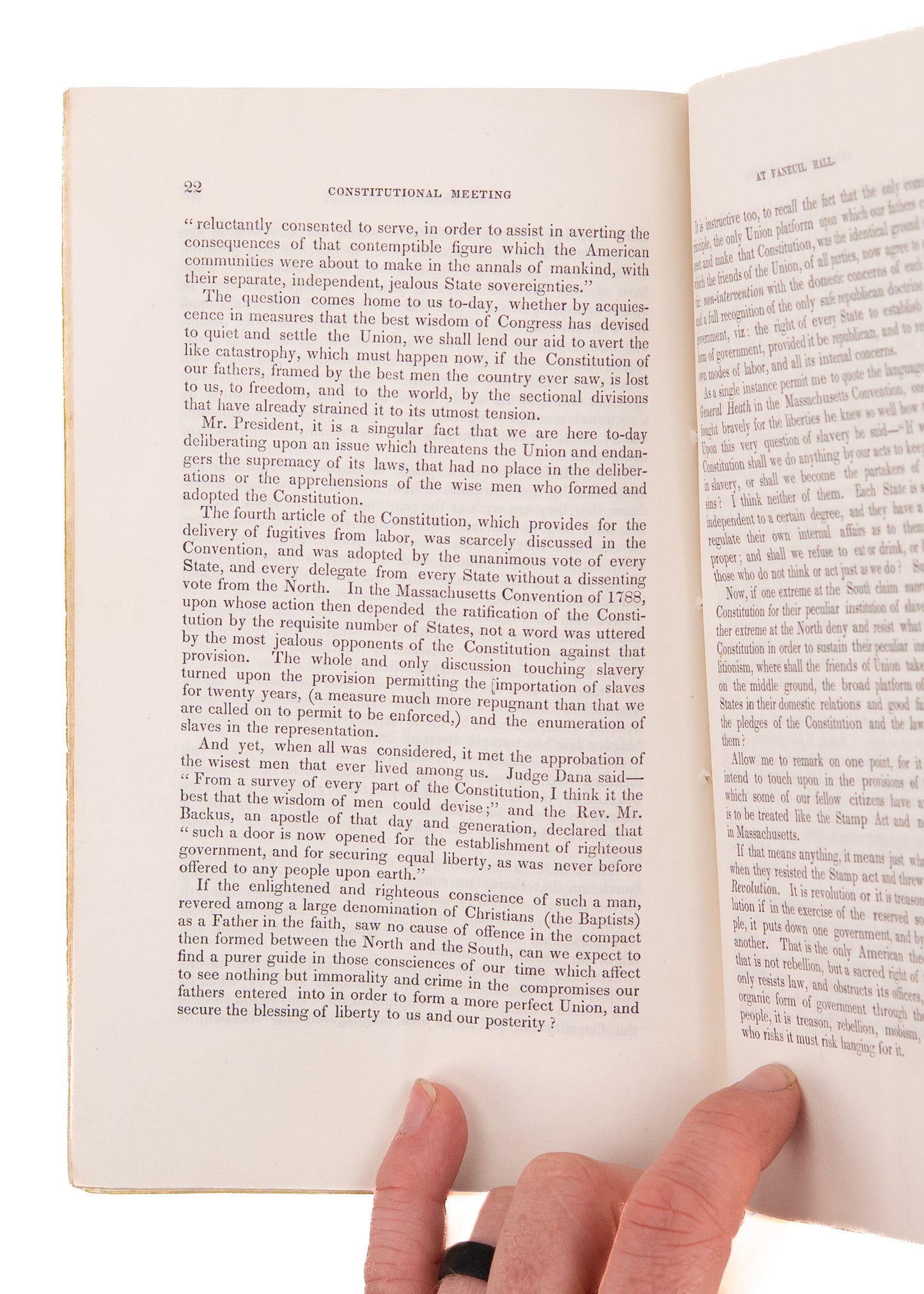
A very finely preserved report of the proceedings of the November 26th, 1850 "Constitutional Meeting" at Faneuil Hall designed to exert pressure on the abolitionists of Boston to accept the “bloodhound laws” of the same year.
The Fugitive Slave Law, signed into law on September 18, 1850 by President Millard Fillmore, had dramatic ramifications across the country, including in Boston. It was part of the broader Compromise of 1850, which provided far more interventionist tools to enslavers to recapture freedom seekers, and all with the full backing and support of the Federal Government.
Boston was already a hotbed of abolitionism, some of it militant. The passage of the Fugitive Slave Act was too much. In early October 1850, Black Bostonians met in the African Meeting House in protest of the new law and called upon their white allies to gather with them at Faneuil Hall to plan their collective response. On October 14, nearly five thousand people rallied at Faneuil Hall against the law, with none other than Frederick Douglass rousing the crowd.
The location of the counter-meeting, recorded here, was not accidental. It was a direct response to Frederick Douglass' speech thundered out from the same location just six weeks earlier.
The Constitutional Meeting was convened by Boston's conservative, pro-Union establishment to push back against the abolitionist tide and endorse the Compromise of 1850, including the hated Fugitive Slave Law, as a constitutional necessity to preserve the Union.
The name itself, the "Constitutional Meeting," was a deliberate rhetorical claim. The organizers were asserting that their position was the legitimate, law-abiding, constitutionally faithful one, in direct contrast to the abolitionists, who were portrayed as dangerous radicals willing to tear the nation apart.
The proceedings included a speech by Rufus Choate titled "Preservation of the Union," which perfectly captures the meeting's purpose. Choate was one of the era's most celebrated lawyers and orators, a leading Massachusetts Whig, and an ally of Daniel Webster, whose own infamous "Seventh of March" speech earlier that year had endorsed the Compromise and cost him dearly among antislavery New Englanders.
[Fugitive Slave Act, Dred Scott] Proceedings of the Constitutional Meeting at Faneuil Hall, November 26th, 1850. Boston. Printed at No. 21 Water Street by Beals & Greene. 1850. 46pp.
Unusually well preserved in original yellow wraps. A vertical soft fold as shown with minor stains to wraps. Very clean and sound.
Share