Specs Fine Books
1852 ALTERNATIVE MEDICINE. Female Medical Pioneers, Native American Herbalism, &c.
1852 ALTERNATIVE MEDICINE. Female Medical Pioneers, Native American Herbalism, &c.
Couldn't load pickup availability
The Eclectic Journal of Medicine sits at a fascinating crossroads in American medical history. The early 1850’s were the peak years of the "Eclectic" medical movement; a reform school that arose in direct opposition to regular medicine, which was dominated by aggressive interventions like bloodletting, mercury purges (calomel), and tartar emetic. Eclectics drew heavily on botanical remedies, many derived from Native American plant knowledge, and positioned themselves as a more humane alternative. Rochester, New York was an apt home for such a journal: the city was a hotbed of reform movements in this era; abolitionism, women's rights, Spiritualism, hydropathy, and health reform all flourished there simultaneously.
The journal is also notable for its explicit engagement with the broader landscape of competing medical systems. You can see this in articles like On the Comparative Merits of Different Medical Systems, Eclecticism and Homeopathy, Allopathy and Patent Medicines, and the pointed Did the Lord Take Him or Did the Doctor Send Him? which was a common reformist rhetorical attack on regular medicine's mortality rates. The journal was not merely a clinical publication; it was a polemical organ in an active medical culture war.
Significant articles include:
Hydropathy for Females by Mrs. L. F. Fowler, and a further cluster of articles on Female Medical Colleges, On Medical Training for Women, and The Female Medical Movement, taken together, represent one of the most consequential debates in nineteenth-century American medicine. Lydia Folger Fowler was a towering figure: in 1850 she became only the second woman to receive a medical degree in the United States, graduating from the Eclectic Central Medical College in Rochester. Her presence as an author here is not incidental; the Eclectic movement was, far more than regular medicine, hospitable to women practitioners.
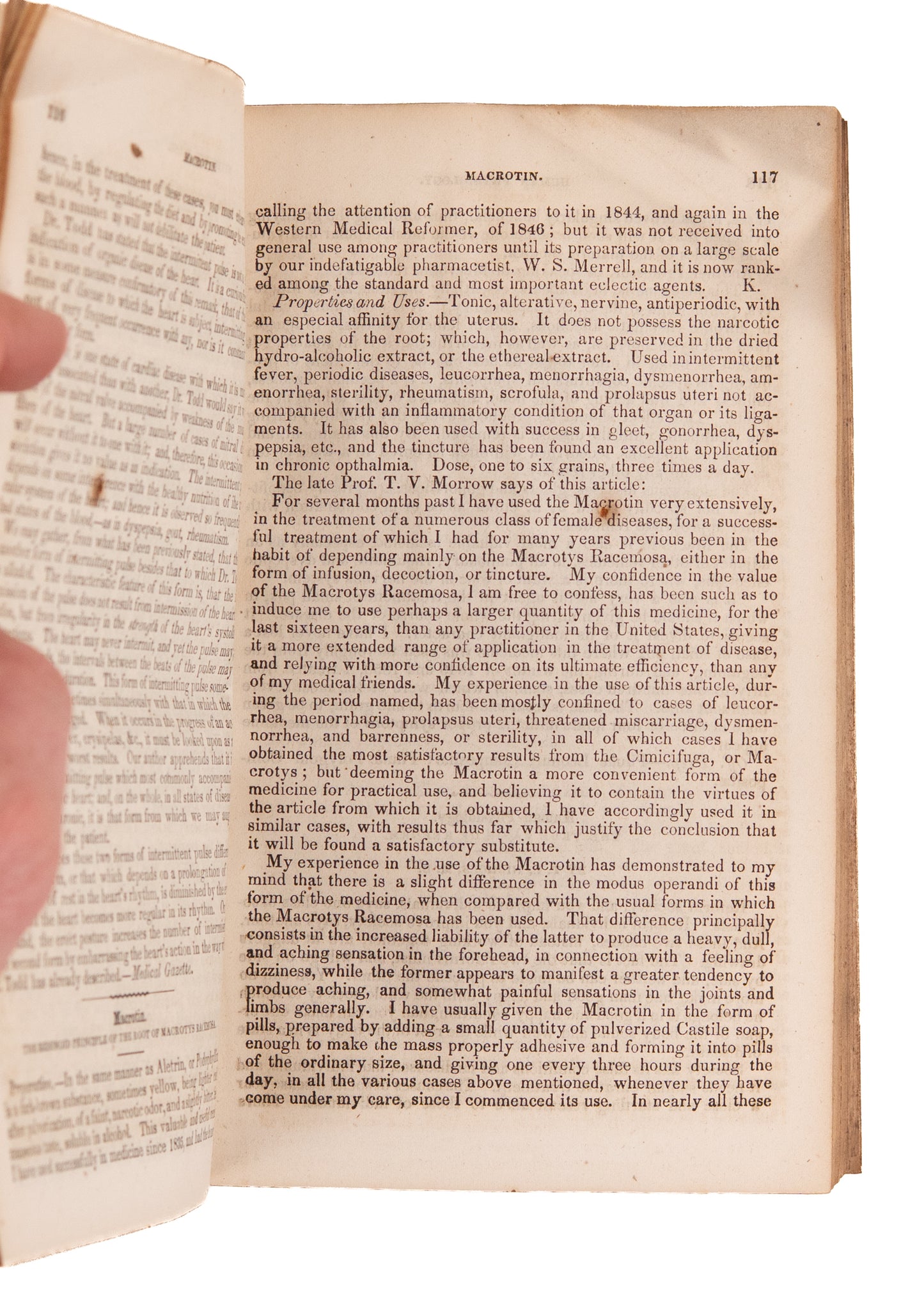
The articles on botanical resinoids, specifically Macrotin: The Resinoid Principle of the Root of Cimicifuga Racemosa (the plant listed as Macrotys Racemosa, now known as black cohosh) and The Resinous Principle of Leptandra Virginica, are of considerable pharmacological and historical interest. The Eclectic physicians of the 1840s and 1850s were pioneers in isolating what they called "resinoids" or "concentrated medicines" from botanical plants, and cimicifuga racemosa in particular has had an extraordinary afterlife.
Detection of Mercury in the Body of a Person Dying of Mercurial Cachexy stands out as perhaps the most medico-legally and scientifically forward-looking piece in the issue. The detection of heavy metals in cadaverous tissue was a new and contested forensic science in the 1850s, closely tied to the development of toxicology as a discipline following figures like Mathieu Orfila in France. For an Eclectic journal, the article also served a polemical purpose: mercury (as calomel) was the signature weapon of “regular” medicine, and documenting its lethal accumulation in the body was simultaneously a scientific and a rhetorical act. It sits at the intersection of emerging forensic chemistry, medical politics, and the broader public debate about whether regular physicians were poisoning their patients, a debate this journal was actively prosecuting, as titles like Profuse Salivation and Sloughing Caused by Three Small Doses of Mercury and Mercury in Syphilis make clear.
Contents include: A New Method of Reducing Dislocation of the Femur by Professor L. C. Dolley; Phosphate of Lime in Scrofula and other Depraved States of the System by W. Stone; Allopathy and Patent Medicines; Eclectic Physicians; Urino-Pathology by L. Oldshue; Synopsis of the Proceedings of the Annual Convention of the Eclectic Medical Society of New York; Hydropathy for Females by Mrs. L. F. Fowler; Consumption and its Treatment by Ira Warren; On the Diagnostic Value of Pains in the Head by David Nelson; Female Medical Colleges; On Medical Training for Women; On Intermitting Pulse by Dr. Todd; Macrotin - The Resinoid Principle of the Root of Macroty's Racemosa; On being Buried Alive; Detection of Mercury in the Body of a Person Dying of Mercurial Cachexy; On the Influence of Agricultural Pursuits on the Health by C. H. Cleaveland; Opiates for the Use of Tramautic Injuries; The Resinous Principle of Leptandra Virginica; The Fibrinous Element of the Blood in Relation to Disease by B. W. Richardson; A Remarkable Case of Foreign Bodies in the Stomach and Duodenum - Complete Obstruction of the Bowels and Mechanical Displacement of Organs by John Marshall; A Remedy for Neuralgia by Ariel Hunton; Bloodletting and Tartar Emetic in Inflammation of the Lungs; Active Principle of Ambrosia Elatior by W. Elmer; Epidemic Enteric Fever; Cases of Acute Rheumatism Cured by Lemon Juice; Crying Weeping and Sighing; The Itch Cured in Two Hours; The Female Medical Movement; Active Principles of the Rhus Glabrum; On the Comparative Merits of Different Medical Systems; On Bandaging the Abdomen after Delivery of a Child; On the Various Alvine Discharges in Children; Treatment of Internal Hemorrhoids; Treatment of Aphonia by Stimulating Inhalations; Electric Commotion Produced by the Cat and Cow; Killing, not Murder; Eclecticism and Homeopathy; On Pus in the Urine; Panama Fever; On the Character of the Physician [series]; Superiority of Eclectic over Allopathic Treatment; On the Natural Treatment of Epilepsy; Cases of Fractured Skull with Loss of Brain; Reproduction of Lactation; Influence of the Imagination of the Mother upon the Fetus; Varieties of Suicide; Sympathies of the Mind with the Body; Profits of Quackery; Did the Lord Take Him or Did the Doctor Send Him? The Treatment of Dysentery; Dry Cupping; Accidental Hirsute or Hairy Growths; Chloroform in Obstruction of the Bowels from Spasms; Cholera; Tobacco Chewing among Boys; Treatment of Laudanum Poisoning [by electricity]; Expulsion of Tape Worm with Pumpkin Seeds; Mercury in Syphilis; The Physical Effects of Pork and Swine's Flesh; Vaginal and Rectum Specula; Blood-Letting; Profuse Salivation and Sloughing Caused by Three Small Doses of Mercury; New Method of Filling Teeth Over Exposed Nerves; On the Treatment of Gonorrhea; etc. etc.
Reuben, L. & L. C. Dudley. Editors and Publishers. Eclectic Journal Medicine, Designed for Popular and Professional Reading. January 1852 to January 1842. Rochester. A. Strong & Co. Printers, Democrat Office. 1852. 524pp.
Fair only, no binding, textually solid and complete, light mildew at prelims and rears, some staining. A few miscellaneous issues bound in the rear, not included in cataloging. The January to January 1852-1853 run complete.
Share