Specs Fine Books
1855 A KNOW-NOTHING MANIFESTO. Rare Nativist Work Against Emigrant Suffrage, Catholics, and Naturalization.
1855 A KNOW-NOTHING MANIFESTO. Rare Nativist Work Against Emigrant Suffrage, Catholics, and Naturalization.
Couldn't load pickup availability
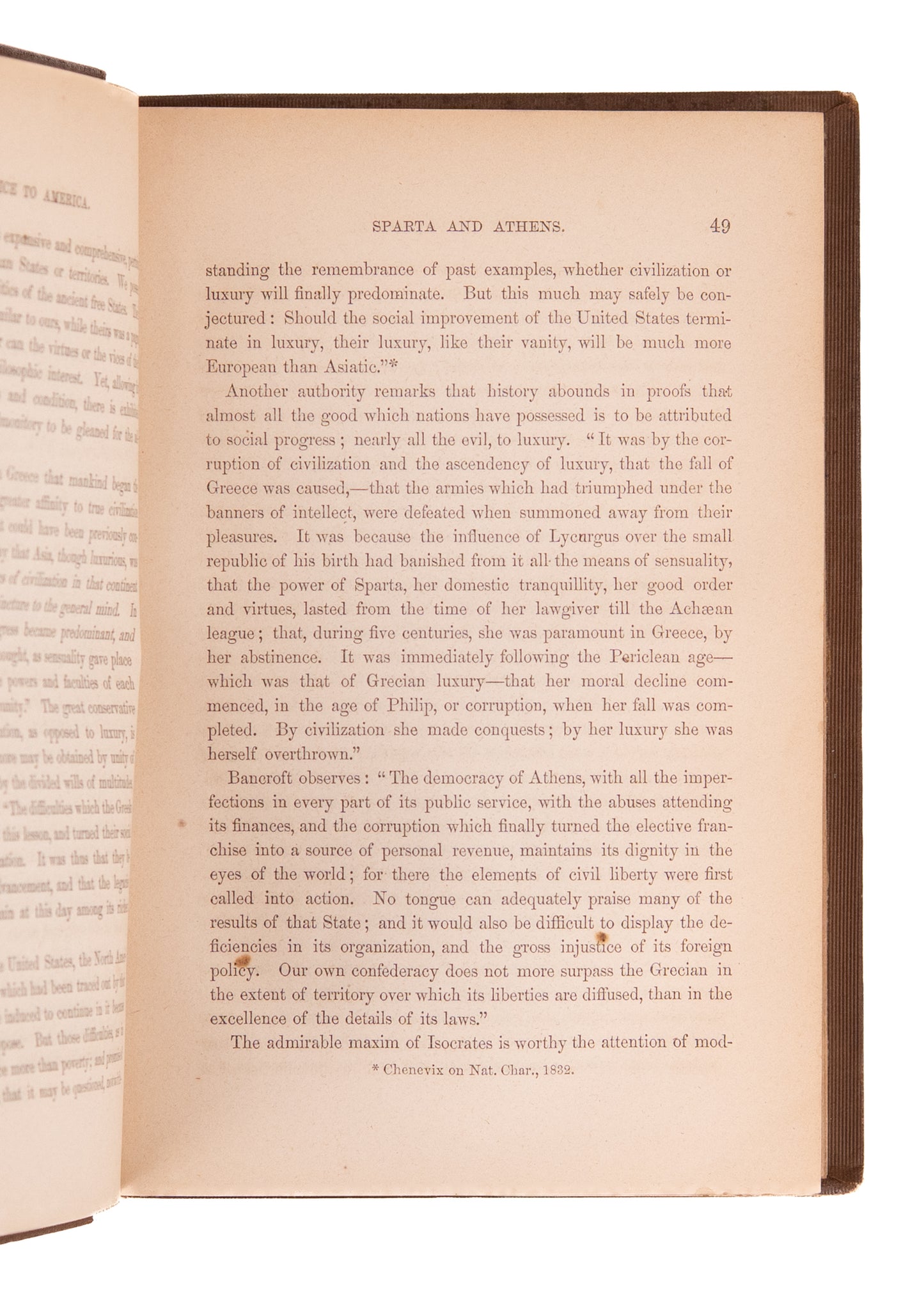
Exceptionally scarce on the market today, A Voice to America (1855) is a highly significant work which served at its publication as a manifesto for emerging mid-19th-century American nativism.
Published anonymously by Edward Walker but compiled and written by notable literary figures Thomas Bangs Thorpe and Frederick Saunders, the book was designed to provide an intellectual, historical justification for the platform of the Know-Nothing Party, officially known as the American Party.
By 1855, the Know-Nothing movement had exploded from a secretive network of fraternal societies into a major national political force. A Voice to America was published to elevate the party's populist, anti-immigrant, and anti-Catholic rhetoric into a serious, philosophical treatise. It attempted to move the movement past its reputation for street brawls and political secrecy by presenting its ideas as essential safeguards for the republic.
The book relies on a sweeping comparative historical narrative to argue that the United States was at a breaking point. It analyzes the fall of ancient Rome, the Italian republics of the Middle Ages, and contemporary Latin American states, arguing that their collapses were caused by "moral decay," "foreign influence," and the subversion of religious liberties.
A significant focus of the text is the alleged incompatibility of Roman Catholicism with republican governance. It frames the growing population of Irish and German Catholic immigrants as an existential threat loyal to the Pope rather than the U.S. Constitution. It argues that American freedom, by contrast, is uniquely tied to Anglo-Saxon Protestant traditions, using the Bible as a political symbol of national identity.
Underscoring the text’s direct ties to the Know-Nothings, the table of contents reads like a checklist of the American Party's 1855 legislative goals, framing them as urgent necessities to prevent "the Fall of the Model Republic.”
The book argues against immediate voting rights for immigrants and promotes a dramatic extension of the naturalization period, expanding it from 5 to a whopping 21 years. They proposed banning "military organizations exclusively of foreigners." But they were against everything. They also defended secret societies, important given the party’s own clandestine origins. They claimed they were a necessary "abuse-resistant" tool to fight entrenched political corruption. The work also intentionally evades slavery. Issued just one year after the highly volatile Kansas-Nebraska Act (1854) shattered the Whig party, A Voice to America represents a deliberate effort by conservative unionists to shift national anxieties away from sectionalism and the expansion of slavery. The authors sought to unite Northern and Southern white voters against a shared "foreign threat" instead of letting the country fracture over the issue of “negro enslavement.”
The present the copy of James Gordon Bennett [1795-1872], founder of the New York Herald.
Scarce on the market, with no copies in the trade at the time of cataloging and offered just twice at auction; once in 1902 [Bangs] and then in the mid-1970's [MacManus].
Anon. [Attr. Thomas Bangs Thorpe]. A Voice to America; Or, The Model Republic, Its Glory, or Its Fall: With a Review of the Causes of the Decline and Failure of the Republics of South America, Mexico, and of the Old World; Applied to the Present Crisis in the United States. New York. Edward Walker. 1855. 404pp.
Good + with breach to cloth at top of front hinge, now neatly relaid. Cloth a bit faded, but well preserved, including the elaborate gold-foil inlay on the front board. Generally solid and clean with only light foxing.
Share