Specs Fine Books
1858-1861 EAST SUFFIELD DEBATE SOCIETY. Young Men Debate Slavery, Secession, and Then Join the Civil War.
1858-1861 EAST SUFFIELD DEBATE SOCIETY. Young Men Debate Slavery, Secession, and Then Join the Civil War.
Couldn't load pickup availability
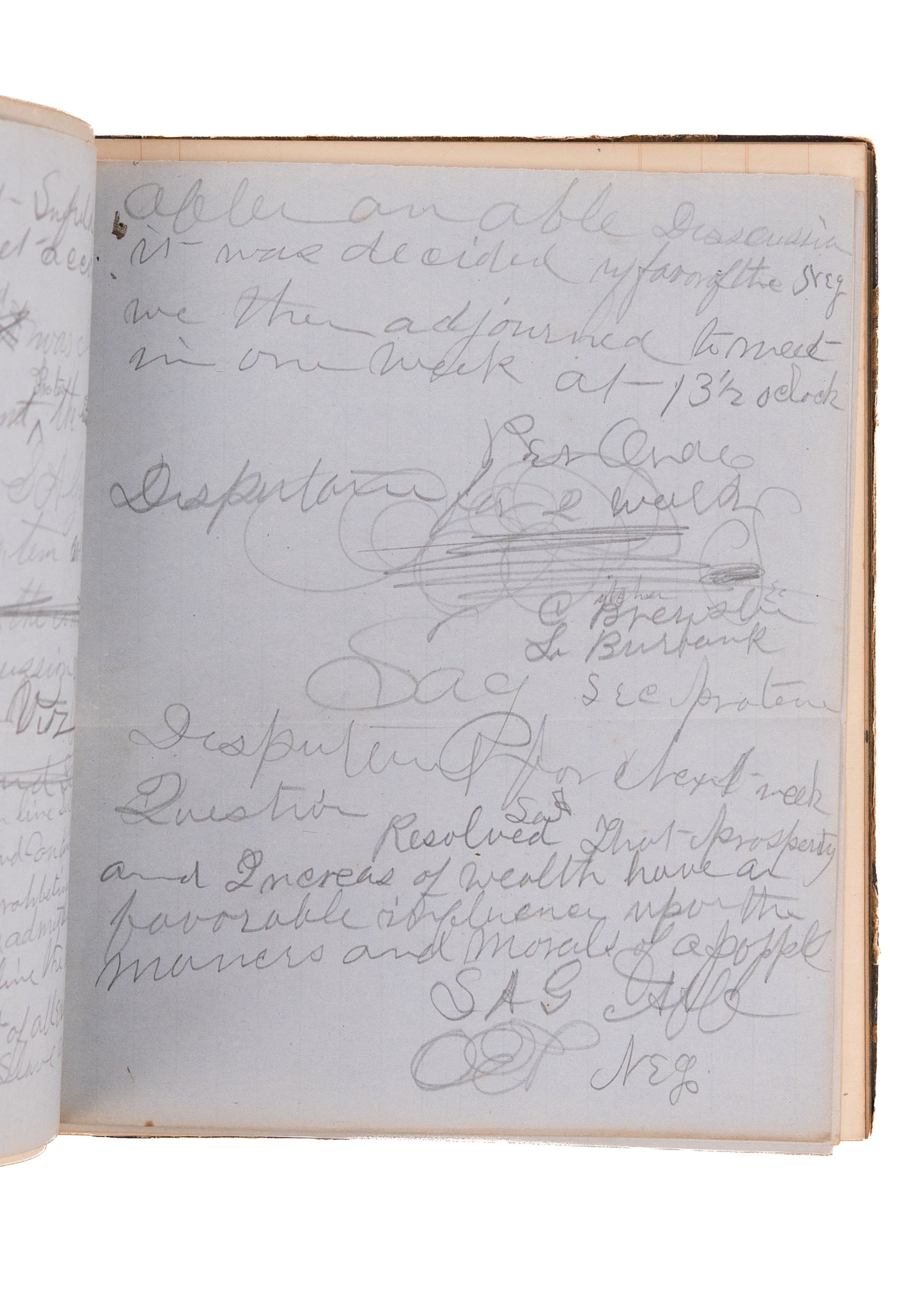
A fascinating pre-Civil War artifact, being the complete constitution and diary of the "East Suffield Debating Society" running from December of 1858 through February of 1861 and including their Constitution.
After the opening few pages detail the organizations constitution, it is signed by the members, including, Orville Douglass, Charles Allen, J. N. Allen, J N. Saunders, Joel Sperry, C. A. Adams, A. S. Burbank, Jonathan Corser, M. D. Ivey, O. S. Douglass, S. Burbank, C. Brewster, D. Beele, Watson W. Pease, Husted Burbank, Erastus Hemingway, Willis S. Adams, Sherwood A. Burbank, Oscar E. Pitcher, Sanford A. Griswold. [Each sign their own names].
Willis Seaver Adams, later an important New England impressionist, seems to have served as Secretary for most of the document, with some meetings recorded by Oscar E. Pitcher.
These young men, many from prominent local familes, have gathered together on a regular basis to debate, and they chose the most significant issues of the time. Their debates include:
*Resolved that, it is desirable that Cuba be annexed to United States. Decided in the Affirmative.
*Resolved that the signs of the times indicate a speedy dissolution of this Union / Federal Government. Decided in the Negative.
*Resolved that Capital Punishment ought to be abolished. Decided in the Negative.
*Resolved that the right of Suffrage ought to be extended to the Negro. Decided in the Affirmative.
*Resolved that the United States would be justified in interfering to preserve the individuality of nations. Undecided in the first session, and in the Negative during the Second.
*Resolved that a protection tariff is necessary for the industry of the United States. Decided in the Affirmative.
*Resolved that the intoxicating liquors has been a greater curse to the people of the United States than slavery. Decided in the Negative.
*Resolved that Armed Resistance to this Government is never justifiable. Decided in the Negative.
*Resolved that War has been the cause of more evil than benefit to mankind. Decided in the Affirmative.
*Resolved that Privateering ought not to be countenanced by any Nation. Decided in the Negative.
*Resolved that the insurrection at Harper's Ferry is or will be as much benefit as evil to the people of the United States. Decided in the Negative.
*Resolved that the negro slaves of the United States is deserving of more sympathy than the Indians of the United States. Decided in the Negative.
*Resolved that Foreigners should not be allowed to vote until they have lived in this country twenty one years. Decided in the Negative.
*Resolved that it would be for the benefit of the Country that slavery should be abolished from the United States. Decided in the Affirmative.
*Resolved, that it is right to encourage and assist Slaves in escaping from Slavery. Decided in the Negative.
*Resolved, that woman exert a greater influence over the Country than man. Decided in the negative.
*Resolved, that married life has more enjoyment than single life. Decided in the Negative.
*Resolved, that Women ought to have the vote. Undecided.
*Resolved, that none of these States has a right to withdraw from the United States to form another Government of their own distinct formation. Decided in the Affirmative.
*Resolved, that the United States have arrived at teh Zenith of their prosperity. Decided in the Negative.
*Resolved, that South Carolina hs reasons or causes which would justify her in Secession. Decided in the Negative.
*Resolved that the Mason and Dixon line so-called ought to be reestablished and continued to the Pacific Coast, prohibiting slavery North of said line and admitting slavery South of said line the same to be a fair settlement of the existing difficulties between teh slave and free states. Decided in the Negative.
*Resolved, that a Monarchial form of Government is preferable to a Republican form of Government. Decided in the Negative.
*Resolved that the Crittendon Compromise ought to be adopted. Decided in the Negative.
But by early 1861, it became evident their monthly meetings would be traded for munitions and military service. Nearly all of the young men were mustered.
*Watson W. Pease. Enlisted as a Private on August 22, 1862, in Company G, 22nd Connecticut Infantry Regiment. The 22nd Connecticut was a nine-month regiment raised largely out of Hartford County. Pease mustered in on September 20, 1862, and served through the duration of the regiment's term in Virginia (including defense duties around Washington, D.C. and the Siege of Suffolk), mustering out safely on July 7, 1863.
*Sherwood A. Burbank. Enlisted in Company D, 22nd Connecticut Infantry Regiment. Mustered in alongside fellow Suffield residents in September 1862. Served out his nine-month enlistment performing garrison and outpost duties in Virginia before mustering out in July 1863.
*Husted Burbank. Enlisted in Company G, 22nd Connecticut Infantry Regiment. Part of the extended Burbank family of Suffield that saw multiple members answer the call for volunteer regiments during the 1862 draft/enlistment drives. Mustered out with the 22nd Connecticut in July 1863.
*Sanford A. Griswold. Served as a Private in Company G, 22nd Connecticut Infantry Regiment. Mustered in on September 20, 1862, and served his nine-month term near Washington and Norfolk/Suffolk, Virginia.
*Oscar E. Pitcher. Enlisted in Company G, 22nd Connecticut Infantry Regiment. Served as a private during the 1862–1863 campaign of the 22nd Connecticut Volunteers.
*Orville S. Douglass. Enlisted in Company G of the 22nd Connecticut Infantry in September 1862, serving out his term through July 1863.
*Abial S. Burbank served in the 22nd Connecticut Infantry (Company G).
55pp with writing. A fascinating item.
Share