Specs Fine Books
1860 VIRGINIA JOINS CONFEDERACY. John Brown and Harper's Ferry Attack Cause Virginia to Join Confederacy.
1860 VIRGINIA JOINS CONFEDERACY. John Brown and Harper's Ferry Attack Cause Virginia to Join Confederacy.
Couldn't load pickup availability
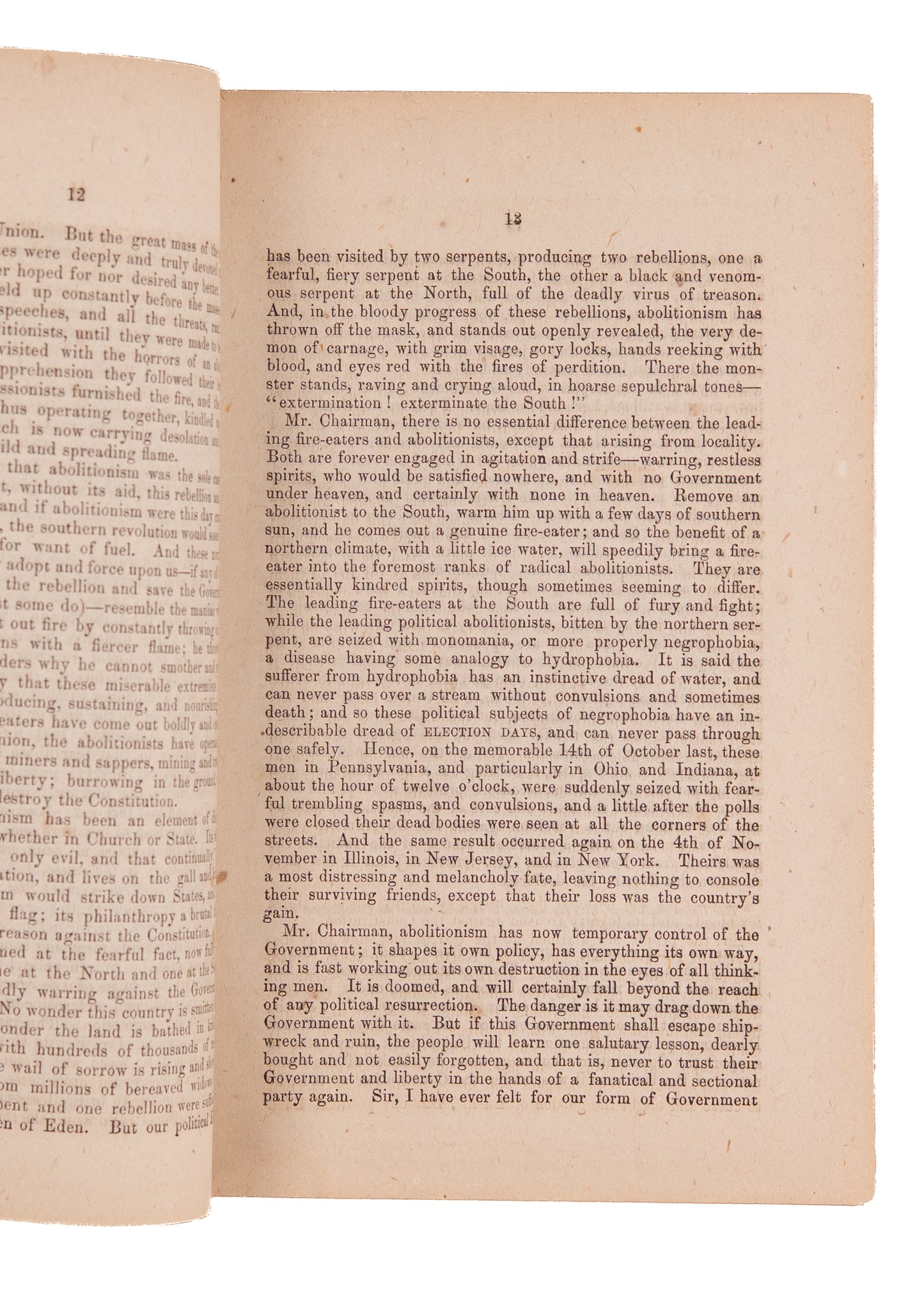
An important speech which nudged Virginia toward alignment with the formation of the Confederacy as a direction reaction to the events at Harpers Ferry. John Brown’s attempt to spark a violent slave uprising shattered the comforting Southern belief that Northern abolitionism was merely political rhetoric. To Virginia’s slaveholding elite, Harpers Ferry was tangible proof that radical abolitionists, backed by broader Northern political sympathy, were actively plotting armed invasions of the South. Rutherfoord, a committed pro-slaver, leveraged this heightened sense of existential vulnerability to argue that Virginia could no longer rely on federal protections or isolated state action. By advocating for a "Conference of Southern States," Rutherfoord was urging Virginia to organize a united Southern defensive front to coordinate security, economic independence, and political solidarity against perceived Northern aggression. His speech shifted the debate in Richmond from whether the North posed a physical threat to how the South should collectively organize to combat it, laying the groundwork for the Confederacy.
In early 1860, Virginia was still dominated by conditional Unionists who hesitated to dismantle the nation. Rutherfoord’s speech acted as a key instrument in eroding that moderate middle. By framing the crisis as an unyielding conflict between free-state aggression and slave-state survival, speeches like Rutherfoord's normalized the concept of Southern inter-state cooperation, a crucial prerequisite for confederation. While Virginia initially rejected immediate secession in early 1861, the rhetoric and arguments laid out by figures like Rutherfoord in early 1860 had already conditioned the state's political infrastructure to view the Deep South as Virginia's natural allies. Consequently, when Abraham Lincoln called for military volunteers following the firing on Fort Sumter in April 1861, the ideological framework for collective Southern resistance that Rutherfoord had championed a year earlier triggered Virginia's swift vote to secede and join the newly formed Confederate States of America.
No copies recorded in the auction history and none in the trade at the time of cataloging.
[John Brown, Harper's Ferry, Confederate Government] Rutherford, John C. Speech of John C. Rutherford, of Goochland, in the House of Delegates of Virginia, 21 February, 1860, in Favor of the Proposed Conference of Southern States. Richmond. Wm. H. Clemmitt, Printer. 1860. 27pp.
Good to good - in original pamphlet form. Unsewn, but generally clean and tidy with some minor handling and foxing, a few closed tears.
Share