Specs Fine Books
1862 REPORT ON EMANCIPATION. Abraham Lincoln Attempts to Push Colonization - Gets Rebuked by Frederick Douglass.
1862 REPORT ON EMANCIPATION. Abraham Lincoln Attempts to Push Colonization - Gets Rebuked by Frederick Douglass.
Couldn't load pickup availability
The 1862 Report of the Select Committee on Emancipation and Colonization is truly a definitive primary document capturing the transition point in Abraham Lincoln and the Union's policy between gradual, compensated emancipation tied to "voluntary" foreign colonization and the ultimate adoption of uncompensated, immediate abolition.
Issued by the U.S. House of Representatives in July 1862, the report represented the high-water mark of official federal support for colonizing freed Black Americans outside the United States, advocating for controlled emigration to places like Central America, the Caribbean, and Africa [Liberia] as the primary solution to racial tension and post-slavery integration.
For Abraham Lincoln and moderate Republicans in mid-1862, colonization served as a necessary political stepping stone. Lincoln used the concept of voluntary, federally funded colonization to make the radical idea of emancipation [not total, but in the context of colonization] palatable to conservative Northern voters and border-state slaveholders who feared white labor competition and social upheaval. The document underscores how, in 1862, the federal government still largely viewed emancipation not as a standalone moral mandate, but as a dual policy paired with voluntary removal. Intriguingly, the report’s appendix included writings by Black leaders like Martin Delany, attempting to co-opt early Black nationalism and emigration movements to validate federal colonization schemes.
The aggressive colonization campaign the Report represented sparked immediate and fierce resistance from African American leaders, most notably Frederick Douglass. Douglass, along with prominent Black activists like Robert Purvis and John Mercer Langston, vigorously condemned the report’s foundational premise that Black and white Americans could not live together as equals. Douglass denounced government-sponsored colonization as a racist distraction that blamed the victim of slavery rather than the institution itself, arguing passionately that Black Americans were native-born citizens who had earned their right to full birthright citizenship and equality through their labor and allegiance to the Union.
In response, Frederick Douglass publicly rebuked Lincoln as follows, The President of the United States combines the qualities of a genuine Western slanderer with the ridiculous position of an itinerant colonization advocate. He asks the colored people to sell their birthright for a mess of pottage, and go off to a central American wilderness to found a colony for the benefit of the United States... Mr. Lincoln assumes the language and arguments of an itinerant Colonization lecturer, showing all his inconsistencies, his pride of race and his contempt for the Negro... He says to the colored people: 'You should sacrifice something of your present comfort for the purpose of being as grand in that respect as the white people.' ... This is cheap advice. It is the advice of a man who has never known what it is to be a slave, or to suffer from the prejudice which slavery has engendered.
Douglass continued his response to the Report, The native land of the American Negro is America. His bones, his muscles, his sinews, are all American. His ancestors for two hundred and seventy years have lived, and labored, and died on American soil, and millions of his posterity have inherited Caucasian blood... Banish the idea that one class must rule over another. Recognize the fact that the rights of the humblest citizen are as worthy of protection as are those of the highest, and your problem will be solved.
Robert Purvis responded, It is contemptible to see the President of the United States asking us to leave the country of our birth, and go to Central America, to make room for white men... Sir, this is our country as much as it is yours, and we will not leave it. We were born here, our ancestors fought for its independence, and we will stay here and fight for its preservation, and demand our rights as citizens.
And the Anglo-African [Newspaper], Thomas Jefferson said that 'he trembled for his country when he remembered that God was just.' We tremble for Mr. Lincoln when we read his speech to the colored deputation... We are citizens of the United States, and we intend to remain such. This is our country, bought with our blood, enriched by our labor, and fertilized by our tears. We will not leave it to satisfy the demands of a cruel prejudice.
The practical failure of colonization schemes outlined in documents like this report, combined with the unyielding pushback from Black leaders and Radical Republicans, played a pivotal role in shifting Lincoln's policy. By late 1862, Lincoln recognized that colonization was logistically unfeasible, politically divisive among his core supporters, and rejected by the very people it claimed to help. As Black Americans increasingly fled to Union lines and enlisted in the military, the paradigm shifted from removing freedpeople to integrating them into the war effort as soldiers and citizens.
No copies at auction since the early 1980's and none in the trade at the time of cataloging.
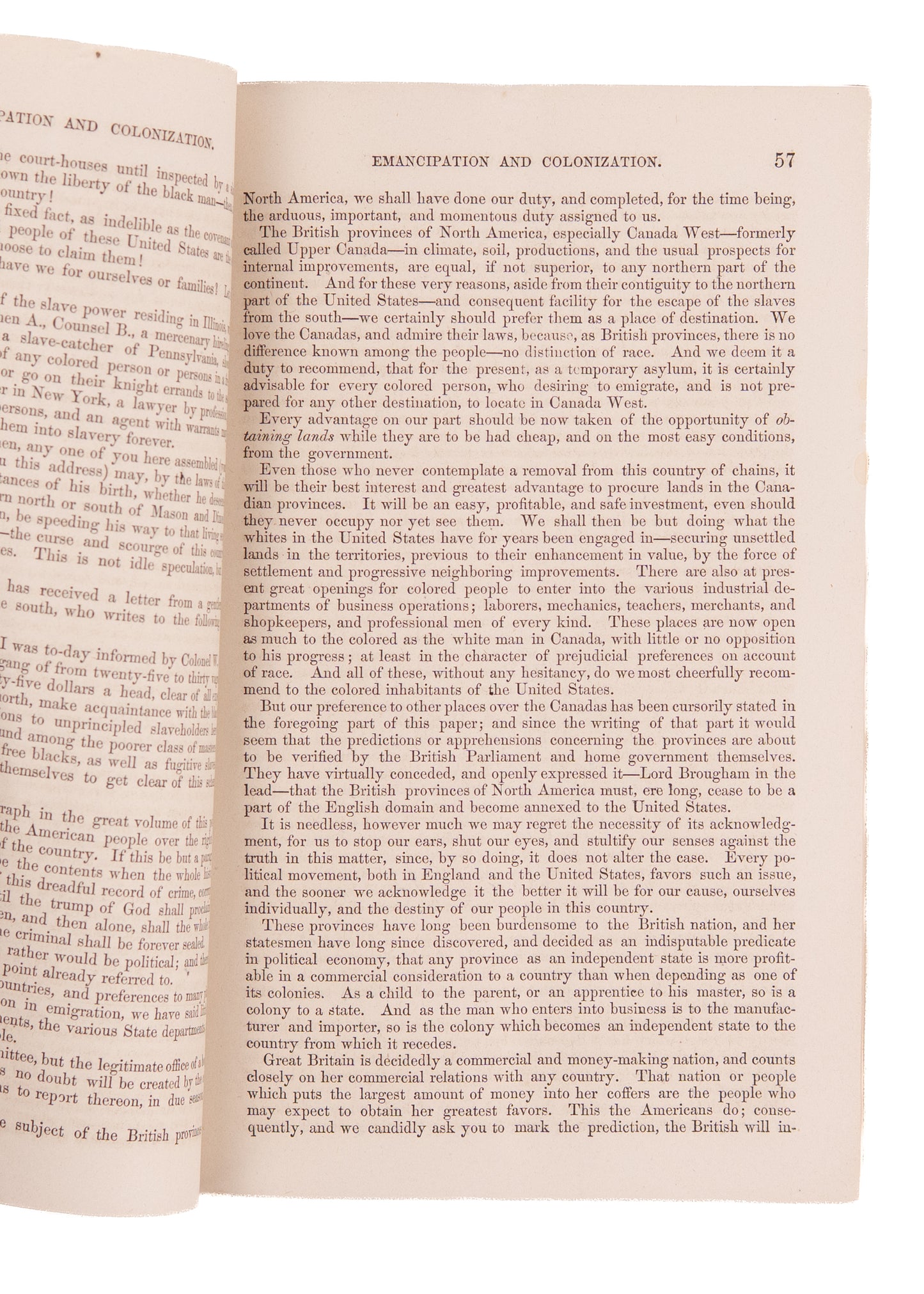
[Emancipation Proclamation and Colonization, Slavery, Civil War, Abraham Lincoln] Report of the Select Committee on Emancipation and Colonization, with an Appendix. Washington. Government Printing Office. 1862. 83pp.
An exemplary copy in original side-sewn binding, some very faint stains as shown, but remarkably preserved on the whole. Scarce in any condition.
Share