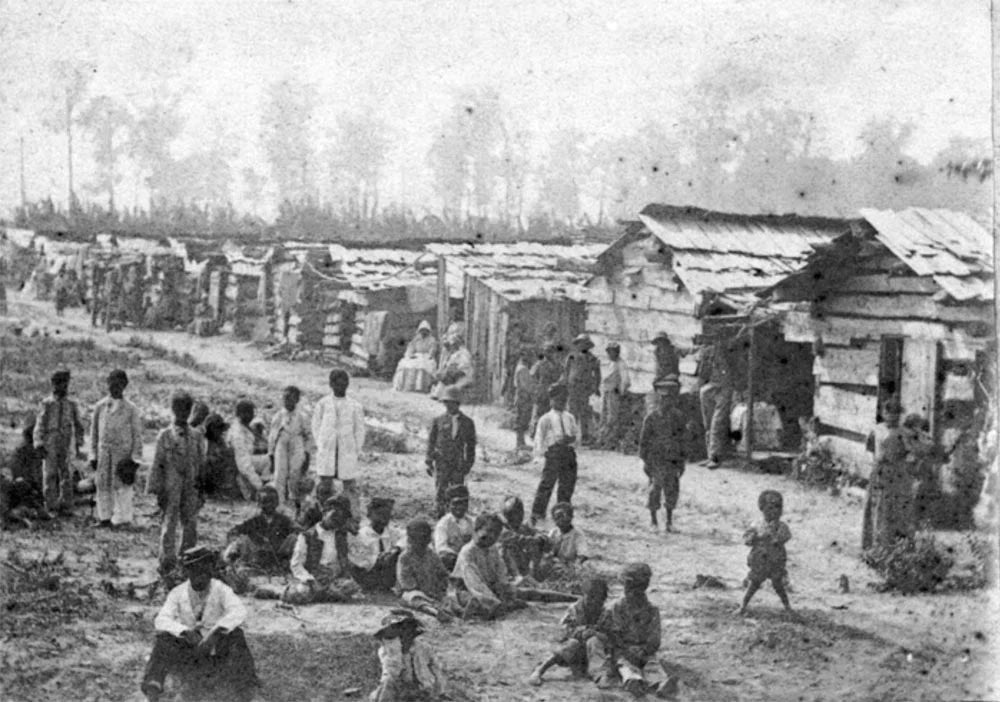
An exceptional, previously undocumented, and almost certainly first-hand watercolor of the early stages of a rural Virginia or Maryland "contraband" encampment.
The description of enslaved persons as "contraband" originated in May 1861 when Union General Benjamin Butler at Fort Monroe, Virginia, famously refused to return three escaped enslaved men to a Confederate officer, declaring them "contraband of war," under the Confederacy's own legal description of enslaved persons as "property." This made them liable to confiscation as "goods" under international maritime law. This precent created a broadly implemented legal strategy that allowed tens of thousands of formerly enslaved men, women, and children to flee behind Union lines throughout the American Civil War, and thence to be immediately declared the "property" of the Union.
The boon of loophole liberations led to a separate crisis, i.e. what was to be done with regard to housing for the new Northerners? The solution, begun in 1861 and carried on through the end of the war, was the development of contraband encampments. These freedom villages were planted on federally allocated lands, often first with a handful of persons or families. Locations like Harpers Ferry and Hampton grew quickly and emerged as makeshift cities, complete with governance structures, etc.
The distinctive architecture of the cities, seen in the watercolor and the included images of Harpers Ferry, was the result of the Army's provision of newly escaped families with military issue tents for accomodation. These were often ingeniously, as the watercolor depicts, converted into something like at least semi-permanent housing, incorporating walls, a fireplace, a small kitchen, etc.
The present watercolor depicts an unusually detailed depiction of a "tent cluster" home, developed into a much more elaborate structure than is usually seen in the larger encampments
The artist's eye for architectural detail helps establish a somewhat solid potential range of location for the scene. Contraband encampments were concentrated across a few prominent wartime hubs. In eastern Virginia and the tidewater region, key sites included Grand Contraband Camp at Hampton near Fort Monroe, as well as sites surrounding Alexandria, Yorktown, and Norfolk. In the Western and Mississippi Valley theaters, major encampments formed along tactical supply lines and river corridors, notably at Corinth and Natchez, along the bluffs of Vicksburg following its July 1863 surrender, around Nashville and Memphis, and at Helena, Arkansas. Along the Atlantic coast, established camps flourished in the Sea Islands of South Carolina, particularly Port Royal and Beaufort, under the administration of the Department of the South.
Our artist records that the central structure has been reinforced or hybridized with horizontal wooden siding or logs that appear to be whitewashed. The tent is further fitted with a prominent stovepipe chimney; the other tents also show stovepipes or improvised heating arrangements. These details likely establish the location of the image as being in or near one of the northern encampments. The Virginia or Mid-Atlantic encampments are known to have been developed with the addition of the same kind of whitewashed timber walls and chimneys shown in the image. The Mississippi Valley and lower Southern sites frequently exhibit palmetto thatch, elevated wooden pier foundations suited for floodplain topographies, stark river bluffs, and cypress or live oak timber.
Where specifically they are located is unknown. Perhaps our image depicts the family in the opening days of a new settlement, closer to 1861. Or perhaps they have managed to find solace on a rural patch of uninhabited land or on property of a Northern host with abolitionist sympathies. An incredibly evocative scene of formerly enslaved persons in an bucolic scene of rest and beauty.
We are also left to wonder who the artist may have been. Though the watercolor is unsigned, it shares much in common with the wartime images from Harpers Ferry and the surrounding environment executed in 1862 and 1863 by William McIlvaine. Some features of the construction of the persons and topography are similar enough, an attribution is tempting. It is of such a size that it is almost certainly not to have been done by a soldier.
The paper, custom matting, and mount [all early or original] and lumber ghosting to the rear of the mount all suggest the work to have been executed in the period. The uniqueness of the scene, both in the sense the subject and the specifics of this atypical contraband encampment, strongly suggest a work created in the first-person.
In exceptional condition, with the colors as fresh and bright as when the work was originally created. It seems to have been stored away, under glass, for over 100 years. And it shows. We rarely fine mid-19th century watercolors in this state of preservation.
A museum worthy work and certainly worthy of both exhibition and ongoing research.
The image itself measures 10 x 14 inches and the mount and custom period matting, 16.5 x 20.5.