Specs Fine Books
1863 EMANCIPATION PROCLAMATION. Ketucky's Furious Backlash to the Federally Imposed Emancipation of Slaves.
1863 EMANCIPATION PROCLAMATION. Ketucky's Furious Backlash to the Federally Imposed Emancipation of Slaves.
Couldn't load pickup availability
Aaron Harding’s speech delivered on January 21, 1863, just three weeks after Abraham Lincoln issued the final Emancipation Proclamation on January 1, captures the furious backlash from Unionist border states against the Lincoln administration’s pivot toward total war and abolition.
As a conservative Democrat representing Kentucky’s 4th Congressional District, Harding voiced the profound betrayal felt by loyal slaveholding Unionists who had supported the Federal war effort under the explicit promise that it was strictly to preserve the Union as it existed, without interfering with domestic state institutions. By directly attacking Lincoln’s executive actions, the speech illustrates the fragile coalition holding the loyal border states within the Union and highlights how the Emancipation Proclamation transformed the political landscape of the Civil War into an ideological battle over constitutional authority, property rights, and the nature of the Federal government.
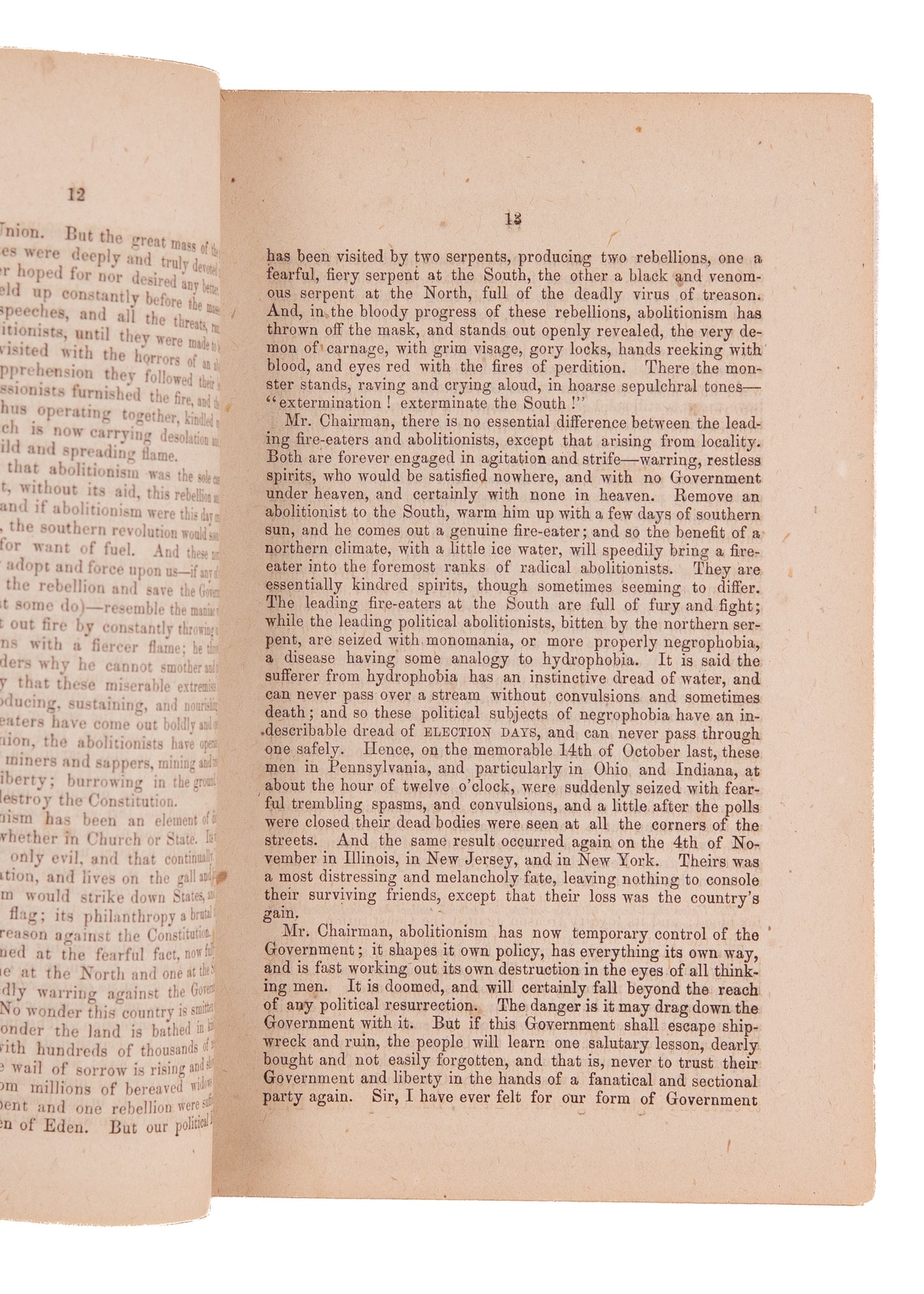
The core significance of the address lies in Harding’s provocative framing of "Two Proclamations" and "Two Rebellions". The proclamations in question, Lincoln’s Preliminary and Final Emancipation Proclamations, alongside his executive orders suspending habeas corpus, were viewed by Harding and Northern Democrats not as legitimate war measures, but as unconstitutional usurpations of power. Harding posited that the nation was trapped between two equal threats: the southern military rebellion seeking to dissolve the Union through secession, and an "abolitionist rebellion" in Washington led by radical Republicans and executive overreach that threatened to overthrow the Constitution from within. By equating Lincoln's emancipation decree with armed treason, Harding’s speech articulated a widespread Conservative argument that the President was substituting arbitrary executive authority for constitutional law, thereby alienating millions of loyal Northern and border-state citizens who rejected emancipation as an war aim.
Extracts:
The President's proclamation is unconstitutional, illegal, and void... It is a decree of universal emancipation, sweeping away by a single dash of the pen the property, the rights, and the constitutional guarantees of loyal citizens... It strikes down at one blow the Constitution of the United States and the sovereignty of the States.
. . .
We are in the midst of two rebellions: one in the South, open, armed, and violent, seeking to overthrow the Government by force; the other in the North, insidious, silent, and treacherous, seeking to overthrow the Constitution by usurpation and the exercise of unauthorized power. The one is as dangerous as the other, and both must be put down if the Republic is to live.
. . .
The people of the border slave States entered into this war to sustain the Constitution and preserve the Union. They never agreed to fight for the abolition of slavery. To tell them now that they must shed their blood to carry out the fanaticism of radical abolitionists is an insult and an outrage... You are driving loyal men into opposition and turning friends into foes.
. . .
This proclamation, if enforced, will flood the country with millions of liberated slaves, without homes, without means, and without the capacity for self-government. It will bring about a war of races, an anarchy of violence, and a scene of desolation such as the world has never witnessed.
[Abraham Lincoln, Emancipation Proclamation] Speech of Hon. A. Harding, of Kentucky, on the President's Two Proclamations and the Two Rebellions. Delivered in the House of Representatives, in Congress, on the 21st of January, 1863. Washington. M'Gill & Witherow, Printers. 1863. 15pp.
Good copy of a scarce imprint. Complete, removed from a larger sammelband with attendant flotsam on the spine. A bit tender as usual. Textually clean with neat "19" on the title as shown.
Share