Specs Fine Books
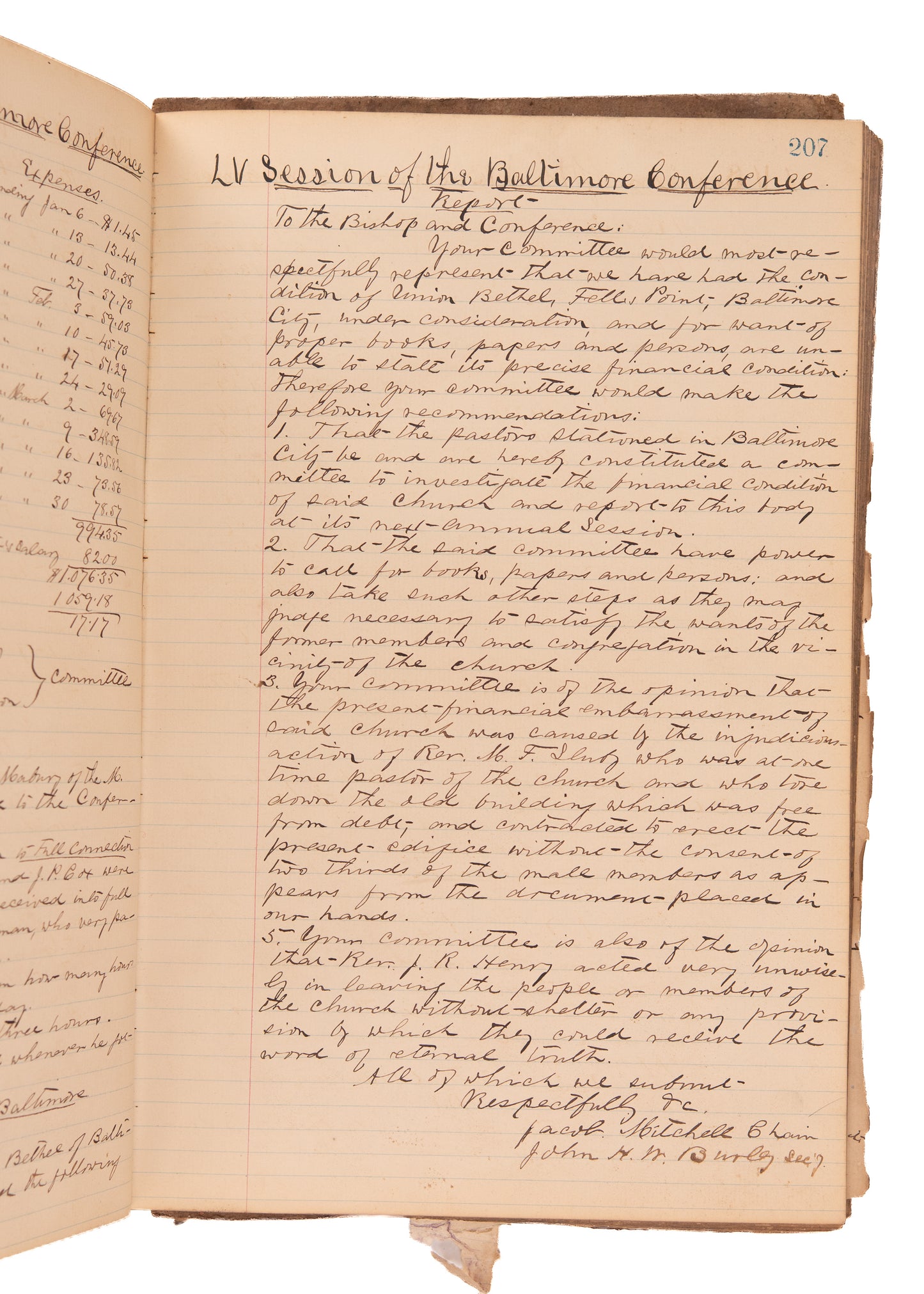
1868-1873 AFRICAN METHODIST EPISCOPAL CHURCH. 300pp Unpublished MSs of Minutes Following Civil War.
1868-1873 AFRICAN METHODIST EPISCOPAL CHURCH. 300pp Unpublished MSs of Minutes Following Civil War.
Couldn't load pickup availability
Conference took a recess at 11.45 to visit the President of the United States. The body with Bishop Wayman at the head proceeded to the President's house; on arriving there Rev. J. H. A. Johnson, who had been appointed spokesperson, delivered the following address:
Mr. President. We are pleased with the opportunity afforded us to extend to you our friendly greetings. We come as members of the Baltimore Annual Conference of the African Methodist Episcopal Church of the United States of America to represent unto you, Sir, the unfeigned regards of this denomination for you as our most excellent Chief Magistrate.
Sir, weare here today as citizens loyal to the flag, and as Christians true to the best interests of the Church, to thank God in your presence for your services which were instrumental in effectively clearing the way for the advancement of our Redeeder's Kingdom among our brethren, who were by slavery kept in spiritual darkness.
Sir, there is no denomination that more extensively realizes the benefit of your achievements in establishing the Supremacy of the general government, than the one represented by us. Where we once had not a member, now we have our tens of thousands, and your administration has been so purely characterized with a disposition for peace that our church there flourishes and wields a powerful influence for the good of the nation. This too has been measurably accomplished by your wisdom and competence, manifested by your forbearance and reticence under the most trying circumstances.
But, Mr. President, the Church of Christ is firm in the belief that the "powers which be" must be sustained by Him who ordains them. Your humble servants therefore, as a part of this great institution, come to express the prayerful desire that our great government, our illustrious republic, may in this manner be sustained during all administrations; and that you whose image, like Mr. Lincoln's, must be stamped on every loyal heart, may under your serious responsibilities be blessed in your person, and in your family, and in your executive capacity, and finally, at a ripe old age, in the dominion beyond the skies.
The President Replied.
No one except yourselves can be more gratified than I am that four millions of your people who were held in bondage and disposed of as chattels are now free to think for themselves and worship God as they think proper. You have not all. your civil rights now, but you will have them.
An exceptional piece of post Civil War, Reconstruction history detailing the role of the Baltimore Conference of the African Methodist Episcopal Church's engagement in the education and care of populations of formerly enslaved persons in the South, of ongoing efforts to obtain the right to vote, and more
The minutes included in the present manuscript cover the 1868 to the 1873 sessions, a time when the Baltimore Conference of the African Methodist Episcopal (AME) Church served as a critical nexus for spiritual, political, and social empowerment during the height of Reconstruction. Positioned in a key border state, the Baltimore Conference occupied a unique geographical and ideological vantage point, bridging the long-established black institutional networks of the North with the newly freed populations of the South.
Following the Civil War and emancipation, the Baltimore Conference became a primary launching pad for AME expansion into the former Confederacy. It served as a conduit for sending ministers, teachers, and resources south to organize new congregations among millions of newly freed individuals, providing them with autonomous, black-led institutions where they could build community away from white oversight.
Beyond its religious mission, the conference acted as a political headquarters where religious leaders doubling as civil rights advocates organized for black suffrage, equal access to public transit, and protection under the 14th and 15th Amendments. AME leaders in Baltimore frequently petitioned local and national government bodies, using the pulpit to mobilize voters and advocate for full legal citizenship. Recognizing that political freedom required economic and intellectual self-sufficiency, the conference also championed educational initiatives for former slaves by raising funds to establish freedmen's schools, supporting missionary teachers, and encouraging literacy, property ownership, and mutual aid societies.
Several key leaders drove the work of the Baltimore Conference during this transformative period. Bishop Alexander W. Wayman presided over the Baltimore district for much of this era, serving as a central figure in expanding the church's reach into the South and acting as a prominent national advocate for African American civil rights. Bishop John M. Brown, who was ordained bishop in 1868 after serving as a key minister and educator in Baltimore, played an essential role in directing missionary work and church extension toward freed people. Bishop Daniel A. Payne, a monumental intellectual force within the conference and president of Wilberforce University, vigorously advocated for an educated clergy and structured religious training for newly freed members. Additionally, Reverend James A. Handy, a leading minister in the conference who was later elected bishop in 1892, was deeply active in local Baltimore politics, freedmen's relief work, and community organizing across the region.
Just a small sampling of the contents include
Rev. Benjamin. Tanner's introduction of a series of resolutions defining the position of the A. M. E. church in relation to the universal brotherhood of man.
Extensive discussions and reports of the mission, functions, and challenges of the early days of Wilberforce University.
Record of an invitation received via telegraph from the Grand Marshall and Secretary on behalf of the citizens of the District of Columbia for the members of the Conference to participate with them on the 16th inst in celebration of Emancipation in the district. The Chairman recommended they accept, but upon the vote, more information from the Grand Marshall was to be requested, et.
Resolution were brought forward by Rev. B[enjamin] Tanner commending any future union with the Methodist Episcopal Church be with the Methodist Episcopal Church North rather than the South.
Resolutions were offered to express the sense of the Conference as to Bishop Payne's tour to England and their determination to stand by the University [Wilberforce].
Extensive discussion of B. T. Tanner and his Frederick City Academy, including their curricula, etc.
Disciplinary proceedings against Rev. A. Robinson for cruel treatment of his wife, along with extensive disciplinary proceedings against a variety of ministers, including sworn testimony for cases of embezzlement, adultery, spousal abuse, heresy, etc.
Addresses and motions urging for political engagement by A.M.E. ministers
Discussion of the A.M.E. position on Temperance
We see with much regret the great evil which spiritous liquors have brought upon the human family, and feel it a special part of our duty as ministers of the gospel to do all we can do discourage the use of an article productive of so much evil. WE think it our duty to applaud all useful measures, to support all bold agents, and to accept every opportunity to make men love water and hate whisky. Resolved, that we the ministers of the Baltimore Annual Conference do most-heartily endorse any and every effort being made for the suppression of this great evil of indulging in the use of intoxicating drinks. Resolved, that we during the year preach ***** on the evils of intemperance. Resolved that we the members of the Conference refrain from the use of tobacco in all its forms. Resolved that we will not admit any man into our ranks as an itinerant minister unless he will refrain from the use of tobacco. Resolved that each pastor on taking his charge be requested to organize a temperance society in his sabbath school, etc.
On Missions
The cause of missions is the cause of heaven and demands our strongest sympathies and should lie near the heart of every true minister of Christ. There is no position on earth in which a Christian minister can be engaged that is of more importance than the missionary cause. There are blessings pronounced upon those who discharge their duty; and curses upon those who neglect it. We believe that if all the ambassadors of the Lord did their whole duty, the glorious work of missions would soon cover the entire globe, and the Banner of the African Methodist Episcopal Church would soon wave in triumph over every hill and mountain, and those who now bow to idols would soon learn the narrative of the cross. Resolved, that we the members of the Baltimore Annual Conference do pledge ourselves to pay the amount of not less than two dollars this Conference year; one half to be paid the last of August, and the balance to be paid at the next session of our Conference.
An 8pp sermon before the Conference by Jabez Pitt Campbell. The text, Seek Ye First the Kingdom of God and His Righteousness, etc.
We have already responded to that cry. Churches are now being organized in Hayti, San Domingo, and the Bahama Islands. Thus we are enabled to say to day that the Gospel is being preached in its purity and simplicity to those who have implored our help. Dear Brethren, this is only the beginning of the end. Africa, now in her pagan condition, must and will become enlightened and Christianized through the labor and instrumentality of her sons and descendants, providentially educated and trained for that purpose by the grace of God in this and other lands. We as a church organization ought to be the principal actors upon the state of the world in this most interesting religious drama. We represent the first, the oldest, in numerical strength, the most powerful and influential Christian organization of colored men in America. The blood-stained banner of Jesus Christ under which we sit today, must be unfurled, not only in the West-India Islands, but it must be planted upon every foot of the soil in the continent of Africa, and wherever any portion of the human race may be found in all the earth. etc.
Extensive communication regarding the ordination of a minister at Santa Barbera de Samaria Island of Santo Domingo and discussion of the difficulties of the late Revolution there, etc.,
A Reply to the Address of the Friends in England
The Baltimore Conference of the A. M. E. Church in the United States to the Religious Society of Friends in Great Britain
Christian Greetings,
We have read your Address and rejoiced in the brotherly Spirit which it breathes. That we should be remembered by the countrymen of William Penn - The countremen of those "Quakers," Americans who, be it said to their honor, never bowed the knee to the Baal of Slavery, is most pleasant unto us. You say that we are free, which is gloriously true; we are free. Free from the bloody lash - free from the still more bloody hearts that wielded it. Nor do we fail to ascribe all the glory unto Him who opens prison doors.
The brotherly admonition of the Address we will remember. As Christians, we will be pure; as citizens we will be patriotic; as the ruled, we will obey the laws; and shoudl any of us come to be ranked with the rulers, we will always remember that magistrates are but servants of God.
May all the Christian blessings rest upon. you. Signed, on behalf of the Conference. Benjamin T. Tanner, Sect. Alexander W. Wayman. Bishop.
Extensive discussion regarding the proposed union of the African Methodist Episcopal Church with the African Methodist Episcopal Zion Churches.
Extensive defense of the work of Wilberforce University. Apparently, the need for education was being viewed with some suspicion.
In a metaphysical sense, the soul and mind are inseparable. The affectional nature comes directly ***** the same discipline, so that no one can develop the one without the other, unless that development is false and a result of a denial of the Deity or a refusal to be controlled by His general laws.
All Christian men have felt the necessity of this proper Christian development and hence all respectable religious denominations have adopted that system by which these religious, philosophical, and metaphysical ideas are developed. For each has some distinctive idea which brought them into being. Some phase of truth which gave them existence and now to **** their peculiar ideas they need teachers and professors who are learned in their views and which can and will boldly enunciate those views and principles.
Such is our peculiar situation; it has made us dependent on others for our instruction, frequently those who have instructed us are hostile either to our theological views or the government of our Church, and not unfrequently do we find those who, because of this dependance, aim at undermining the very foundation of our conclusions and convictions, drawn as we believe from the Bible. In many instances those who enter our ministry are not with us and secretly oppose the teachers of the fathers and thus the people grow dwarfish and instead of the development of true Methodist sentiment, we find our people quite otherwise.
The conclusion thereof is no denomination ought to continue an existence a year without aiming at the culture of the young of their church as well as all the education of her ministry. How can a Calvinist make a Methodist minister? How can a man who is theologically divergent from us rear up a healthy and vigorous group of men for our work and for our ministry?
With all due respect and profound understanding to those who have aided our young brethren who have entered the ministry, yet the query with profound and deep consideration comes up to us, what is due to first the. young people of our Church; Second, to the young men whose duty it is to enter our ministry? etc.
There is then a letter recorded from General O. O. Howard of the War Department, Bureau of Refugees, Freedman, and Abandoned Lands apparently granting them a school building, etc.
On missions:
We are of the opinion that did all of Zion's watchmen faithfully fearlessly and regardless of consequences execute the duties pertaining to their holy calling, the good that would be accomplished eternity alone could tell, and the long prayed for period doubtless would be accelerated when "the wildness should bloom and blossom like the rose, the lion and the lamb should lie down together, when nought should be found to be hurt in all of God's holy mountain and the ransomed of the Lord should return with singing unto Zion with shouts of grace grace enter it." In so desirable a consummation the African Methodist Episcopal Church, whose banner the immortal Allen flung to the breeze over a half century ago, is destined to share a glorious part and through from Maine to California and from the Atlantic to the Pacific that banner floats triumphantly, no prophets vision is needed to discern that the day is not distant when the African Methodist Episcopal Church shall be planted on the soil of the Queen of the Antilles, in Arabia's burning desert, in the remotest isles of the sea, amongst the rudest inhabitants of the wolds of Kamschatska, amid the snows of Greenland, and to the poor Indian . .. yes, it shall spread on, on, on until her broad arms encircle the whole earth.
An address by Rev. G. T. Watkins
Full text of a Annual Sermon by Rev. John F. Lane on the liberation of the people of Israel from bondage and slavery.
Minutes of the "Secret Session" for Disciplinary Cases, including one minister who apparently was discovered in a state of undress with a mistress, whom it was learned he had been engaged with for four years.
Housed in an original folio ledger, nearly disbound, both boards detached. Two prelim leaves with rodentia damage, thankfully not intruding to text. The text of the minutes in multiple hands, highly legible, and complete through to 304pp. It is unclear whether there may be a page or two lacking at the end. Some stains, handling, etc., as shown.
Share