Specs Fine Books
1877 SLAVERY SONGS. Cabin and Plantation Songs as Sung by Formerly Enslaved Persons.
1877 SLAVERY SONGS. Cabin and Plantation Songs as Sung by Formerly Enslaved Persons.
Couldn't load pickup availability
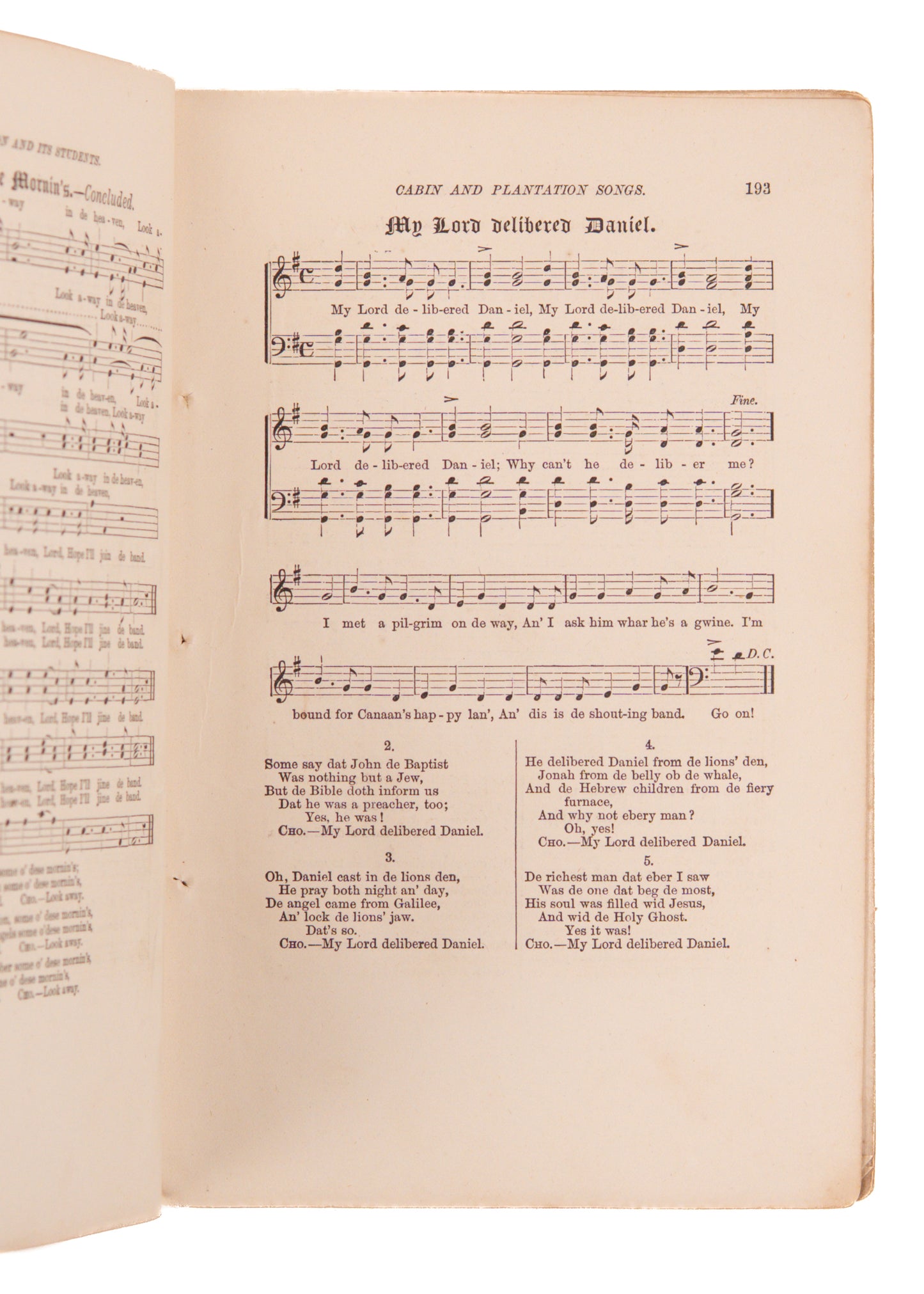
A now very scare imprint of Cabin and Plantation Songs as Sung by the Hampton Students, a landmark in American musical and cultural history, rooted in the extraordinary circumstances of Reconstruction-era education and the urgent desire to preserve a suddenly destabilized and vanishing oral tradition of African American song.
In 1868, former Union Army general Samuel C. Armstrong founded the Hampton Normal and Agricultural Institute as a school specifically for African Americans. The institution would become central to one of the most important cultural preservation efforts of the nineteenth century. Armstrong believed strongly in the benefit of communal singing, and when the Fisk University Jubilee Singers achieved a tremendously successful national tour in 1871, he decided to form a touring choir modeled after them — the Hampton Singers — as a way to raise money for the struggling school. To lead this effort, he recruited Thomas Putnam Fenner, a music educator and choral conductor who arrived at Hampton in June 1872 as the first director of the school's music program.
In order to establish the Hampton Singers, Fenner and Armstrong traveled throughout Virginia and North Carolina, auditioning singers at schools and finding individuals working in the fields. Together they selected 17 singers, thirteen of whom were former slaves. This composition gave the ensemble a distinct character. Because of the larger number of former slaves in the choir, the Hampton Singers gained a reputation for having a different and more authentic sound when it came to performing spirituals and plantation songs, maintaining what one writer of the period described as the "pathos and wail" heard on the plantations when those songs originated.
While the Fisk Jubilee Singers' formal dress, careful vocal cultivation, and characterization of their concerts as "services of song" emphasized the missionary nature of their work, the Hampton singers took a more folkloric approach, introducing new concepts of perceived authenticity to white concertgoers.
Working with the Hampton Singers, Fenner and Armstrong realized that the art of African American spirituals and plantation songs was in danger of being lost, as it was not written down and many former slaves were reluctant to continue singing these songs. Wikipedia This recognition drove Fenner to begin a systematic effort of collection and transcription, though the task was technically challenging. He struggled to find a way to notate these songs in an authentic way, as the authentic performance practices often involved improvisation in the harmonies and the songs were never performed exactly the same way twice.
The songs Fenner collected with colleagues Bessie Cleaveland and Frederic G. Rathbun were first published in a shorter form in 1874, included within Hampton and Its Students. The school continued then printed an expanded editions, as offered here. The collection includes songs such as "Swing Low, Sweet Chariot," "Babylon's Fallin'," "Git on Board, Little Children," and dozens of other spirituals and work songs drawn directly from the students' living memory of plantation life.
Fenner's editorial approach set the Hampton collection apart from comparable anthologies of the era. Unlike George White's arrangements for the Fisk Jubilee Singers, which subjected the spirituals to precise pitches and standardized language, Fenner demonstrated a greater appreciation for folk performance. He retained ornaments like vocal slides and melismas in the melodies and created a denser texture by using up to seven separate voice parts, compared with White's typical four-part soprano-alto-tenor-bass structure. Fenner's more folkloric approach was also evident in the origin stories that often prefaced the transcriptions in the Hampton anthologies, giving each song a sense of its history and human context.
Before the Civil War, spirituals were sung in the privacy of Black spaces — the brush arbor, the praise house, the cotton field, the levee. After the war, groups of student singers representing Black educational institutions brought them to the concert stage, and the impact of hearing these songs from the lips of people who were formerly enslaved was profound, particularly among white Northerners who had been abolitionists.
The Hampton Singers, though not as financially fortunate as the Fisk troupe, nonetheless introduced new spirituals to the public — being careful not to duplicate the Fisk repertory — and spread the music to new parts of the country. The published collection served the dual purpose of fundraising and documentation, functioning as both a songbook for audiences and a record of an imperiled tradition. For many white audiences, the tour was the first time hearing traditional plantation work songs and spirituals.
Fenner, Thomas P. Cabin and Plantation Songs as Sung by the Hampton Students. New York. G. P. Putnams. 1877.
A generally well-preserved copy; in need of resewing and lacking spine cover and rear wrap. Chip at lower corner of final leaf not impacting text. Textually clean and complete.
Share