Specs Fine Books
1914-1922 PROHIBITION TRACTS. Rare Group of Bootlegging, Moonshire, Effects of Prohibition, &c.
1914-1922 PROHIBITION TRACTS. Rare Group of Bootlegging, Moonshire, Effects of Prohibition, &c.
Couldn't load pickup availability
Fine hand-tied sammelband of Prohibitionist Congressional offprint tractates and temperance addresses, each scarce, that trace the trajectory of American Prohibition from its parliamentary origins through constitutional passage and early federal enforcement.
The assemblage opens with Richmond Pearson Hobson’s landmark May 1, 1914 speech, a pivotal congressional address that helped launch the legislative drive for the 18th Amendment. Hobson, a Spanish-American War hero and Congressman from Alabama, delivered one of the earliest and most influential speeches advocating a constitutional amendment to ban alcohol, framing prohibition as a paramount national security and public health imperative.
The collection then shifts to the post-ratification enforcement era with Andrew J. Volstead’s August 16, 1921 speech, "Prohibition and its Enforcement." Volstead, the primary author and namesake of the Volstead Act, explicitly targets the medical community's resistance to temperance, arguing that the therapeutic value of liquor is negligible and utilizing medical authority to justify closing prescription loopholes used to obtain alcohol.
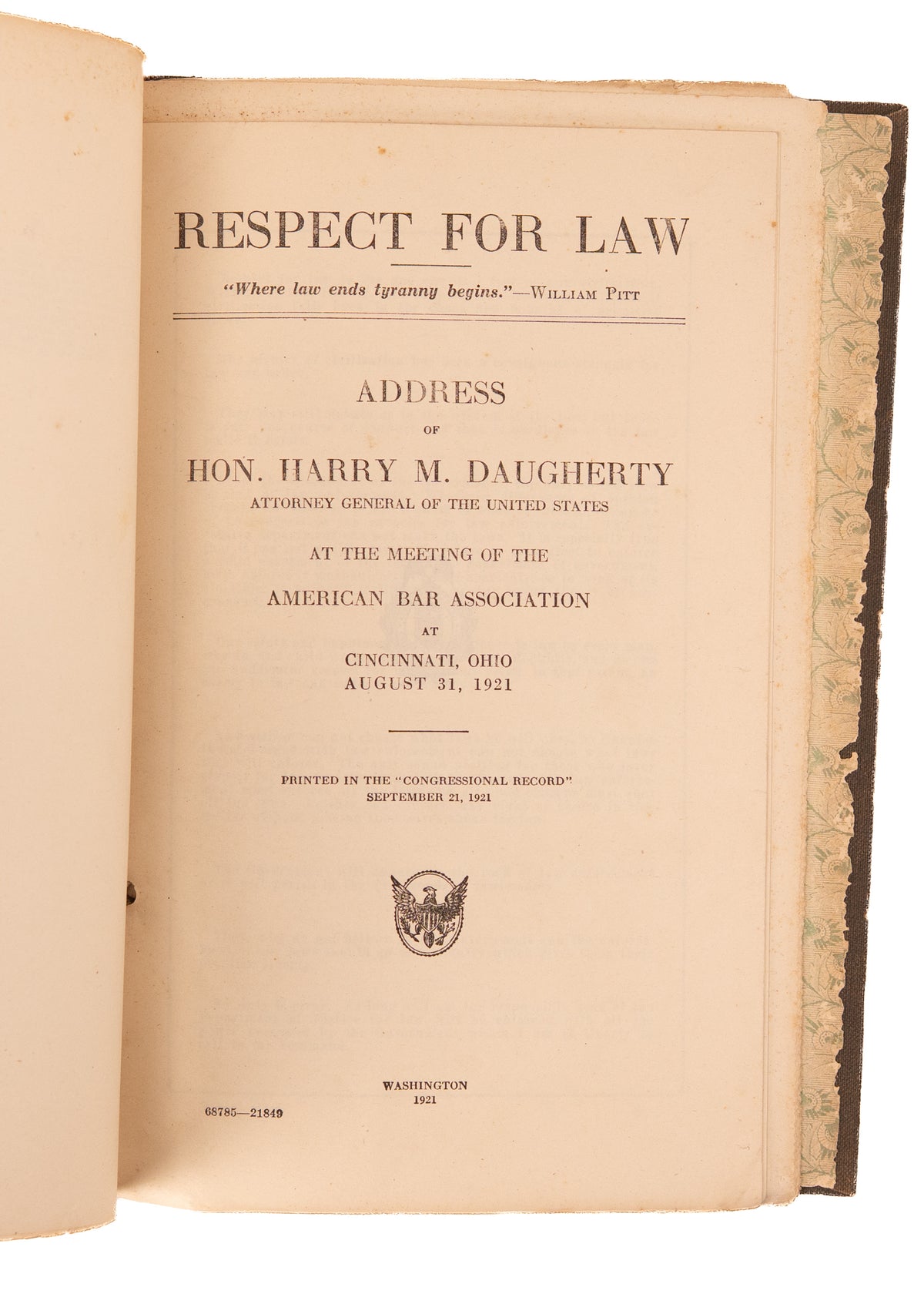
Attorney General Harry M. Daugherty’s August 31, 1921 address to the American Bar Association, "Respect for the Law," highlights the early federal crisis of widespread bootlegging and public non-compliance. As the nation's chief law enforcement officer, and a central figure in President Harding's administration, Daugherty frames adherence to the Volstead Act not merely as a debate over alcohol, but as a fundamental test of American constitutional order and respect for rule of law.
Wesley L. Jones’s November 15, 1921 Senate speech, "Results of National Prohibition," provides one of the earliest official congressional assessments of the 18th Amendment's impact, presenting statistical arguments regarding decreased crime and improved public welfare to defend the policy against growing public criticism.
The volume concludes with Frank Crane’s 1922 Anti-Saloon League tract, "The Little Church on Main Street," demonstrating how grassroots Protestant Christianity was leveraged by the Anti-Saloon League to maintain public support for moral reform and law enforcement during the initial years of the Volstead era.
The contents as follow:
a. National Constitutional Prohibition. Speech of Hon. Richmond P. Hobson of Alabama in the House of Representatives, May 1, 1914.
b. Prohibition and its Enforcement. The Medical Value of Intoxicating Liquor Negligible - The Medical Profession Changing its Opinion - Science Condemns Liquor as Therapeutic Agent. Speech of Andrew J. Volstead of Minnesota. August 16, 1921.
c. Respect for the Law. Address of Hon. Harry M. Daugherty, Attorney General of the United States, at the Meeting of the Bar Association at Cincinnati, Ohio. August 31, 1921.
d. Results of National Prohibition. Speech of Hon. Wesley L. Jones of Washington in the Senate of the United States. November 15, 1921.
e. The Little Church on Main Street by Frank Crane. Saloon League. 1922.
The last work bound without wraps, but else each generally very good, though punctured for the side-tied assemblage folder.
Share