Specs Fine Books
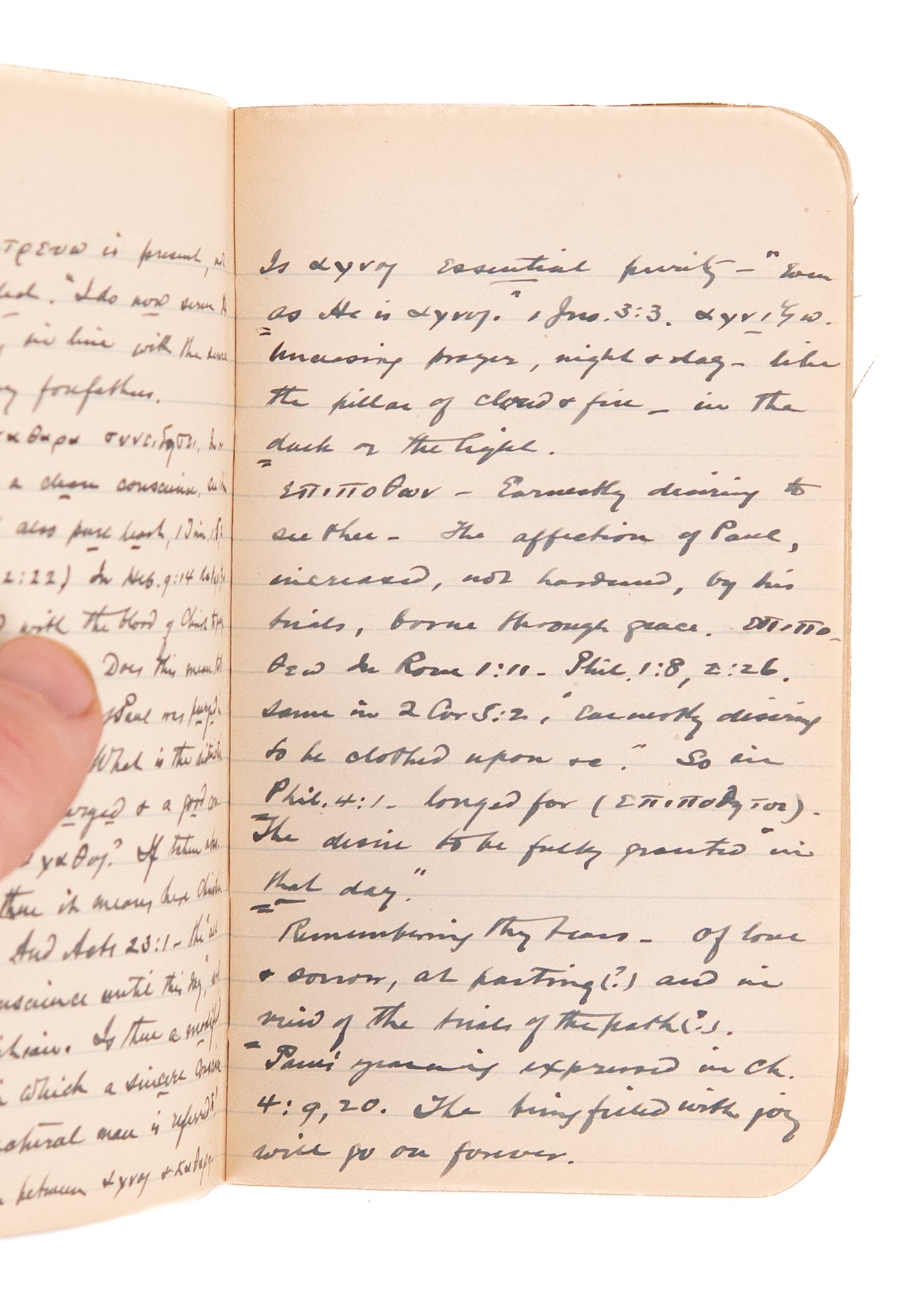
1921 SAMUEL RIDOUT. 114pp Unpublished MSs. Notes on Colossians, New Covenant, Key Words in Greek, &c.
1921 SAMUEL RIDOUT. 114pp Unpublished MSs. Notes on Colossians, New Covenant, Key Words in Greek, &c.
Couldn't load pickup availability
A superb, previously untraced and unpublished 114pp manuscript entirely in the hand of Samuel Ridout. Inscribed on the interior of the front wrap, "Samuel Ridout, 37 Prospect Place, Plainfield, New Jersey. October 11/21."
Includes responses to I. M. Haldeman's Can the Dead Communicate with the Living?, theologoical questions, i.e. Can Satan Work Miracles of Healing, on The Gift of Faith, on Fasting and Mourning among the Jews, Exegetical Hints on Colossians, Key Words in I Timothy [Greek], Root and Fruit, Some "New Things" in the New Covenant, Notes for a Possible Series on Psalm 19, Typology of Creation [Sun as a Tabernacle, etc.], Notes on a "Good" or "Pure" Conscience, etc. etc.
Samuel Ridout (1855–1930) was a pivotal figure within the Plymouth Brethren movement, recognized as one of the most gifted teachers and writers in the "Exclusive" branch following the death of John Nelson Darby.
His significance layprimarily in his ability to systematize and articulate complex dispensational theology for a broader audience, bridging the gap between the movement's founding generation and its early 20th-century expansion. As a close associate of F. W. Grant, Ridout was instrumental in editing and contributing to The Help and Food for the Household of Faith, a monthly periodical that became a cornerstone of Brethren intellectual life and served as a primary vehicle for spreading Darbyite hermeneutics across North America and Europe.
Ridout’s most enduring contribution to biblical studies is his work on typology, particularly his exhaustive analysis of the Old Testament tabernacle and the Levitical offerings. In works such as Lectures on the Tabernacle and The Person and Work of Christ, he moved beyond mere historical narrative to present every detail of the Hebrew cultus as a "type" or shadow of New Testament realities. This typological approach became a hallmark of dispensationalist Bible study, influencing the way generations of Evangelicals interpreted the relationship between the two testaments. By framing the Old Testament as a coded, prophetic blueprint of Christ’s ministry, Ridout provided the "scientific" and spiritual scaffolding that allowed the movement to maintain a high view of biblical inerrancy while navigating the rise of modern higher criticism
Pastorally, Ridout served as a stabilizing force during the various schisms that plagued the Brethren movement in the late 19th century. His writing was characterized by a gentler, more pastoral tone than many of his more polemical predecessors, making him a beloved figure whose influence extended into the broader Bible Conference movement. His teachings helped lay the groundwork for the popularization of dispensationalism in American seminaries and remained a primary source of reference for the creators of later study Bibles, ensuring that the rigid theological distinctions of the Plymouth Brethren would permeate mainstream conservative Protestantism well into the modern era.
Share