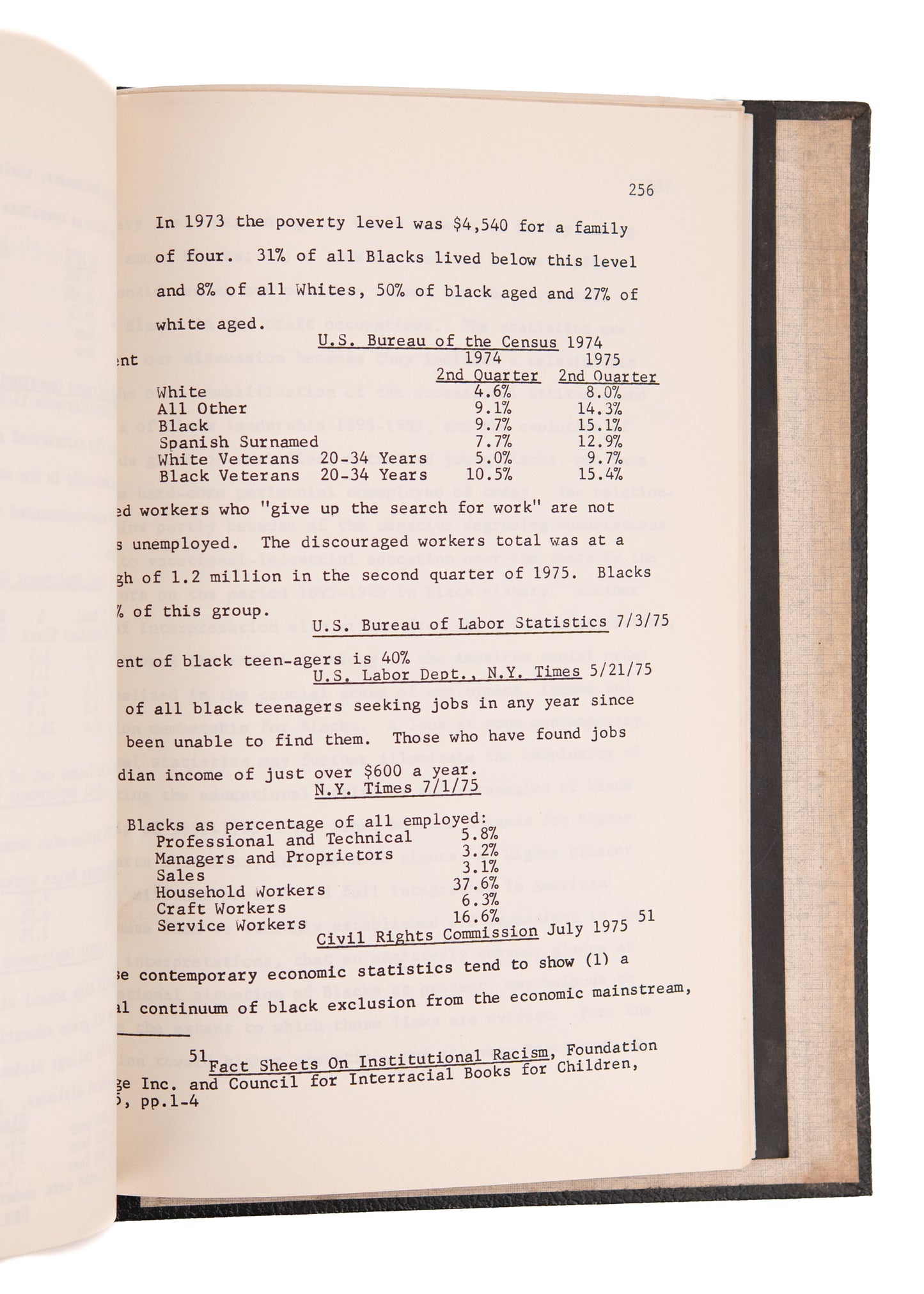
An exceptional nearly 600pp seemingly unpublished typescript academic work which attempts to address over-simplified historical interpretations that categorize late 19th and early 20th-century Black leadership into rigid, opposing dichotomies, i.e. militant hero vs. passive villain or accommodationist vs. non-accommodationist frameworks. Instead the author explores influential character such as Booker T. Washington, W. E. B. DuBois, Frederick Douglass, &c., through the lens of the various ways in which they saw black communities entering into broader society via education as a way of understanding their differences.
The core analytical narrative spans from 1895 to 1925, focusing heavily on the educational attitudes, political strategies, and socioeconomic constraints facing Black leadership who were tasked with educating the masses of Black Americans just a few decades removed from slavery. Later chapters address the ongoing challenges of black education, but the bulk of the text is historical and analytical.
Chapter 1 anchors this conversation by tracing the continuity of Western educational traditions from colonial America forward, contextualizing how traditional American values regarding education were internalized by the "new" Black Americans after emancipation. From there, The work then assesses crucial historical turning points, important leadership figures in the black community, and systemic hurdles. These include the origins of the Tuskegee Institute via Lewis Adams in the 1880 election, Southern political disenfranchisement and voter reduction trends around 1900, and the impact of Social Darwinism and laissez-faire economics on the perceived conduct and consequences of marginalized populations, i.e. the developing view that black persons were poor and uneducated based on an inherent inability, whether moral or intellectual.
The second half of the volume transitions into a curated sourcebook. The compiler chronologically arranges speech transcripts, essays, and manifestos written or spoken by the Black leadership elite. Featured primary texts mentioned or visible in the pages include:
An 1888 speech by Frederick Douglass addressing life in the South twenty-five years after Emancipation.
The 1901 "farewell" speech to the U.S. Congress by Congressman George White regarding the systemic exclusion of Black citizens from political representation.
W.E.B. Du Bois’s 1936 study "The Basic American Negro Creed," originally requested by Alaine Locke for the "Associates in Negro Folk Education", which analyzed the intersections of employment, health, and education, and proposed a cooperative Black industrial system.
An excellent, robust attempt at trying to understand the challenges of early black leadership, thoroughly documented, and worth of preservation. The only notice indicating potential origin or ownership is a signature of Leonard A. James at the beginning of each volume.