Specs Fine Books
1740 ELIZABETH SCOTT. 8 Stanza MSs Hymn by Signifanct Female Hymnist of Great Awakening.
1740 ELIZABETH SCOTT. 8 Stanza MSs Hymn by Signifanct Female Hymnist of Great Awakening.
Couldn't load pickup availability
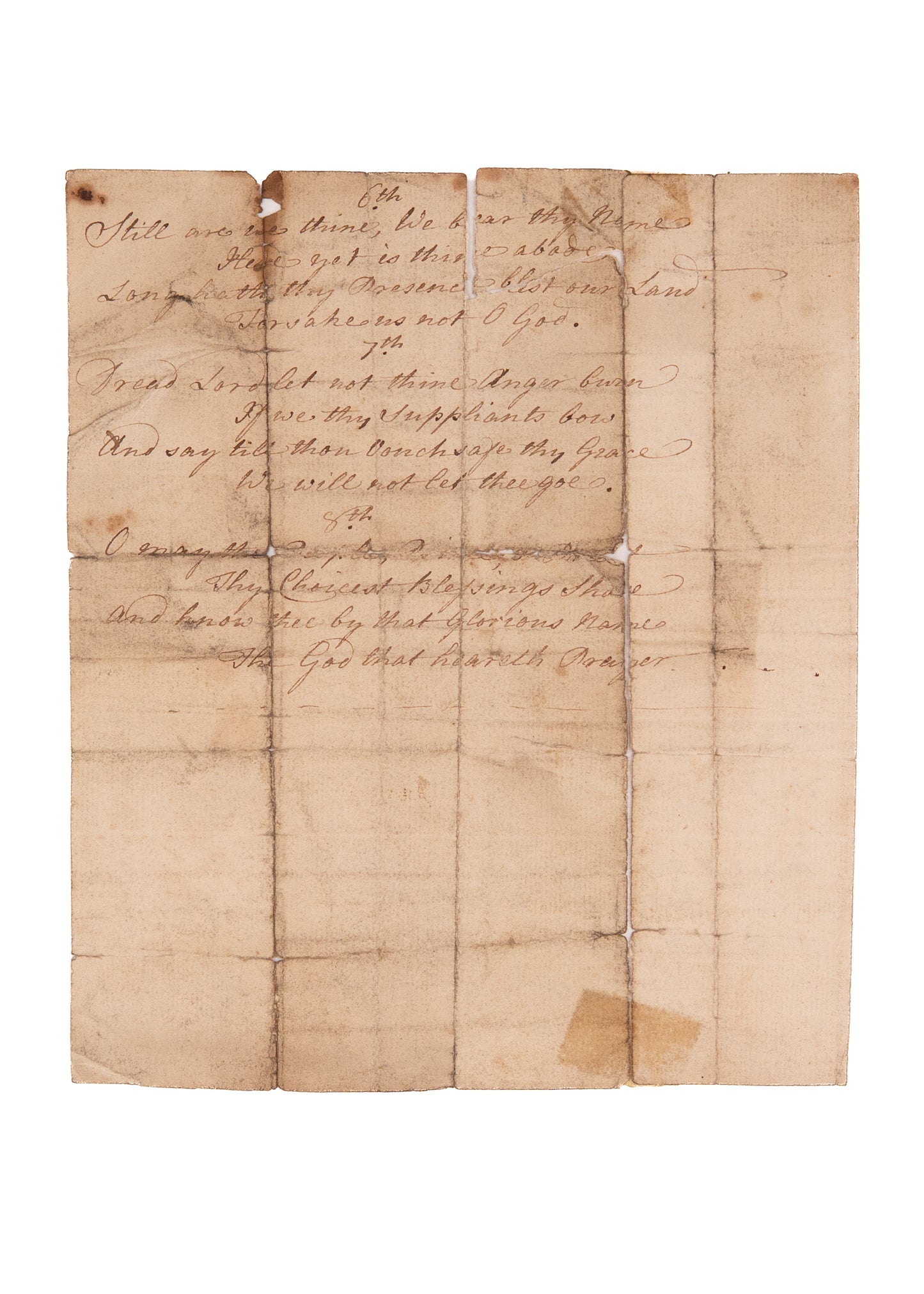
An exceptional original manuscript by Elizabeth Scott (1708–1776), later Elizabeth Scott Williams Smith, a significant 18th-century female hymnwriter and poet who bridged British Nonconformist literary culture and colonial American intellectual history.
Born in England to Independent dissenting minister, theologian, and commentator, Thomas Scott, she composed a vast corpus of over ninety hymns before 1750. She was in fact one of the earliest English-speaking women to have a large body of original hymnody widely adopted across Baptist, Congregational, and Universalist hymnals in both Britain and North America, with her texts published in landmark compilations by John Ash, Caleb Evans, and John Dobell.
This specific hymn, beginning "When Abrah'm, full of sacred awe," is one of her most famous national intercessory works, written "For a Fast Day" and widely printed in late 18th- and 19th-century American and British hymnals. Drawing on Genesis 18, where Abraham pleads with God to spare Sodom for the sake of a righteous few, the text functions as a solemn, patriotic plea for divine mercy on behalf of a sinful nation. The hymn uses the biblical precedent of Abraham's bargaining to argue that God will spare a country if a faithful remnant continues to offer fervent prayer.
In 1751, Elizabeth Scott married Colonel Elisha Williams, a prominent Connecticut minister, legislator, and former Rector (President) of Yale College, subsequently emigrating with him to Wethersfield, Connecticut, in early 1752. Following Williams's death, she married the Honorable William Smith in 1761, a distinguished member of the New York Governor's Council and father of the prominent loyalist historian William Smith Jr. Scott lived out the rest of her life in Connecticut, dying in Wethersfield in June 1776 on the eve of American independence.
Her surviving personal archive of original poetry and hymn manuscripts was bequeathed to Yale University, cementing her status as an extraordinary transatlantic figure who connected English dissenting hymnody with the colonial elite of Connecticut and New York and making any manuscript material from her hand exceptionally rare.
Below is the complete manuscript text. We don't trace stanza 7 as ever having been published. Dated c.1740.
1 When Abrah'm, full of sacred awe,
Before Jehovah stood,
And with an humble fervent pray'r,
For guilty Sodom sued;
2 With what success, what wondrous grace,
Was his petitions crown'd!
The Lord would spare, if in the place
Ten righteous men were found.
3 And could a single, pious soul
So rich a boon obtain?
Good God! and shall a nation cry,
And plead with thee in vain?
4 Britain, all guilty as she is,
Her several saints can boast;
And now their fervent prayers ascend –
And can those prayers be lost?
5 Are not the righteous dear to thee,
Now, as in ancient times?
Or does this sinful land exceed
Gomorrah in its crimes!
6 Still are we thine, we bear thy name,
Here yet is thine abode.
Long has thy presence blest our land:
Forsake us not, O God!
7 Dread Lord, let not thine anger burn,
If we thy suppliants bow;
And say till thou vouchsafe thy grace,
We will not let thee goe.
8 O may our people, rulers, priests,
Thy choicest blessings share;
And know thee by that glorious name,
"The God who heareth pray'r!"
In far condition, taped at folds, very minor losses. Still very attractive and a significant piece of evengalical, Great Awakening, and female literary history.
Share