Specs Fine Books
1806-1849 WILLIAM JENKS. Group of Correspondence, Including Important American Tract Society Circular.
1806-1849 WILLIAM JENKS. Group of Correspondence, Including Important American Tract Society Circular.
Couldn't load pickup availability
A small archive of correspondence related to Reverend William Jenks (1778–1866), a prominent 19th-century American Congregational clergyman, scholar, linguist, and pioneer in social reform. Educated at Harvard College, Jenks served as a pastor in Bath, Maine, and later at Boston’s Green Street Church for twenty-five years, while also occupying the chair of Oriental Languages and English Literature at Bowdoin College. His primary literary legacy rests on his monumental work as editor of the Comprehensive Commentary on the Holy Bible (1835–1838), a widely circulated six-volume reference that became a standard text for scriptural exposition and theological study across 19th-century American households and seminaries.
Beyond his biblical scholarship, Jenks played a significant role in early American institutional and intellectual life as a co-founder of both the American Antiquarian Society and the American Oriental Society, alongside active leadership in the Massachusetts Historical Society. He was also an early American pioneer in urban and specialized ministry, establishing charitable outreach programs and founding the Mariner's Church on Central Wharf in Boston to address the spiritual and material welfare of sailors, a social group largely overlooked by the religious institutions of his era. Additionally, early in his career, he authored the satirical Memoir of the Northern Kingdom (1808), an early work of political fiction critiquing early American partisan conflicts.
Of particular note is the untraced American Tract Society circular.
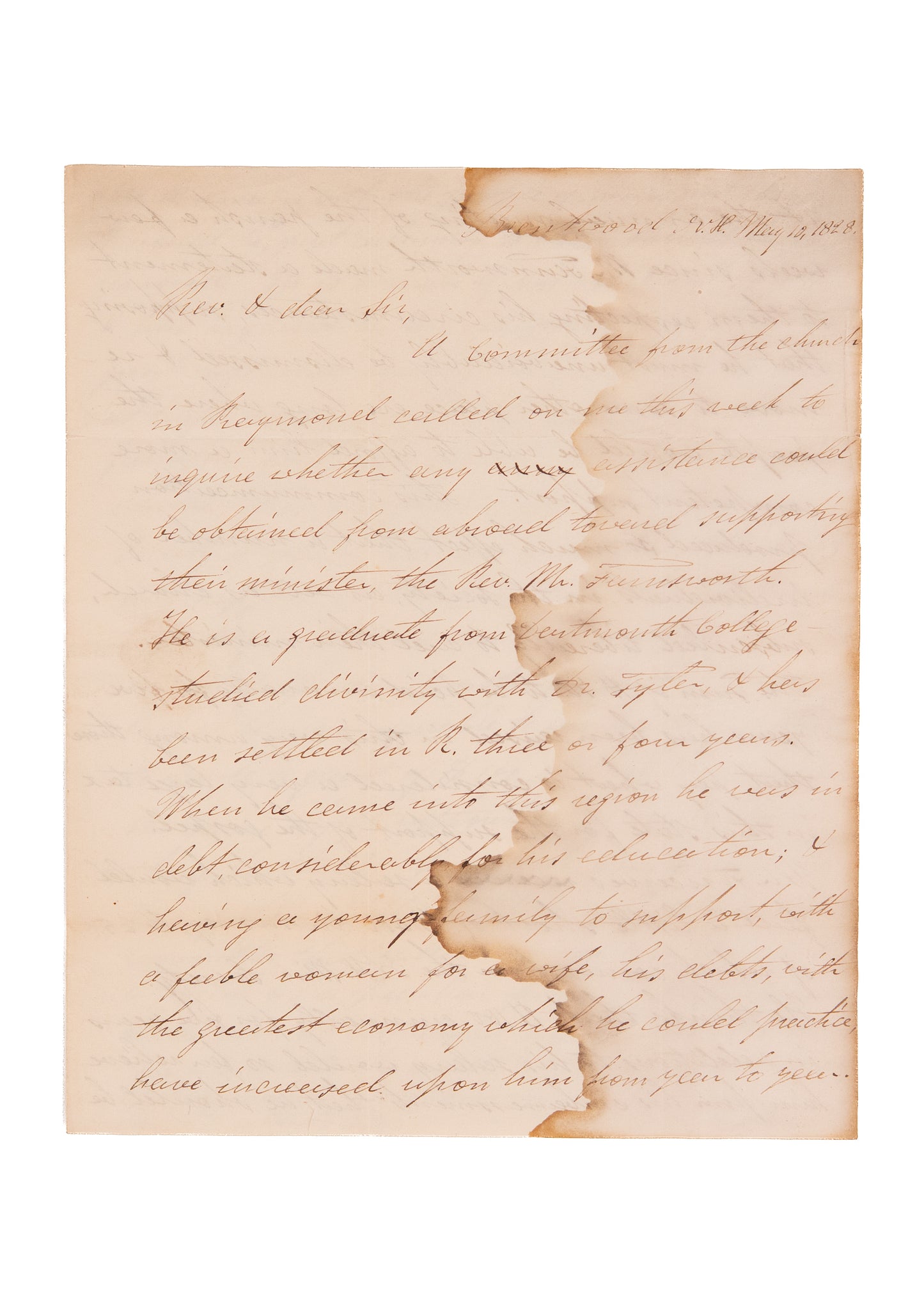
1. May 10, 1828. Reverend Luke A. Spofford of Brentwood, N. H. to Rev. William Jenks. 3pp.
Requesting aid in assisting Rev. Mr. [Seth] Farnsworth, the minister in Raymond, who had been a graduate of Dartmouth, studied under Dr. Tyler, etc., but who had significant debt from his education. The people are challenged as they "pay what is considered a very large tax in this state for the support of the gospel." He also receives funds from the New Hampshire Missionary Society. They still lack $25 per annum to obtain for him a livable wage.
He is a man of an excellent spirit & has acquired, by his prudence & faithfulness great influence among the people of the town at large, many of whom are sectarian in their feelings.
Stained, but entirely legible.
2. November 25th, 1806. Judith Cooper Russell [Later Mrs. Captain John Binney] to her sister, Betsy [Russell] Jenks, i.e. Mrs. Rev. William Jenks. 3pp.
Largely family discussions, news of their local church, etc.
3. October 24, 1845. 3pp Lithographed Letter from Seth Bliss, Corresponding Secretary of the American Tract Society, Boston, to William Jenks. Inscribed at the beginning and addressed by Bliss.
We do not trace this extensive circular communication to ministers from the Tract Society as being published anywhere, nor any other examples.
Bliss reports their present activities as being "onward" and "aggressive" and asks their supporters to consider whether the ATS should continue to advance, or be cause to recede for lack of generous assistance. He reports they are at present publishing more than 2,000 books in 100 languages and dialects. Even at home, there is still need, he says. They estimate that from one sixth to one eighth of the West are without a Bible, and one third have no religious books aside from the Bible. This is not taking into account the 2,000,000 German Immigrants; 750,000 Irish; 250,000 French; and 70,000 Welsh who are "so numerous, so influential, so needy, so rapidly increasing."
He then gives the account of two of their most fruitful "agents," one a former German Catholic and the other a former Irish Catholic, now both winning people to the Evangelical Gospel by the hundreds with tracts and books. They're sending workers now into the Appalachians, Westward, Southward, etc.
An important piece of American Tract Society correspondence.
4. September 23, 1849. West Poultney, Vermont, from Cornelia Jenks to Rev. and Mrs. William Jenks. 4pp.
She mentions finding herself on a train with Edward Beecher, who she ended up chatting it up with, extensive record of her travels to Poultney, Vermont and of her stay with the Ruggles family. Generally chatty. She does add, "Affairs in Cuba are getting considerably entangled, who shall arise to unweave the woven mesh."
Share