Specs Fine Books
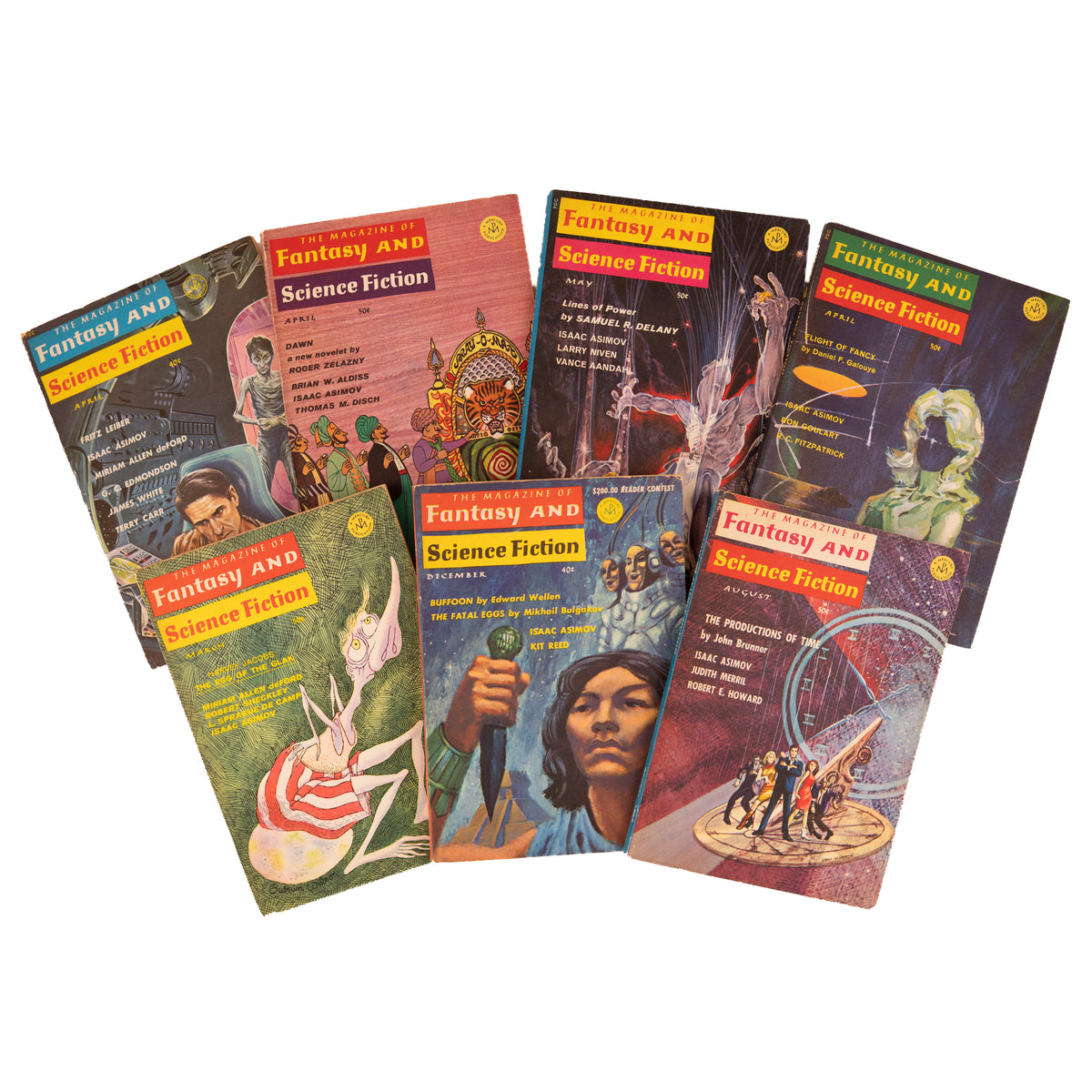
THE MAGAZINE OF FANTASY AND SCIENCE FICTION. 64 Issues. Flowers for Algernon 1st Appearance - Isaac Asimov
THE MAGAZINE OF FANTASY AND SCIENCE FICTION. 64 Issues. Flowers for Algernon 1st Appearance - Isaac Asimov
Couldn't load pickup availability
An excellent single largely original collector assemblage of The Magazine of Fantasy & Science Fiction, spanning 64 desirable issues from 1955 through 1969.
Across these issues are represented landmark entries in modern speculative fiction that won major awards or redefined genre boundaries. Foremost among these are Daniel Keyes’s "Flowers for Algernon" (April 1959), winner of the Hugo Award for Best Short Story and one of the most celebrated masterworks in the history of science fiction; Shirley Jackson’s iconic story "One Ordinary Day, with Peanuts" (January 1955); Robert A. Heinlein’s famous time-travel paradox tale "All You Zombies—" (March 1959); Walter M. Miller, Jr.’s "A Canticle for Leibowitz" (April 1955), the foundational novella that launched his Hugo-winning novel; Fritz Leiber’s Hugo-winning novella "Gonna Roll the Bones" (August 1967); Samuel R. Delany’s Hugo and Nebula-winning novella "A Night in the Lonesome October" (February 1969); Philip K. Dick’s "Oh, to be a Blobel!" (June 1964); and Harlan Ellison’s seminal Hugo and Nebula Award-winning masterwork "'Repent, Harlequin!' Said the Ticktockman" (December 1965).
Throughout the pages are original contributions desirable for both titan genre collectors seeking complete runs of key figures, and literary/crossover collectors. These include: Philip K. Dick (August 1959, June 1964), Harlan Ellison (December 1965, April 1967, December 1967, January 1968, May 1968, October 1968, January 1969, May 1969), Ray Bradbury (September 1963, October 1964, October 1968), Robert A. Heinlein (October 1956, March 1959, October 1959), Fritz Leiber (July 1958, July 1961, March 1962, October 1964, August 1966, August 1967, March 1968, August 1968, February 1969), Brian W. Aldiss (April 1958, August 1959, December 1960, May 1961, September 1961, January 1962, May 1962, April 1963, June 1965, June 1967, June 1968), Roger Zelazny (January 1963, August 1963, April 1965, May 1967, February 1968, August 1968, March 1969), J. G. Ballard (December 1961, February 1962, November 1962, April 1963), Jack Vance (August 1962, July 1963, April 1965), Poul Anderson (February 1956, April 1958, December 1960, August 1961, April 1962, May 1963, November 1965, May 1968, April 1969), and Robert Silverberg (January 1968, July 1968, January 1969, December 1969).
Also included are several of the early special dedicated author issues and those containing major award-winning story debuts or serialized novels. The October 1962 Special Theodore Sturgeon Issue, the September 1963 Special Ray Bradbury Issue, the May 1966 Special Isaac Asimov Issue, the October 1964 15th Anniversary Issue, and the October 1968 19th Anniversary Issue are highly sought. Additionally, individual issues containing seminal first printings, such as January 1955 for Shirley Jackson's "One Ordinary Day, with Peanuts," April 1959 for Daniel Keyes's "Flowers for Algernon," March 1959 for Robert A. Heinlein's "All You Zombies—", December 1965 for Harlan Ellison's "'Repent, Harlequin!' Said the Ticktockman," and key serializations like Heinlein's The Door into Summer (beginning October 1956) and Starship Soldier [Starship Troopers] (beginning October 1959), are always tough to come by in their first states and in good condition.
The complete collection includes:
1955. January and December.
The January 1955 issue features Shirley Jackson’s classic short story "One Ordinary Day, with Peanuts," a famous tale of unsettling suburban morality. The issue also includes "Single Combat" by Robert Abernathy, alongside fiction by Richard Matheson, Lord Dunsany, P. G. Wodehouse, and Manly Wade Wellman.
The December 1955 issue features C. M. Kornbluth’s satirical science fiction story "The Minimum Man," about an incompetent colonist sent to a harsh alien world. The contents also present Gerald Kersh's "The Unsafe Deposit Box," alongside short fiction by Avram Davidson, Arthur C. Clarke, and Chad Oliver.
1956. February and October.
The February 1956 issue features Poul Anderson’s "Operation Afreet," initiating his popular Mathemagics universe where magic operates under scientific laws. The issue also includes Isaac Asimov’s "Each an Explorer" and short fiction by Charles L. Harness and Mildred Clingerman.
The October 1956 issue features part one of Robert A. Heinlein’s celebrated serialized time-travel novel The Door into Summer. The issue is further highlighted by C. S. Lewis’s poem "The Author's Farewell to Each of His Protagonists" and Avram Davidson’s story "The Meaning of the Act."
1958. April and July.
The April 1958 issue features Brian W. Aldiss’s novelette "Poor Little Warrior!", an influential time-travel story deconstructing dinosaur hunting. The issue also presents Poul Anderson’s "The Long Remembering," Zenna Henderson’s People story "Captivity," and short fiction by C. M. Kornbluth.
The July 1958 issue features Fritz Leiber’s urban fantasy tale "Little Old Miss MacIntosh," alongside Robert Sheckley’s "The Minimum Wage," Avram Davidson’s "The Grantha Sight," and Isaac Asimov's science feature "The Days of Our Years."
1959. April, August, and October.
The April 1959 issue is a legendary issue featuring the original first printing of Daniel Keyes’s "Flowers for Algernon," winner of the Hugo Award for Best Short Story and one of science fiction's greatest masterworks. The issue also contains Damon Knight’s "Idiot Stick," Robert Bloch’s "That Hell-Bound Train" (which won the Hugo Award for Best Short Story that same year), and Felix Marti-Ibanez’s "Niña Sol."
The August 1959 issue features Philip K. Dick’s short story "Fair Game," exploring cold cosmic surveillance of an earthly professor. The lineup also presents Brian W. Aldiss’s "The Pipe," Avram Davidson’s "The Wild Nessus," and Ray Russell’s "The Image."
The October 1959 issue leads with part one of Robert A. Heinlein’s landmark serialized novel Starship Soldier (published in book form as Starship Troopers). The issue also includes "The Sound of Screaming" by Damon Knight and Isaac Asimov's science column.
1960. February and December.
The February 1960 issue features Richard McKenna’s acclaimed story "Mine Own Ways," alongside Avram Davidson’s "The Certificate," Zenna Henderson’s "Subcommittee," and Will Stanton’s fantasy short "The Death of Logan."
The December 1960 issue is highlighted by Brian W. Aldiss’s "Old Hundredth," a far-future vision of evolved animal heritage on Earth. The issue also presents Poul Anderson’s "The Alooki," Will Stanton’s "Barney," and Isaac Asimov’s regular science essay "The Sight of the Mind."
1961. February, April, May, July, August, September, October, and December.
The February 1961 issue features Gordon R. Dickson’s "Minotaur," alongside Avram Davidson’s "The Quellen Force" and short fiction by Rosel George Brown and Vance Aandahl.
The April 1961 issue features Philip José Farmer’s "Tongues of the Moon," a dramatic lunar conflict story, alongside Robert F. Young’s "Goddess in Clouds" and Isaac Asimov’s science feature.
The May 1961 issue presents Brian W. Aldiss’s "A Kind of Artistry," set in a far-future decaying galaxy, along with short fiction by Miriam Allen deFord and Vance Aandahl.
The July 1961 issue features Fritz Leiber’s "Scylla's Daughter," a novella later integrated into his Fafhrd and the Gray Mouser saga, alongside Avram Davidson’s "The Singular Events Phantasmagorical of the Second Bay State Theater."
The August 1961 issue presents Poul Anderson’s "Time Lag," examining galactic relativistic travel, paired with Zenna Henderson’s "The Return" and Edgar Pangborn’s "The Persistence of Desire."
The September 1961 issue features the debut installment of Brian W. Aldiss’s Hugo Award-winning Hothouse series, describing a far-future Earth dominated by giant vegetation.
The October 1961 issue features Robert Bloch’s macabre tale "A Toy for Juliette," alongside Avram Davidson’s "The Sources of the Nile" and Gordon R. Dickson’s "The Amsirs and the Iron Thorn."
The December 1961 issue features J. G. Ballard’s surreal story "The Soft Whispers of the Midnight Snow," accompanied by Isaac Asimov’s monthly science essay "The Evens Have It."
1962. January, February, March, April, May, August, October, and November.
The January 1962 issue features Brian W. Aldiss’s Hothouse story "Timberline," along with Avram Davidson’s "The Story of Lean Nora" and Terry Carr’s "Hop-Friend."
The February 1962 issue features J. G. Ballard’s climate disaster precursor story "The Zone of Terror," alongside Vance Aandahl’s "When Lilacs Last in the Dooryard Bloomed."
The March 1962 issue features Fritz Leiber’s "The Cloud of Hate," another classic Fafhrd and the Gray Mouser story, paired with Robert F. Young’s "The Court of Rain."
The April 1962 issue features Poul Anderson’s "Progress," a post-apocalyptic story set in an alternate Pacific empire, alongside Avram Davidson’s "The Tail-Tied Kings."
The May 1962 issue presents Brian W. Aldiss’s "Shadrach," along with Terry Carr’s satire "Brown Robert" and Isaac Asimov’s science entry.
The August 1962 issue features part one of Jack Vance’s classic planet-fantasy serial The Dragon Masters (which won the Hugo Award for Best Short Story), alongside Isaac Asimov’s "My Built-In Doubter."
The October 1962 issue is a dedicated "Special Theodore Sturgeon Issue," featuring his new story "When You Care, When You Love," along with a biographical profile by James Blish and a complete Sturgeon bibliography.
The November 1962 issue features J. G. Ballard’s dystopian art story "The Thousand Dreams of Stellavista," set in Vermilion Sands, alongside Avram Davidson’s "The Restorer of Gear."
1963. January, March, April, May, July, August, and September.
The January 1963 issue features Roger Zelazny’s early story "A Gallinger Song" and Fritz Leiber’s "237 Talking Statues, etc.", accompanied by Isaac Asimov’s science feature.
The March 1963 issue features Edgar Pangborn’s post-apocalyptic story "The Children's Crusade," alongside Avram Davidson’s "The Loss of Kabak."
The April 1963 issue features Brian W. Aldiss’s "The War of the Nerves" and J. G. Ballard’s time-dilation story "The Time-Tombs."
The May 1963 issue features Poul Anderson’s "No Truce with Kings" (which won the Hugo Award for Best Short Story), examining feudal post-collapse America.
The July 1963 issue features Jack Vance’s "Green Magic," a masterwork of fantasy spellcraft, alongside Avram Davidson’s "Where Do You Live, Queen Esther?".
The August 1963 issue features Roger Zelazny’s landmark story "A Rose for Ecclesiastes" (nominated for the Hugo Award), detailing a poet's encounter with dying Martians.
The September 1963 issue is a dedicated "Special Ray Bradbury Issue," anchored by his story "To the Chicago Abyss," accompanied by a critical essay by William F. Nolan and a Bradbury bibliography.
1964. June, October, and December.
The June 1964 issue features Philip K. Dick’s satiric alien novelette "Oh, to be a Blobel!", detailing the psychological plight of a human spy transformed into an amoeboid alien.
The October 1964 issue marks the magazine's "15th Anniversary Issue," featuring Fritz Leiber’s "Be of Good Cheer," Ray Bradbury’s "Heavy Set," and Isaac Asimov’s "Thiotimoline, Endochronic Theatricality."
The December 1964 issue features Thomas M. Disch’s early story "Descending" and Avram Davidson’s "The House the Pecks Built."
1965. April, June, November, and December.
The April 1965 issue features Roger Zelazny’s novelette "The Doors of His Face, the Lamps of His Mouth" (which won the Nebula Award), depicting a monumental fishing hunt in the seas of Venus.
The June 1965 issue features Brian W. Aldiss’s "The Earth Buyer," paired with Isaac Asimov’s science column "The Big AX."
The November 1965 issue features Poul Anderson’s "Kyrie," a tragic story of a telepath's link to an entity caught in a black hole, alongside Thomas M. Disch’s "Come to Venus Melancholy."
The December 1965 issue features Harlan Ellison’s seminal masterwork "'Repent, Harlequin!' Said the Ticktockman," winner of both the Hugo and Nebula Awards for its iconic rebellion against a timed totalitarian society.
1966. August and November.
The August 1966 issue features Fritz Leiber’s Fafhrd and Gray Mouser tale "Stoor Worm," alongside Roger Zelazny’s "The Keys to December."
The November 1966 issue features Samuel R. Delany’s early novelette "Out of the Mouths of Dragons," accompanied by Isaac Asimov’s science essay "The Prognosticators."
1967. April, May, June, August, and December.
The April 1967 issue features Harlan Ellison’s surreal story "The Pitll Pawob Division," alongside Thomas M. Disch’s "Problems of Creative Writing."
The May 1967 issue features Roger Zelazny’s "The Force That Through the Circuit Drives the Current," alongside Avram Davidson’s "The Purpose of Life."
The June 1967 issue features Samuel R. Delany’s "Corona," exploring telepathic resonance across space, alongside Brian W. Aldiss’s "Wonder the Word."
The August 1967 issue features Fritz Leiber’s classic Hugo and Nebula Award-winning novella "Gonna Roll the Bones," detailing a high-stakes dice game with the Devil.
The December 1967 issue features Harlan Ellison’s "Pretty Maggie Moneyeyes," a famous dark fantasy tale about a haunted slot machine in Las Vegas.
1968. January, February, March, April, May, June, July, August, October, and November.
The January 1968 issue features Robert Silverberg’s "Going Down Smooth," alongside Harlan Ellison’s "One Life, Furnished in Early Poverty."
The February 1968 issue features Roger Zelazny’s "Angel, Dark Angel," paired with Thomas M. Disch’s "The City of Malcolm."
The March 1968 issue features Fritz Leiber’s "Answering Service," alongside Samuel R. Delany’s "Lines of Power" (later known as "Time Considered as a Helix of Semi-Precious Stones").
The April 1968 issue features Larry Niven’s Known Space story "There Is a Tide," along with Avram Davidson’s "The Certificate."
The May 1968 issue features Poul Anderson’s "The War of the Nerves," alongside Harlan Ellison’s "The Sleeper With Still Eyes."
The June 1968 issue features Brian W. Aldiss’s "The Total Environment," exploring densely populated closed-ecosystem experiments.
The July 1968 issue features Robert Silverberg’s "Hawksbill Station," depicting a harsh temporal prison in the Precambrian era.
The August 1968 issue features Fritz Leiber’s "Square Station," alongside Roger Zelazny’s "The Monster and the Maiden."
The October 1968 issue marks the "19th Anniversary Issue," featuring Ray Bradbury’s "The Lost City of Mars" and Harlan Ellison’s "The Worm in the Whimpergene."
The November 1968 issue features Samuel R. Delany’s novelette "Night and the Loves of Joe Dicostanzo," alongside Larry Niven’s "All the Myriad Ways."
1969. January, February, March, April, May, and December.
The January 1969 issue features Robert Silverberg’s "Nightwings" (which won the Hugo Award for Best Novella), describing a far-future Earth watchman awaiting alien invasion, alongside Harlan Ellison’s "A Boy and His Dog" precursor elements.
The February 1969 issue features Samuel R. Delany’s Hugo and Nebula Award-winning story "Time Considered as a Helix of Semi-Precious Stones," alongside Fritz Leiber’s "Ship of Shadows" preview.
The March 1969 issue features Roger Zelazny’s "The Dead Man," alongside Larry Niven’s "Passerby."
The April 1969 issue features Poul Anderson’s "The Sharing of Flesh" (which won the Hugo Award for Best Novelette), exploring tribal ritual cannibalism on an alien planet.
The May 1969 issue features Harlan Ellison’s "The Whimper of Whipped Dogs," inspired by urban apathy, alongside Avram Davidson’s "The Big Fan."
The December 1969 issue features Robert Silverberg’s "Sundown," alongside Isaac Asimov’s monthly science column "The Ultimate Split."
In generally good + condition with a few issues having chips to the lower rear wrap, and a couple with small chips from the spine. Some generalized rubbing. Generally crisp, bright, and clean.
Share