Specs Fine Books
1857-1865 REVIVAL & CIVIL WAR. 200pp of Correspondence Whitecar Brothers on Civi War, Prayer Revival, &c.
1857-1865 REVIVAL & CIVIL WAR. 200pp of Correspondence Whitecar Brothers on Civi War, Prayer Revival, &c.
Couldn't load pickup availability
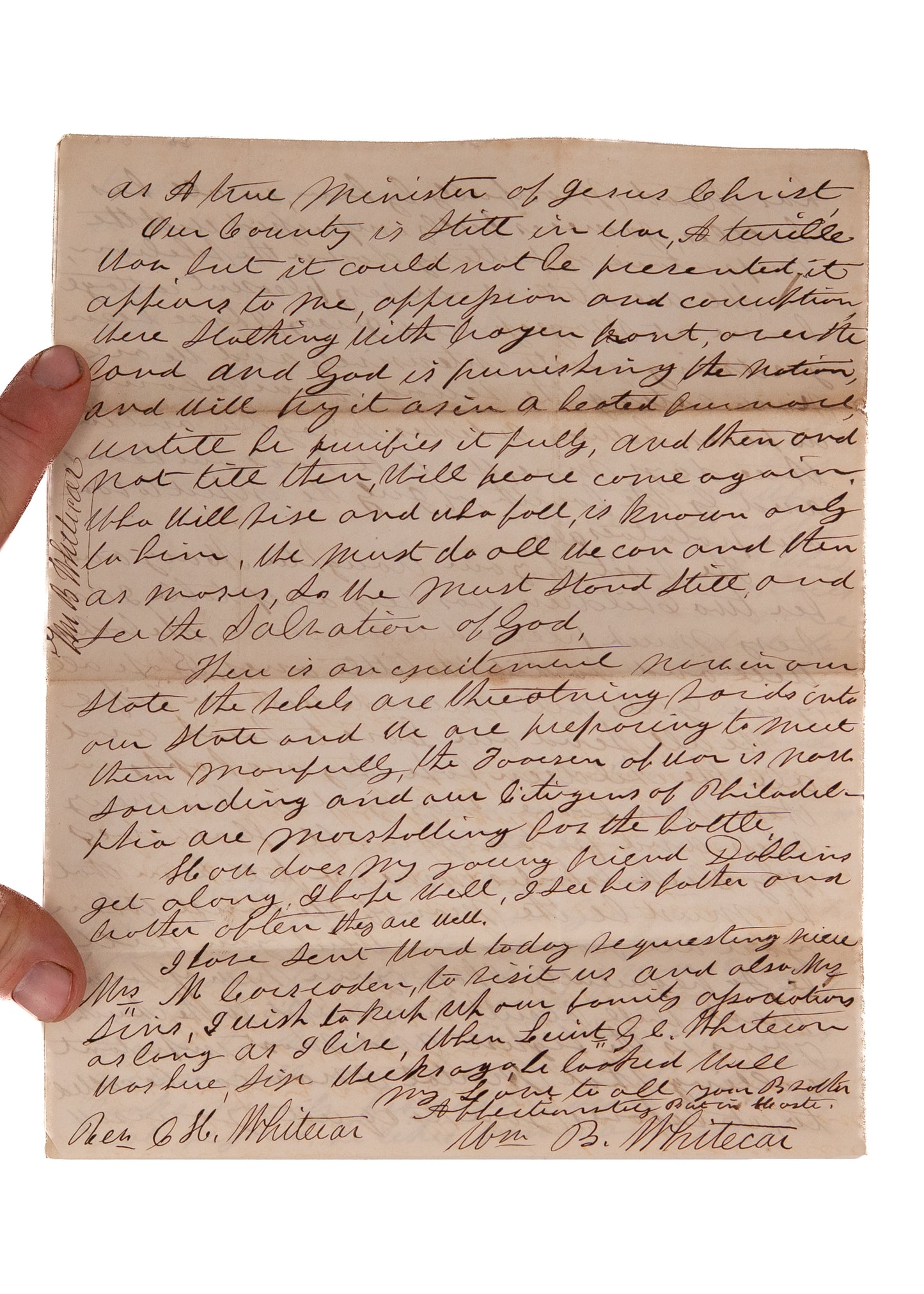
An exceptionally preserved archive of 47 letters from the estate of and by descent through the family of 19th century Methodist preacher, Rev. Charles H. Whitecar. Whitecar was a significant actor among the New Jersey Methodists throughout the entirety of the century, first receiving his license to preach sometime in the early 1830's and functioning as a circuit rider, regular conference preacher, and then pastor of some of its most significant churches from the 1850's forward.
The letters occupy nearly 200 pages, the highest concentration of which date from the period of the Prayer Revival of 1857 / 1858 through to the end of the Civil War. 90% or so of the letters are from his brother, Wiliam B. Whitecar.
William B. Whitecar Sr was a merchant in Philadelphia and father to William B. Whitecar Jr, who published Four Years Aboard the Whaleship in 1864. Interestingly, his preparation and correspondence from the whaling journey pop up in the correspondence, including accounts of catching sperm whales, etc., The work by Jr. often appears in discussions about Herman Melville, the young man having taken to sea just shortly after the issuance of Moby Dick.
Housed in a charming 19th century leather correspondence satchel, the content is superb. The letters from 1857 and 1858 contain significant commentary relevant to the ongoing prayer revival happening in Philadelphia, Boston, and Brooklyn. He describes prayer services happening in Philadelphia related to the Prayer Revival of the same years begun at Fulton Street, the filling of the altars, times of waiting and great emotion, etc. The Civil War year letters contain exceptional content, as below and are worthy of preservation.
Please note we have looked through perhaps half the letters and left the other half substantially untouched, so almost certainly some further wonderful content similar to the below in the remaining letters. We do note that perhaps 2 or 3 letters are not complete.
Examples include:
1834, May 18th. Milford Pike, PA. Wesley C. Hudson to Rev. Charles H Whitecar.
I arrived in this place last Friday afternoon after a tedious, and somewhat fatiguing ride of 26 hours over the hills of Pennsylvania, in the company and edifying conversation of some of the roughest fellows I ever saw, - unpolished raftmen. . . It is a strange step in a man's life to be called to leave the place of his nativity - to sever himself from all the associations of his earliest days and to resign himself to the lot of a Methodist itinerant preacher. . . I find the people here very kind and obliging, though very strange and uncouth in their manners. . . I am quite an object of curiosity here! And withal somewhat in vogue with the Prebyterians! They are the most numerous denomination here - they heard me in the courthouse on Sunday, and though I threw some of the strongest peculiarities of Methodism directly in their teeth, yet I pleased them so that they offer me a support if I will remain here! Are they not strange people here? etc.
1851, August 28th. Philadelphia. Benjamin Whitecar. to Rev. Charles H. Whitecar. 2pp.
You have had some trouble in your city with the Rioters of different kinds & presume the Catholic portion are the most to blame. Things must have borne a very serious aspect at some of the disturbances, but it will work for good in the end. You see what we have down in our City. Some persons cannot comprehend how it was done, but if we know nothing, yet something has been & more will be done by the same means to recover to the American people the future control of our own Country. I cannot consent that the liberties that both our grand fathers fought for should be taken from us by the Votes of men who have no sympathy with us or our Country further than to get office & to benefit unprincipled priests and jesuits. Mothers Father & Fathers Father were both in the War of the Revolution. Father's Father was with General Washington in the Battle on Long Island & so was old Uncle Joseph Whitecar & Mother's Father fought the British in Jersey in sight of his own home & in full view of his wife & children. And Our elder Brother was out as a Volunteer in the Wr of 1812 and continued to the end of the War & can it be that we can allow any foreigners to take from us what we are so directly interested in as what I consider to be a part of our birthright & that to which I cleave more firmly than to any other temporal care. I recollect a remark that our Father made at the time it was thought the British would attempt to reach Philadelphia in the War of 1812. It was this, "If they do attempt to come to Philadelphia, I will take my Gun & go to meet them & if they kill me they will not cheat me out of many days & if it should become requisite to defend our Liberties, I for one am determined to do what I can to maintain what was so dearly bought by the Brave men who are now nearly [all] passed away. etc.
1855, August 13th. Philadelphia. William B. Whitecar Sr. to Rev. Charles H. Whitecar. 4pp.
My son Williams sailing on his long voyage. My every hour which I could possible spare was occupied for his benefit. I wrote to him almost every for four weeks (except the Sabbath). I also sent him our daily papers every day. William earned quite a nice sum whilest he was waiting sailing orders, which with the money he had obtained by his Merchants, after paying his board, he also appropriated to his outfit. Amongst other things, we sent him the Daguerrotypes of my self, his mother, & his seven sisters & brothers. So he will sail around half the world with a pleasant reflection to us and no doubt very satisfying to him . . . William sailed on the 24th of last month, and expected to arrive at the Western Islands in 21 days. The Messrs Slocums of New Bedford, the ship Agents, inform me by letter that he had the confidence of his Captain and that he left in fine spirits. My son informed me that he had been regularly installed doctor of the ship and was regularly appointed to examine the men before being shipped.
1857, April 8th. Trenton. Rev. Charles H. Whitecar to Sarah [Wife]. A charming 3pp letter written will at the Presbyterian Convention in New Jersey, accounts of preaching, business, etc., and the end quite a gusher, with many kisses and so forth.
1857, July 4th. Philadelphia. Benjamin W. Whitecar to Rev. Charles H. Whitecar. 2pp.
In my last I said there was not any thing interesting in the Church at Green Street & that I knew of none having been converted there since it had been built, but that cannot be said now as there is quite a good work there at present & has been for some ten days past, & bids fair to continue, there being meeting there almost every evening for that time & is still, being kept up as the alter is generally full each evening and there is quite a lively time and good feelings in the Church.
The warming up commenced under the Preaching of the Rev. Mr. Smiley from Lewis vill Caintucky [sic] who was here to delivery one of a course of lectures in the Church. He remained until sunday last. He has gone, but the meeting is still going on. How many has been converted I do not know, but quite a number has. It is very gratifying to the Society to have a revival here, as every thing has been so cold & dull. They were much discouraged. Encouraged [now] with hopes that all will go right. etc.
1858, January 5th. Philadelphia. William B. Whitecar Sr. to Rev. Charles H. Whitecar. 3pp.
We were all pleased to hear of your continued good health. We were also much gratified to be informed of the prosperity of your Church, the increased size of your congregations and their deep manifestation of feeling and action on account of their present salvation. May these nature results of a gospel faithfully preached multiply with you until hundreds of those that shall be saved will be added to your church.
Here too the Churches are being revived. Green Street is up and doing, the congregation is deeply moved, they are beginning to crowd to the altars in large numbers, these seekers are composed of intelligent men, women, and children. If you would consent to leave home I think our minister and congregation would esteem it a special favor if you would come down and preach them two or three of your revival sermons. . . the presiding elder is now preaching two sermons for us, and with much favor. The truth is that we have a pleasant people to preach to, that are willing to hear the whole Gospel in its purity and force. Our young man is I think better at preaching other than revival sermons and not so well experienced in conducting the worship of the altar as of the great congregation. But he does the very best he can, but a more experienced person could at this time carry the whole congregation with him.
1862, December 14th. Philadelphia. William B. Whitecar to Rev. Charles H. Whitecar. 4pp.
Today whilst I write my son James and our nephew George are engaged in battle with the foes of our common country. The strife by the accounts we receive is a very deadly one. More than 200 pieces of cannon on each side, and more than 100,000 troops engaged on each side. A terrific contest truly and one from which nothing but the providence of God can save our boys. . . thus far those ardent prayers [of family and friends] have prevailed, for their escape has been almost miraculous. Two young men were killed by an explosion of powder at James' side and many by balls and shells in different battles, and the ball that grazed George's knee, killed the soldier next to him. Then he had the sole of his foot as he stood resting upon his sword i battle partly shot off and a button also off his coat. God is good, for what is man that he should be thus mindful of him. These brave young men who entered teh army on account of the ardent love they bore their country and their ****, and living or dying God will have them in remembrance and I trust his holy keeping. We are watching the news from the field of battle with intense interest. If our armies prevail and Richmond falls, the effect will be excellent upon our Army, on the Government, and the whole Country. And in fact, upon our cause abroad. But the end of the War will not be yet. The rebels will still fight on with a renewed desperation. But the fall of Richmond will ameliorate the fall of slavery, more certainly if the rebels continue to hold out than if they entirely surrender.
God has a controversy with the Nation, and he is schooling us . . . Did you ever think of the many thousands of ardent prayers that are daily going up to Heaven from the slave cabins of the South, asking a just and loving Father to let his oppressed children go free, and such prayers as only the enslaved ones can conceive and fully express. Such ardent prayers will open Heaven in spite of all the schemes and intrigues of politicians and traitors and slave drivers.
1862, December 23. Philadelphia. William B. Whitecar Sr. to Rev. Charles H. Whitecar. 2pp.
The great battle alluded to has been fought and the result is known. My son James Whitecar is safe. So is our nephew George Cookman Whitecar. God be thanked for his mercy displayed toward them. He has had these young men in his holy keeping. James writes me that the men fell all around him. That the fight was so terrible that many of the new troops left the field in perfect terror, which created something of a panic amongst the veterans, to which he is attached. He writes that when night closed upon them, that there was but eight men of their company standing besides the Captain and himself. He says also that if McClellan had had the command, the battle should not have been fought for a month, but then he would have been sure to miss the enemy. My son William says that at the battle of Yorktown the rebels had 500 pieces of artillery in position and that these works were impregnable against assault. And yet Genl McClellan by his superior engineering actually burrowed them out without losing but a few men. For this great feat he has been treated with the greatest ingratitude by his Government.
What the end of this War will be, no one I am sure can say, but God rule sin the affairs of men and he can bring order out of confusion. So we must have faith and abide in patience his own good time. . . .Our family all join in wishing you all the complements and love of the season, in the midst of all the gloom in which the Country is placed. Our beloved Philadelphia is now very lively and good cheer consequent upon the season goes around large preparations are making to entertain the sick and wounded soldiers at home and abroad. Philadelphia abounds as you will see in the papers in works of blessed generosity to the poor and the Soldiers, particularly. She stands head and soldiers [sic] above all competitors in these good works.
1864, August 30th. Philadelphia. William B. Whitecar Sr. to Rev. Charles H. Whitecar.
I received a letter from the Hospital Chaplain at Baltimore in answer to yours, wrote about son James. But then he had been transferred to a Hospital at York Penn. He remained there two months, got well, and was sent again to the front. Since which time he has been in several battles and the last one, the battle terrible and bloody, with General Hancock [Winfield Scott Hancock]. . . since which battle we have no word from him and are deeply anxious therefore about his safety. O these are terrible times for fathers and mothers, and others. God grant that he is safe, yet the chances are against him. No word from William. Strange. Very strange. But we must submit. These terrible events undermine the health and mind of my wife greatly. Captain George C. Whitecar calls often to see me. He is not well. . .
p.s. Since I wrote the above I have received a letter from son James, informing me that he passed through the most terrible battle of the War, with his General Hancock on the Weldon Railroad last week, that the enemy surrounded surrounded them on all sides, and they had to cut their way out & lost heavily. "But thank God I am safe," he says. Also says his Colonel Davis & several others of their officers were wounded & are on their way to Philadelphia. . . He has been promoted to a Sargent. etc.
1864, October 25th. Philadelphia. William B. Whitecar Sr. to Rev. Charles H. Whitecar. 8pp.
Our excellent form of Government has been violated at the hands of ambitious, bad men; men that would rather rule in Pandemonium than to serve in Heaven. such a Rebel was Satan, the arch traitor, who rebelled against the Government of God and was hurled for his treason, from its everlasting and sublime towers, to the depths of punishment suited to his crime. Such I sincerely believe will be the fate of these bad men who have laid their polluted hands on our equal and good Government, secured to us by the blood and sacrifices of our glorious lives. These conspirators have trampeled in the dirt our sacred emblem of religious and civil freedom, our Star Spangled banner, the beacon of hope to the downtrodden of all Nations. These men have and are defying God and man. The set at naught the Proclamation made eighteen hundred years ago by the angels to the shepherds of Judea, "Of peace on earth and goodwill to men." In place of peace they have sent a sword and instead of good will they have without cause acted out hatred and death. They are now as a consequence receiving the punishment due to their high crimes.
You say that you are no political abolitionist, that you voted for Bell at the last Presidential election. But that upon a careful review of the situation of the Country, that you have resolved to vote at the coming election for President Lincoln and Governor Johnson. And you desire that I may do likewise. President Lincoln and Governor Johnson I am free to admit have shown purity of purpose and great love of Country. And personally appear to be doing all in their power to put down the rebellion, a rebellion that has and is now shedding the innocent blood of our sons and brothers.
You know . . . that I am a democrat in all that pertains to the Government of our Country. I was born during the administration of President Jefferson and so great an admirer was our father of that Great and good father of democracy, that he named one of his sons two years my senior, Thomas Jefferson. I therefore from my earliest youth was educated in his principles of democracy. After a long life of activity in public and private life, I can truly state that I am note ashamed of my parentage nor my political preceptor, President Jefferson. He was in my opinion one of the very wisest and the most fore-seeing men that ever filled our Presidential office. To be convinced of that be pleased to re-read his Declaration of Independence, his Inaugural, and other Messages. And his other State papers and last but not least, his notes on Virginia. And then if you don't pronounce him a true Statesman, a good man, and a national prophet, I am mistaken.
Being a disciple of Jefferson, I am free to say to you that whilst I have a great respect for General G. B. McClellan and would be truly pleased to have had the opportunity to have voted for him if he had been nominated by the true and union democracy of the Country, the Jeffersonians; but surrounded as he is by leading sympathizers of the rebels and rebellion, men who have no sympathy with the Republicanism of the fathers, I cannot conscientiously give him my support and vote. This I regret, for I consider him personally a good soldier and a true patriot. But General McClellan is young and ambitious and with such counsellors and such a Cabinet as Pendleton, Seymour, Woods, and others just like them in views and ambition, I fear that he would be so adversely controlled as to prove as dangerous to the nation and the union as Louis Napoleon has been to the Republic and liberties of France. I have no faith in these men. . .
You must not for a moment suppose that I sanction all the measures of the party now in power. No I do not. I consider the hairbrained theories of Greeley, Sumner, Stevens, Chase, Fremont, and others equally destructive of the Union and the liberties of the Nation. . . these men thought to drive President Lincoln into the adoption of their miserable theories of Government by the nomination of General Fremont, but thanks to an overruling Providence, Lincoln has shown a firmness worthy the praise of every true democrat. His *** as a rule has been the Constitution of our fathers and his sworn abolition to see that the laws are faithfully administered in every portion of the United States and by such means to give Authority to the Constitution and the laws.
A portion of the men who aided in the election of Mr. Lincoln, in perfecting and carryig out their ultra abolition views of immediate and unconditional abolition, should in their own language "let the Constitution slide." Happy is it for the Republic that their schemes were frustrated by the firmness of the President. If they had succeeded chaos would have come again. If our Government and union is saved, it will be saved by the firmness of the true sons of the Union and the Constitution, without regard for party action. God governs the worlds by laws, not by sympathy. Nations to be strong, useful, and happy, must conform to law an lay aside sickly sympathy. I need not say to you for you know that I desire the freedom and happiness of all men, but there is a fitness and time for all things. The slaves are now being taught in our armies and navy the proper use of liberty; as well their duty to the Government. And this fitness being complete, the time is rapidly approaching when they should become free. This War is a purifier of the Nation. We are going through the crucible. . . .
Share